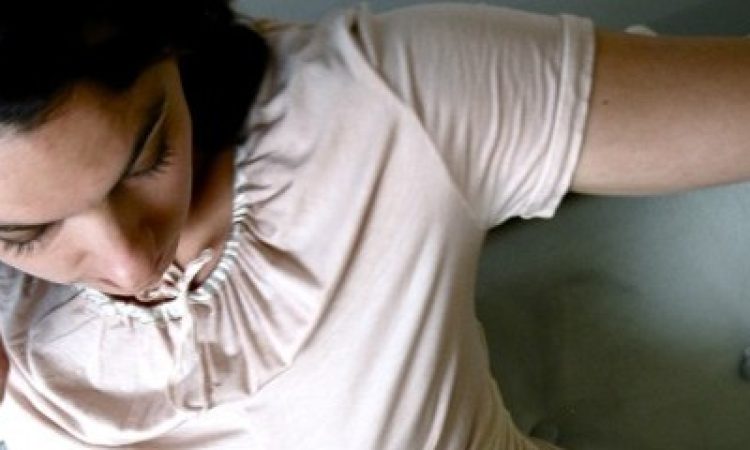
I was peering into the window of a stranger’s bedroom from the outside. The world of Lesya Popil’s Uninvited Guest was mostly private, and exposed. It was a dance-poem. Instead of verses, there were layers. Thoughtful layers of clothing, layers of text, sound, and props. Layers of Lesya.
As the piece began, Popil stood behind a podium, her head and torso mostly hidden inside a green hoodie, as she shuffled nervously through a stack of papers, attempting, but unable to speak the words that appeared in front of her. She let some papers slip and fall to the ground. Soon, we met performer number two–Megan Bridge, whose role in the piece was not so much a human character as a force, or agent. Unlike Popil, Bridge saw the audience; we were an intimate group of witnesses. Dressed in black, seated in a chair downstage, Bridge was neutral, unanimated, and calm. She spoke freely, formally addressing us: “Entertaining an uninvited guest could be difficult for careless hands. But it is always easy for the strategic host who understands the true worth of an uninvited guest.” The words “careless hands” were silently echoed via projection on the wall behind her.
In the next phrase Bridge referred to the subconscious mind’s reptilian brain, while Popil, still crowned in green, used the floor to perform an undulating lizard-like dance. After Bridge described this part of our brain as being “responsible for behaviors such as aggression, dominance, submission, and greed,” Popil spit out a mouthful of green marbles, letting them scatter on the floor, the audience unaware that she’d hidden them in her cheek until now.
Popil, a beautifully controlled mover, didn’t sustain any one pattern for too long, instead inviting the audience into her legible evolution. When she removed the hoodie, she revealed the next foil: a black dress, and then added to her ensemble a pair of hospital green latex gloves, preparing to carefully pick up each of the dispersed stones. With her palm full, she paced around, shaking her fist and shooting electric glances to Bridge, still seated. Popil’s use of marbles sent my attention to a question about props in dance. I often wonder about inanimate objects as performers. When should I project a meaning or symbol onto them, and when do I simply allow their neutral lifelessness to add visual interest to the moving tableau in front of me?
When I noticed the sparkling determination in Popil’s eyes, my attention returned to the dance, just in time for Bridge to join her in a hawk-like battle of flapping wings, and for the narrative to unfold in a dramatic crescendo. Here we saw physical confrontation break through the invisible border between them.
Bridge’s third line of text included “coming to terms with the fear of death,” a solid clue into the weight of this material. She exuded a kind of secret power, which made her a fitting choice to represent something Popil was perhaps supposed to ignore, but couldn’t possibly. Yet, Popil was a good match for Bridge. Throughout Uninvited Guest she shed her many skins. Her journey, at first nervous and erratic with sharp edges and flexed palms, ended in a defrost. She traveled throughout the space finally like soft liquid. She surrendered. Sealed in her new state of being, dressed now only in what was underneath it all—a nude dress, out of breath, sweat glistening, she took the seat downstage. She was still.
Uninvited Guest, Lesya Popil, thefidget space, Saturday, January 21, 2012. No further performances.