In his program message, Pennsylvania Ballet Artistic Director Roy Kaiser praised Robert Weiss’s Messiah as “not overly-costumed or ornate; it’s dance-driven and pure.” Indeed, the dance-driven moments of Messiah were divine; unfortunately, a number of sections distracted from the dancers’ otherworldly strengths, bringing us all crashing back down to earth.
The opening night performance began with a dozen dancers in jewel-toned Puritan’s cloaks gathering in a church. Tenor Steven Sanders, in similar garb, sang from amidst the dancers, preaching the prophets’ words from the sparse set: clean light pierced through fog and hints of stained glass windows. I had been particularly excited to see the “full choir on stage” noted on the Pennsylvania Ballet’s website, as this Messiah also features the Philadelphia Singers. To my disappointment, this was one of only two such onstage appearances. Most solos were performed offstage (albeit visibly) from box seats and in evening wear rather than costumes, while the rest of the choir was entirely hidden. The show was advertised with George Frideric Handel’s well-known music as its centerpiece, but the magnificence of the live choir faded into the background. Not only were the singers visually absent, the choreography and detailed narrative mostly drew my attention away from the music.
Prior to this performance, I hadn’t realized the narrative breadth of Handel’s Messiah – the text covers events from Old Testament prophecies to scenes from Jesus’s life to the Day of Judgment, not to mention the God-is-Great refrain, the Hallelujah Chorus. Weiss wrapped this Biblical grab bag in yet another layer: the story of a congregation’s faith stirring as they listen to Messiah. Tossed from watching parishioners to shepherds to golden-winged angels to soldiers in battle – Confederates to modern-day camouflaged – I felt torn between trying to follow the plot and just relaxing into the less-narrative portions. I ended up so lost, it took me a day to realize that Principal Zachary Hench crossing strips of blue fabric was Jesus walking on water.
Admittedly, at the time I was focused on the dancers’ painstaking attention to the fabric they manipulated from the sides of the stage. As with the incomplete integration of the choir, the use of props and puppetry throughout was a compelling idea not fully embodied. At times, the dancers were both engaged and engaging (Apprentice Alexander Peters deserves praise for a particularly demanding stage presence), but when manipulating an angel’s wings to evoke flight, or flouncing a large silky black square like a kindergarten parachute game, they seemed consumed by correct execution.
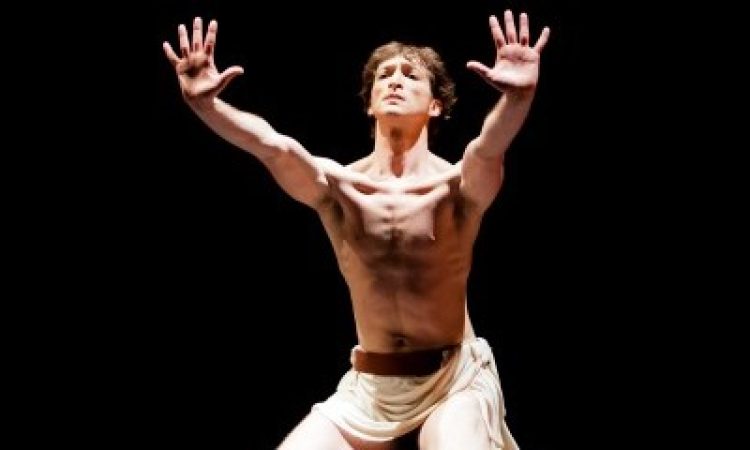
Weiss, a former Artistic Director of the Pennsylvania Ballet, was more successful when his choreography played to the company’s strengths: precise timing, stamina, and, well, strength. In a number of “aha!” moments, the dancers arrived at a formation or froze in an elaborate scene delightfully incongruous with their stage-crossing leaps and twirls moments before. At one point, they connected hands, arms in jagged zigzags, then wound through the spaces between one another in fluid circles, eventually piling nonchalantly into a precise line, arms interwoven, heads leaning on neighbors’ shoulders. Principal Arantxa Ochoa’s and Soloist Ian Hussey’s duet as parishioners celebrating their child contrasted sharply with the big party immediately prior – I felt privy to an intimate exchange, their bodies manifesting a strength and grace reflecting that of their god.
Handel’s Messiah is big and divine. In trying to match its lofty heights, Weiss instead showed his own humanity. Hench suffered a fall towards the end (even Jesus was human); he recovered quickly, but lost some of his initial confidence. After two and a half hours of Biblical themes related to Jesus’s teachings, the audience forgave both with a standing ovation.
Messiah, Pennsylvania Ballet, Academy of Music, Mar 8-17. Mar 17, 2 pm & 8 pm. www.paballet.org