Cotton candy for all, toppling egg cartons and cell phones playing songs by P!nk and Ed Sheeran. Miller Rothlein’s newest work, From the Spot Where We/You/I Stand (Stood), invited the audience directly into the performing space. The invisible wall between viewer and performer was broken; human interaction was foregrounded and the viewer was given an active voice in the work.
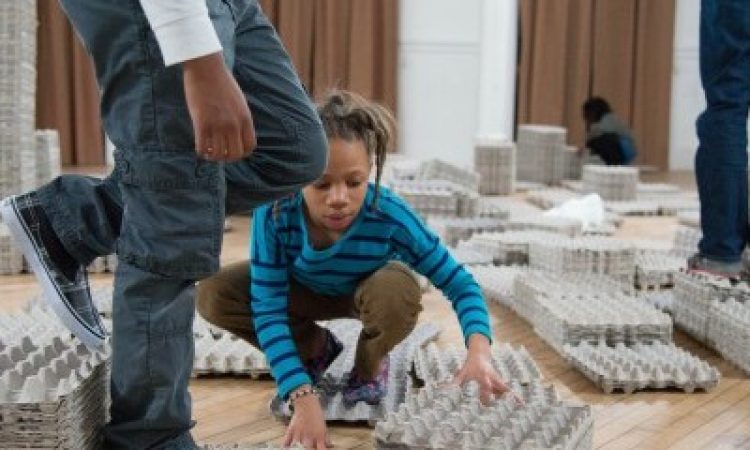
Upon entering the White Space at Crane Arts Old School, I find egg cartons covering an asymmetrical space on the floor in the middle of the room. The performers, four dancers from the MIRO troupe and four children from their Girard College outreach program, stand atop egg carton pillars. They create a scene of living sculpture, bodies noticeably trying to stay balanced on their respective towers. The builder of the maze, young Damir Williams, begins to create paths through the egg cartons allowing us to weave through the performance space. A few of the adult dancers grasp the shoulders of observers walking by to help them balance, take a moment to simply embrace, or even play with their hair. In these intimate moments, the audience is completely integrated into the performance and the performer/viewer interaction helps shape the evolving space.
The dancers get more daring with their balance atop the cartons. They continuously explore the limit that the egg cartons have placed on them; a negotiation between their obvious abilities and the power that a small limitation has over them. Their towers fall, creating beautiful surprises. We don’t quite know what is going to happen next. These moments of unpredictability and reality enforce the humanity of the performers and the difficulty of finding pure balance. A duet between Beau Hancock and Amanda Miller unfolds; through weight sharing and seamless movement, they come to rest in an embrace on the floor. Chandra Moss and Paul Struck begin to push and pull each other, skating across the space on the egg cartons. There is a shift of energy in this duet; they are now desperately trying to break out of their restraints. They pick up young Dajon Wright and gently glide on the egg cartons: upside down, twisting around, she moves like an airplane. Their movement is affectionate and bright, like a family playing outside in the sun. The trio settles, Dajon surrounded by adults. Damir calls upon audience members to help build the final fort in a collective, caring action. I am touched by this ending; because the work had a dependency on the audience members present, allowing them to participate in the final act brings the piece full circle. The work draws to a close as Damir exits the space.
Miller Rothlein’s integration of props, movement and audience involvement created a work filled with unpredictability and human connection. The work thoroughly explored the divide that can separate performer and audience and gave the audience a powerful physical presence in the performance.
Miller Rothlein, From the Spot Where We/You/I Stand (Stood), White Space at Crane Arts Old School, February 20-23, 2014.