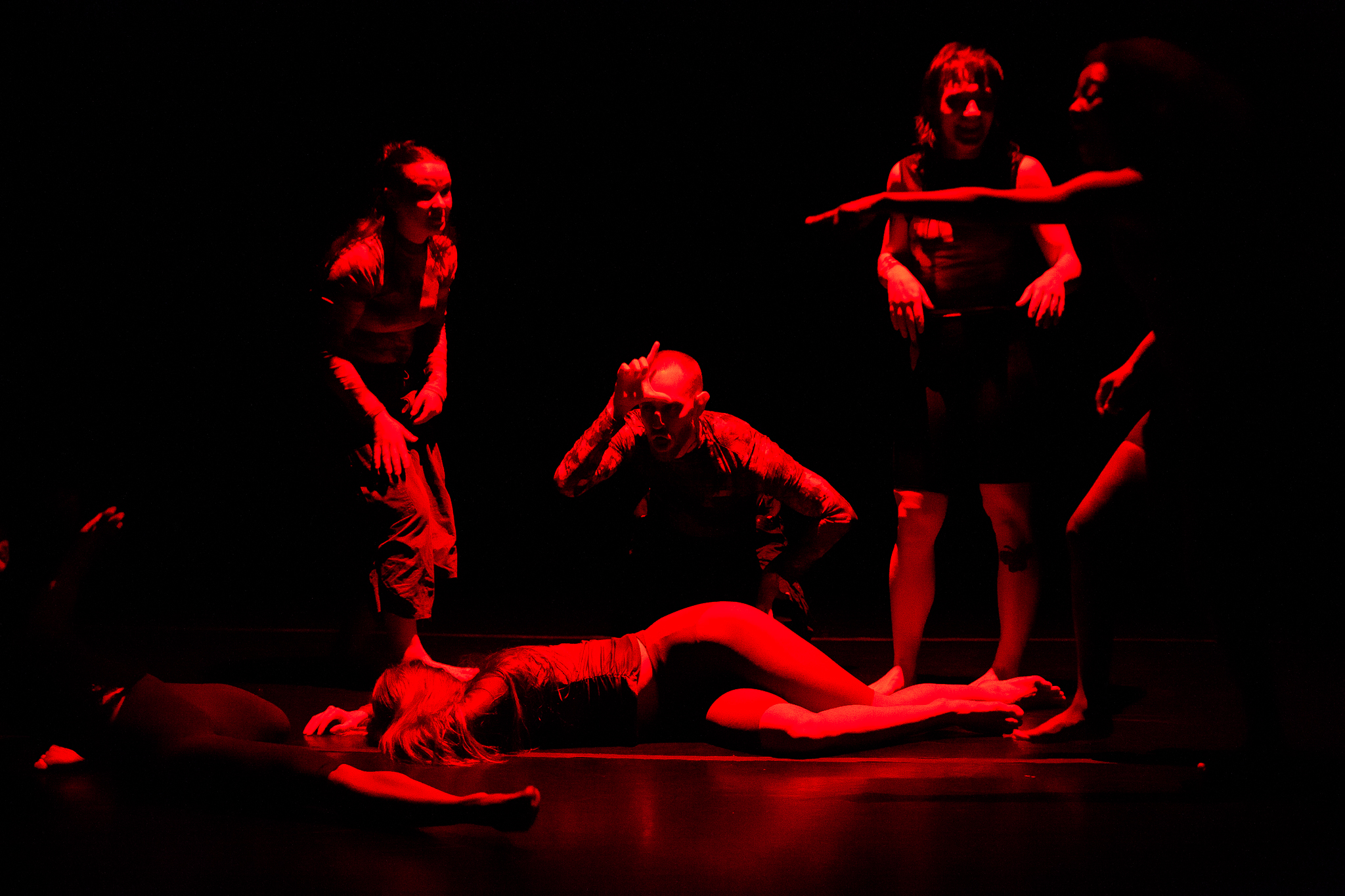
In Fore-ign/Fore-out, four choreographers explore states of liminality—of how to be between things.
In Matriz, Evalina Carbonell uses a stage-spanning black banner and fluid yet precise movement to paint the space her cast of five women inhabit. The opening section is set to David Lang’s “Just (After Song of Songs)”—the lyrics resonating particularly with Carbonell’s visibly pregnant body. Each specific item, situation, or body part named seems called into being by gesture or phrase. Later in the piece, Weiwei Ma and Asya Zlatina mesmerize in a duet, their nuanced understanding of weight and gravity transforming their earthbound movements into a type of flight.
Nikolai McKenzie choreographed and performed Boy, a physicalized monologue with text taken from Ken Baumann’s debut novel Solip. For most of the piece, McKenzie swans and staggers across the space in white socks and underwear, a red X on his chest, book in hand. Baumann’s enigmatic turns of phrase are heightened by McKenzie’s strangely narcissistic delivery. The solo is revelatory and coy—a push-and-pull of exhibitionism captured in lines like this one: “Transmission will be intermittently interrupted by sounds of sobbing—pardon us.” There is a madness in transitioning from childhood to adulthood, in learning to suppress whole aspects of ourselves. McKenzie makes the psychic costs of this process concrete.
Melissa Chisena has two remarkable pieces on the program, Entangle—a duet created in collaboration with Marie Brown, and Breath—a work choreographed to an original breath score performed live by Katonya Mosley with percussion by Jonathan Cannon. In Entangle, Chisena and Brown work within the confines of a huge skirt, the interpretive potentials endless. Brown’s echoing and manipulation of Chisena’s upper body at times looks like addiction, at times possession, and at times a struggle between sisters, friends, or lovers. Breath begins as a performance done to a score, but by the end Chisena and Mosley’s breathing are indistinguishable, the unification achieved by extremities of effort and attention.
The program ends with Annielille Gavino-Kollman’s La Migra, Let’s Run, an at-times quite literal exploration of themes surrounding immigration. Gavino-Kollman offers up a train-ride, a baseball game, and a lesson in assimilation that begins with “sorting, by shape and color.” The humor in this piece is dark, and Gavino-Kollman’s last monologue—in white face, channeling both Charlie Chaplin and Donald Trump—is a chilling reminder that we minimize jingoism at our own peril.
Fore-ign/Fore-out, choreographers Carbonell, McKenzie, Chisena, and Gavino-Kollman, Chi Movement Arts Center, Sept. 16 and 17.