Just a month before seeing SaltSoul I finished my own evening-length work. Explicit Female explored ideas of femaleness and motherhood tied to my own narrative (growing up in Communist Bulgaria) and the stories of my ancestors (who suffered the brutality of the Turks during the Ottoman Empire*). Knowing that SaltSoul was about loss and large-scale tragedies (a South Korean ferry sinking, the collapse of the 22nd and Market Salvation Army building in Philadelphia, and the death of SaltSoul director Jungwoong Kim’s father),** I was curious to see a perspective different from my own.
The night of the show I am greeted by three young women selling tickets and giving away torn red and yellow fabric armbands. I am asked to put the name of someone I lost on my yellow fabric band. The first person that comes to mind is my long-gone grandfather. It has been more than 15 years since I’ve lost someone close. Guilt of my privilege in the randomness of life seeps through me.
Eventually two women bring us outside the Asian Arts Initiative and around the corner to the back alley. Double file, we witness the dark city, and weave around the building; “caution,” reads yellow construction tape flying in the wind. We reach the back and are left alone. As if brought together by a natural disaster, all thirty-plus of us are listening, waiting for something. It gets colder and I think of waiting to be saved, to be told what to do. There is a helicopter approaching. Is it coming to save us or to rain havoc? It passes, and I feel relieved.
After about ten minutes, we hear a distant melody. It’s coming from inside the building. The one-tone traditional Korean wind instrument (performed by gamin) reminds me of a Turkish tune. I scold myself for my bias, but immediately think of Ottoman oppression and tragedy.
Gradually, I notice three women I know approaching from the other side of the alley. Marion Ramirez, Merian Soto, and Germaine Ingram balance large branches with the red and yellow strips hanging amidst quietly ringing bells. I’ve seen them do a similar ritual before, in another performance, at another time. They move slowly, deliberately; a procession that takes another ten minutes to finally reach us. Their eyes scan the space as if we are part of the cement creating this alley.
The door to the inside opens, Soto enters, and we follow into a dark hallway. Careful not to touch each other, we are civil and quiet. Finally saved, we are nothing like people in need.
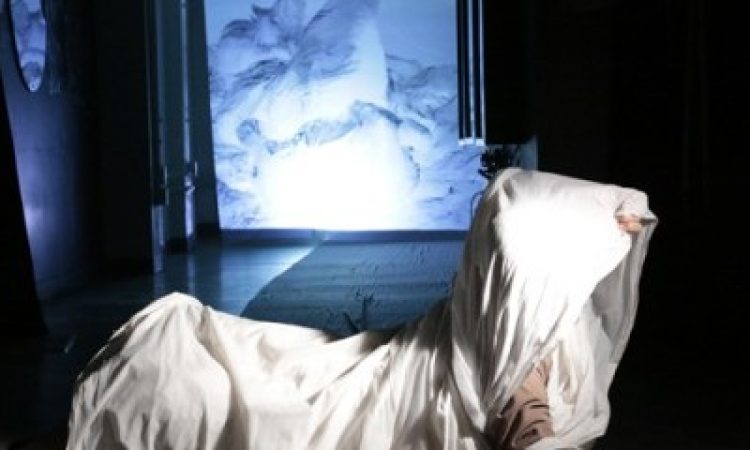
An abstract black and white video takes up the whole back of the hallway, displayed on a plastic screen that reminds me of a meat market. Soto slowly falls toward the ground, where a long white piece of fabric stretches through the hallway, disappearing behind the screen. She slowly rolls, covering her body in white. We continue to follow her through the translucent screen and into the main gallery, where we had been before. The white blob figure moves, crawls, and sings. Does the fabric represent death, transporting Soto into a spirit of the afterlife?
We are finally split into red and yellow teams. I am in the group that stays on the first floor to watch a video of Kim sharpening small branches with a pocket knife. There is something immediately violent, but also gentle and caring in his action. He puts the tiny branches next to each other, as if counting human life. We watch for what feels like another ten minutes and over time his sharp molding of the sticks makes me only see his gender, in contrast to all the female support staff and the gentleness of the three women performers. He is a lost boy in a story I still don’t understand.
The piece continues in a similar pace on the second floor where a literal translation of a sinking boat plays out. The three women performers fall off balance, bouncing on and off the walls of the long hallway. Names of lost ones are read out loud and I shiver. My group moves through projections and installations; at one point we watch the building’s turn-of-the-century freight elevator come and go. The environment is effective, yet somewhat predictable, reminding me of an old horror film.
Around another corner I witness an image still etched into my visual memory. Through a window Ingram kneels next to a large white crooked table. She is the oldest of the performers; gaze down, her dark skin contrasts with the large yellow turban on her head. She is unmoving, her serene face unseen by the other audience group sitting behind her. It is a work of art so simple and strong that I don’t want to stop watching. But I wonder, is there cultural significance in mixing these visual elements that is part of the performance’s message?
The whole audience make their way behind Ingram, watching for a long time. In a split-second Kim erupts from under the table—traumatic to the serene energy that has been building in the room. He shakes in tiny jumps on top of the now overturned table. I am surprised, tickled and confused by the outburst. I love watching his limbs move, a dance of equal fluidity and aggression. Is the lost boy found, or does he represent a more traditional idea of masculine energy? Is he the natural phenomenon that brings havoc to everything?
Eventually we all make our way to the third floor. The space is vast, the whole floor open with only two columns supporting the structure. Initially I only see the three women performers. They lay down one by one on long strips of white fabric. Alternately getting up and laying back down, as if counting time, they inch closer to the edge of the fabric. The duet by Kim and Ramirez (his real-life wife) is stunning; full of longing, gentleness, and mild eroticism. They climb each other, hug and fall on each other as if saying good bye for the last time.
The staging of SaltSoul clearly allows for reflection of feelings of loss and tragedy, and in between the scenes I find substance and meaning. Such a beautiful overall experience, the performance portion makes me question Kim’s choices in choreographing gender and cultural reference. SaltSoul is more than a show. It is a visual art walk through a curated environment, and I leave full of melancholia.
SaltSoul, Asian Arts Initiative, 1219 Vine Street, October 6, 7, and 8, www.saltsouldance.com/home.php
*The Ottoman Empire was known to many Eastern Europeans as Turkish Slavery. Bulgaria was part of the Ottoman Empire until 1908, and old people tell stories from their parents about the brutal raping and killings of the Ottomans.
**For an essay on the origins and process of SaltSoul, see tD’s two-part essay by Toni Shapiro-Phim: https://thinkingdance.net/articles/2016/10/01/3/SaltSoul-Loss-and-Mourning-part-1/; https://thinkingdance.net/articles/2016/10/02/3/SaltSoul-Loss-and-Mourning-part-2/. An earlier version of this work, capsized, was reviewed here: https://thinkingdance.net/articles/2014/10/11/I-Could-Barely-Breathe