The Colored Girls Museum, an ordinary house (and home to the museum’s executive director Vashti Dubois) in an ordinary Germantown neighborhood, is also an installation site, an artist residency, and most importantly, a sanctuary offering peace, respite, and a place to foster creativity. Dedicated to the “ordinary extraordinary colored girl,” this month the museum has been transformed into an “urgent care” facility for its annual FringeArts show, a guided tour titled “Urgent Care: A Social Care Experience.”
The theme goes way beyond the medical connotation, pointing to the extreme stress placed on communities of color and the effects of that trauma on everyday life. “It’s our interpretation of this moment that we’re in, and I’m sure we agree that it’s an urgent time,” says Dubois in her introduction to the museum-goers assembled in the parlor.
The cozy reception area is a curious blend of gallery and waiting room; it is where everyone gathers to await the start of the tour. Artists mingle with spectators, and are on hand to answer questions, along with Dubois and curator Michael Clemmons.
The art itself is everywhere—on the walls, hanging from ceilings, stationed in corners, stairway landings, on shelves and in nooks in every room. The tour moves through a series of rooms one might visit in an urgent care setting: Reception, Triage, Examination, Recovery, Apothecary, and Aftercare. One or two artists wait in each area, poised to describe and answer questions about their work.
In Reception, an entire wall is draped with eye-catching pieces of cloth titled “The Fainting Room,” hung by artist Destiny Palmer in what Dubois describes as a “painting in fabric.” The work references the popular Victorian era diagnosis of hysteria and its related symptom of fainting, caused perhaps by the tight-laced clothing of the day, as well as the prevalence of arsenic, copper, cadmium, and other toxins used to create green paints and dyes.
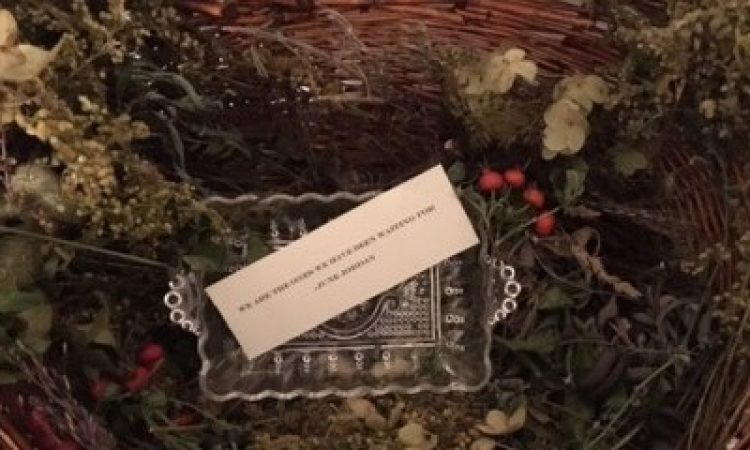
Above the fireplace is “Sitting Pretty” by Lavett Ballard, a posed photograph of a black girl superimposed on salvaged wooden fencing. The image is disrupted by the lines of the wood and rusty reddish-brown color that runs across the girl’s face and dress. On the wall to the left stands an altar piece made of repurposed furniture, a basket of plants with healing properties gathered locally from Bartram’s Garden and Awbury Arboretum. A placard carefully laid in the center bears the words of the late poet June Jordan, “We are the ones we have been waiting for.”
Petra Floyd and Marie Mathol-Clarke are on hand to explain their aim in bringing this message to those who enter the Colored Girl Museum. “Waiting rooms,” Mathol-Clarke explains, “are not often welcoming to people of color, to the colored girl.“ She welcomes the audience into the space, saying “we need to be the ones generating our own reception when operating in a hostile environment.”
The reminder of just how hostile that environment can be is located just above the altar. “The Birmingham Four” is a haunting installation of four clay vessels on a wall shelf, each topped by the sculpted face of one of the girls lost in the 1963 Birmingham Church bombing. “There is no space dedicated to colored girls,” Dubois says softly, pointing to the four faces lined up in a neat row. “Part of what we’re calling attention to is the colored girls’ story.”
Ascending the stairs to “Triage,” we enter a room on the third floor. The room is bathed in electronic sound, designed to emulate the chaos and confusion of the triage unit of an urgent-care facility. Petra Floyd, who has led the way up, describes the process of creating the installation “Chamber,” with Joy Uday. “Chamber” is a room within a room, featuring two large cloth-coiled baskets sitting under a panoply of dangling handwritten affirmations of self-care. The baskets are made from repurposed bedsheets, and are large enough to sit in; Floyd invites the audience to try it and “rest in the work.”
A bedroom has been transformed into the “Exam” room, in which the museum’s first resident artist, Nkechi, has been living since February, “examining my own life and my process.” On her bed sits an oversized blue book, symbolizing the testing and scrutiny she says is often trained upon black women, who are “tested constantly, looked at, and asked ‘what are you doing, where are you going to go?’”
On the second floor we find the “Washer Woman” room, dedicated to the lives of domestic workers throughout the ages, and “Recovery.” Artist Inga Kimberly Brown stands by to discuss “Welcome to the Smoke House,” her three-dimensional work inspired by her cultural roots in the Carolinas.
The museum is full of color and life, each room a reminder of the resilience and creativity of black women and girls, captured by artists in a variety of media. As painter and mural artist Inistar Hamilton tells me about her work “The Cure” at the top of the stairs, “the colored girl is not always the patient; sometimes she’s the remedy.” Dubois intends this museum to be just that, both a celebration of and a respite for the often overlooked woman of color.
Urgent Care: A Social Care Experience, Colored Girls Museum, FringeArts, Sept. 8-23, http://fringearts.com/event/urgent-care-social-care-experience/