To describe my experience with Compagnie Marie Chouinard, I will need to take you on a thought experiment.
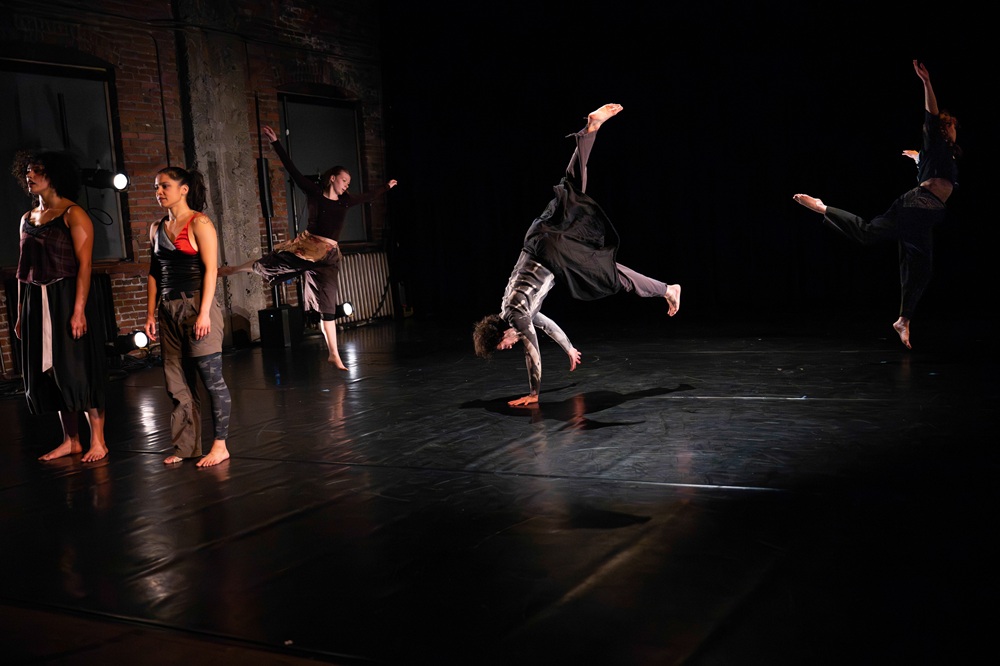
A troupe of aliens arrives in our midst. They are muscular, flightless bird creatures, and the first thing they hear is Chopin—specifically, his 24 Preludes. Stay with me: this is where it gets tricky. The creatures immediately begin translating the music into their own kinetic vocabulary. Each of the preludes offers them a blank slate. They sometimes convulse, sometimes undulate torsos; they twitch and circle wrists; they pigeon and cobra their necks; they strike hieroglyphic poses; they lift and carry each other to earlier sites when musical phrases repeat. All they do, they do to communicate the piano. Watching them, you begin to hear it as they do: their translation alters your perception. When one of the creatures discovers she can vocalize, she attempts the language of “do, re, mi” but her fellow travelers are unwilling to have her speak, and march past her, using their physical magnetism to again and again pull her into the pack of red-eyed, mohawked movers. Struggling to hold onto her newfound individuality, she is eventually subsumed into the mob.
That was before intermission.
Afterwards, they are creatures still. This time, the minimal clothing worn (in deference to human custom) has become more minimal. Braided ropes of hair have been knotted into horn-like projections. Again, there is music, but this time they use Stravinsky’s The Rite of Spring to explain things about their home world—its mating rituals and culture of war. They show us their weapons, simple curved spikes that can be worn like nails on the fingers, clicked together like scissors or crab claws, or held to the crotch and head, indicating their sources of power and pleasure. They lecture us with their bodies. When two, wearing multiple spikes, engage in a vegetative embrace, gracefully curving around each other’s bodies like sea anemone, we begin to learn about the vulnerability of their flesh.
It is, after all, our flesh. Their open-mouthed rage, our rage. Their dis-associative sexuality—an all-too human experience. The stylized work of Compagnie Marie Chouinard’s instructs. It alienates you from the dancers’ humanity just long enough, and just far enough, that you begin to see your own in an entirely different light.
Compagnie Marie Chouinard, 24 Preludes by Chopin and Rite of Spring, in the Dance Celebration Series presented by Dance Affiliates and the Annenberg Center, December 8-10. No further performances.