A man rings a woman like a bell. She is harnessed at the waist and dressed in a pink hoop skirt, he in black coattails. Both in white make-up and frizzed blonde wigs. Ever so easily, he pulls on a rope, sending her high into the air and lower again, to the soundtrack of a church bell. Earlier, she perched atop a second man in black coattails. She walked up over his back and along the length of his extended arms. She hung almost lifeless above him, only to fall into his arms jagged, like a runner caught mid-finish. These “milliseconds of practiced rhythm,” as Avshalom Pollak refers to them, made the audience giggle with delight. For me, this was the most memorable section of Inbal Pinto & Avshalom Pollak Dance Company’s Oyster; it communicates at once the hard exterior of staged spectacle and the inner vulnerability of its performers.
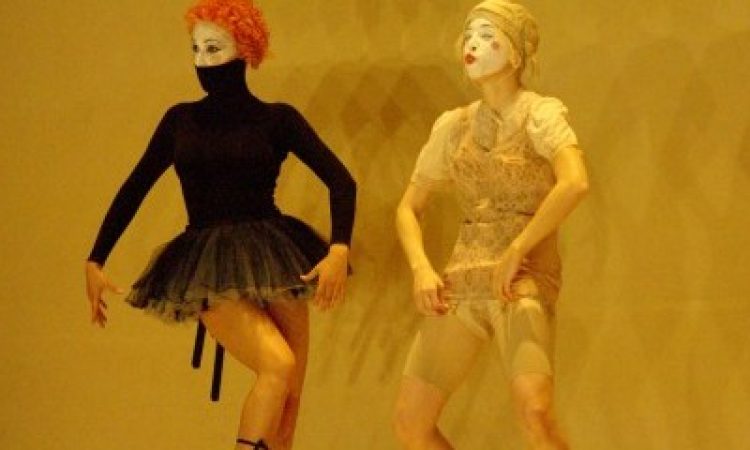
With stunning costumes and set, Oyster navigates a circus world with a host of characters. In the beginning, a contortionist in pink tutu hops straight toward the audience with her foot held high above her head, while a man in black coattails faces upstage in silhouette, stuttering his movements like a marionette on and off its strings. Enter two men sharing the same large black coat, an inventive contraption pushed around the stage by a tiptoeing ballerina in slippers and tutu (conventional), a turtleneck up to her nose and a seat strapped to her bottom (surprise!). The men act out simple hand gestures, sounds, and a twin-like relationship. Two ballerina-puppies on leashes scamper through a doggie door, held by an older man whose muted movement is a stark contrast to their romping, back-bending, and tutu-ed crab-walking.
At the talk-balk following Friday night’s concert at the Annenberg Center for the Performing Arts, dancer Ricardo Rus Da Sava said, “You are challenged as a mover, as a performer, to find your way into the character, into the choreography, and into yourself.” The performers indeed fully embodied these characters. After a thirteen-year run of this show, they managed to keep it alive with tremendous precision, impeccable unison, and subtle facial expressions. They are some of the best actors I have seen in dance recently. Zvi Fishzon, the shuffling older man, anchored the audience’s experience with his presence in several vignettes; the subtlety in his way of moving became a touchstone. To me, he was the pearl of this oyster.
Instead of relying on dialogue, Oyster developed its characters through movement qualities and limitations of the body, yielding compositional innovation. On the list of inventive moments: A woman posed with an oversized prosthetic arm, longer than her legs. Men in coattails high-stepped and log-rolled with their hands stuck in their pockets. A group in nude outfits tangoed slumped over. Bent over, two women performed a torso-less duet with their legs and bottoms, framed by red tutus. Although each scene was clever, I grew restless at the ceaseless deconstruction of the body.
Some danced on a small stage for the others, highlighting the exoticization of circus bodies and dancers’ bodies alike. The imposed limitations seemed ironic to me given the extra-capable bodies and clear ballet aesthetic influence. I could not help but gawk at the extreme flexibility, strength, and uniformity of these circus bodies. Much of the movement looked extremely wearing on the knees and back, yet they handled it all with great fluency. It made me think of how our society idealizes dancers’ bodies as ones that can do what the rest of ours cannot. But dancers are not just circus bodies. Pinto and Pollak allude to what’s inside: softness.
Oyster, Inbal Pinto & Avshalom Pollak Dance Company, Annenberg Center for the Performing Arts, February 9-11, No further performances.