I lack external genitalia; today, this relieves me. Were I to dance naked in John Jasperse’s Fort Blossom revisited (2000/2012), I need not worry about how those parts look, where they might get caught, whether they might involuntarily and unexpectedly swell, stiffen, or lift. I need not make of my face a mask to assure my audience that my choreographer’s aim is more sculptural than sexual–despite the pneumatic peek-a-boo cushions that serve as a deflating prophylaxis between my gyrating pelvis and a prone male dancer’s at the work’s onset. Lacking penis and scrotum, were I one of the four dancers cast in last night’s revisitation of Jasperse’s pre-9/11 creation, I would not be naked. My slick hair, painted lips, red mini-dress and strap-on cushion would alert the audience to one of my possible professions: 60’s era robot stewardess in an arty sci-fi porno.
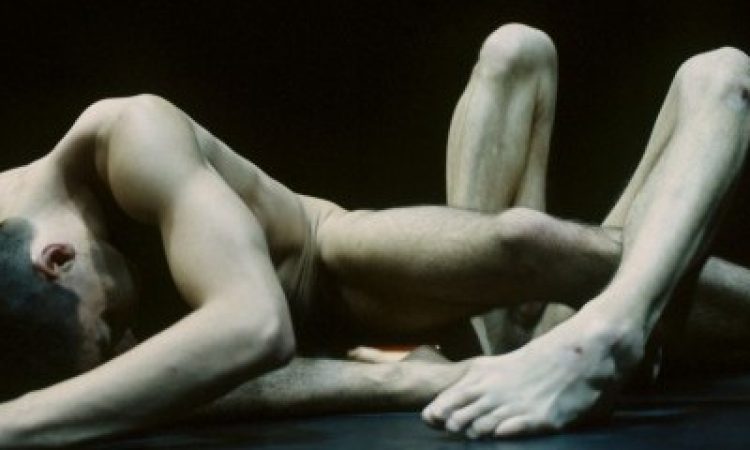
The initial two duets of last night’s performance were extended studies in awkward precision, the first accompanied by galactic droning and the other, silence. On stage right’s white marley floor, Erika Hand and Lindsay Clark settled into translucent mini-mattresses before buckling them onto their backs like angels’ wings. The doll-faced doppelgangers moved in nearly absolute unison with a steady control as blasé as airplane safety-pantomime. When they finished, face down beneath the airy bulks, Ben Asriel and Burr Johnson began touching anatomy to anatomy in a silent, experimental calculus. The men were providing in-depth, in-flight mechanical distraction—an alternating jigsaw puzzle of male body parts—fitting, not fitting, slipping past one another, bucking less-agreeable arrangements. Seated with legs overlapping, they finally looked at one another, marking the close of the emotionally sterile, gender-segregated portion of the evening.
A pillow fight ensued to the Brazilian-influenced Japanese techno-pop of Fantastic Plastic Machine with Calin. Austin Powers would have been pleased. The dancers smiled and bopped one another with the plastic tuffets for a while, men and women, naked and not, before withdrawing to different zones of the stage. There, they dutifully worked through various manipulations of their props before retiring them.
The rest of Fort Blossom returned to the space age strains of Ryoji Ikeda. A double duet—man with man, woman with woman—allowed me to blatantly compare, to think through how these differently-gendered bodies and their presentations affected my reading of their movement. Not as much as I imagined it would. The partnering in this section was more dynamic and expansive than the earlier duets, the interactions more tender than anonymous, less a meditation on the underutilized potential of the gluteals and more concerned with the body entire. The couples then switched partners, eventually becoming a quartet in a progression almost musical. Several codas later, the piece ended with wholly different concerns than it began. The men’s nakedness had been effectively formalized, the cause of my vicarious anxiety now merely a costume option.
The most sensual moment in the piece came when the two men stood butt-to-butt at the end of their first duet, looking away from one another as they swayed and grazed. At that moment, the audience’s eyes were also directed elsewhere as the women began to move. The evening kept warning me of impending discomfort, then sailing past those moments without much turbulence.
Blank-faced nakedness and portable mattresses may point to a disassociated sexuality, as plane travel may produce irrational anxiety. With time (say, a little over a decade) and the right drugs, we can learn to sever even hardwired associations. We can stop worrying, and that is a good thing. Such disassociation provides pleasure–the vague elation of untethering nudity from sexuality, intimate physical contact from romance, air travel from apocalyptic dread. But new freedoms, in turn, bring their own anxieties. While driving home from the performance I marveled at the distance my perceptions had traversed in a single evening–and then I began to ponder the implications of my new coordinates.
Fort Blossom revisited (2000/2012), John Jasperse Company, Bryn Mawr College. February 24-26. No further performances.