Fort Blossom revisited (2000/2012) opened with a single naked body lying prone. For just this one moment, it didn’t seem to matter that this was a male body.
The world-premiere of John Jasperse’s highly anticipated work was slow to unfold, deliberate, almost pedantic. The dancing was exquisite, the choreography thoughtful and rigorous. It was stuffy and warm in the theater. Fort Blossom’s pace was lulling at times, but it was thrilling to be in this shared space of thought, movement, and discovery with fellow audience members. We were huddled impossibly close. Jasperse’s gorgeous, commanding, leggy cast of four led us on a journey which laid bare assumptions about gender.
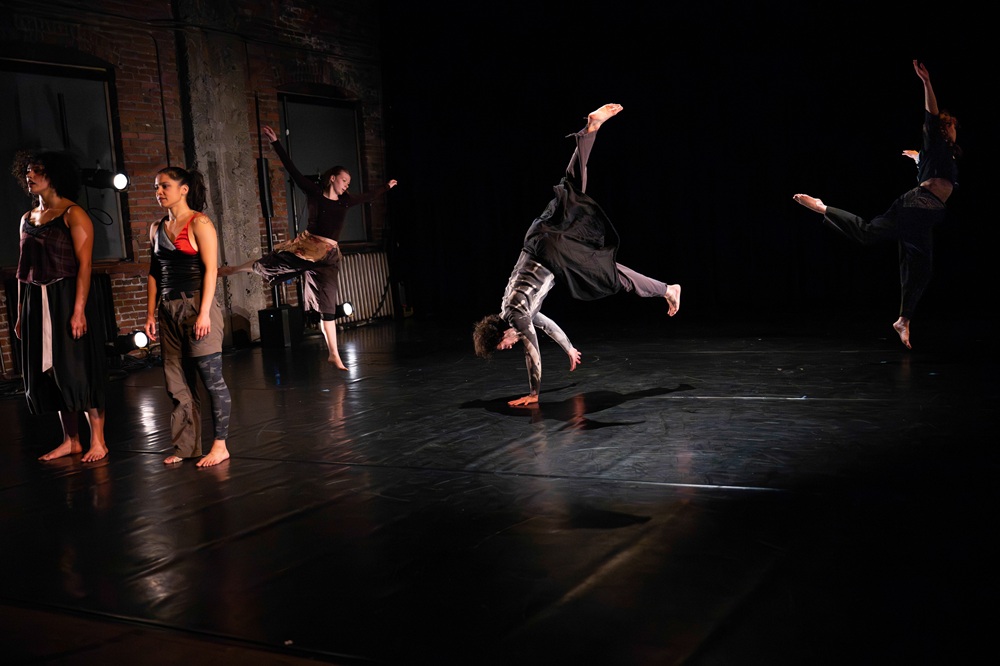
For the first part of the work, the quartet was divided into gendered pairs: two women, futurial lab technicians with short, persimmon-colored dresses and matching panties, and two men, nude, strong, rail thin, exuding biology and strapping young flesh. The women (Lindsay Clark and Erika Hand) moved in unison with casual precision. The men (Ben Asriel and Burr Johnson) were anatomical, revealing the beauty of anuses and ball sacks in compelling architectural arrangements, showing how the weight of a bony pelvis shifts over the rounded lower back of another. Ass cracks were slid down arms and legs…the approach safely transverse, always avoiding a potential perpendicular penetration.
In today’s political climate, where Rick Santorum is quoted in every news cycle, it is hard not to read Fort Blossom as a provocation in the culture wars. But what values are really being challenged by this kind of work? There is an age-old problem here: transgressing social norms and changing social norms can be mutually exclusive projects. Jasperse is trying to have it both ways. In many respects, Fort Blossom reinscribes conservative notions of gender difference and sexual taboos. It places us in a world of two clearly defined genders that, even when in cooperation, remain absolutely distinct from one another. With scrotums and penises prominently on display, the vagina holds secure the place where the “caves are darkest and deepest” (Suzanne Carbonneau, in program essay). Would it be possible to imagine Fort Blossom with gender roles reversed? Or would this imagined work immediately be read as exploitative? The artist, however, has no obligation to sort this out for us. It is our problem, not his.
The intense drone of the first part (accompanied by a sound score whose vibrations were as much felt as heard) escalated to a playful exuberance, clothed women slamming air-filled, translucent plastic cushions against the hurtling bodies of their men. It felt Dionysian. Pillows were tossed by all and caught fancily with outstretched arms and arabesques. As the group settled down again, the couples performed unison partnering duets and then finally moved into cross-gendered pairings. This predictable structural move was made more interesting by the work’s most intricate kinesthetic weavings. Some of the same moves were done here as before, but this time a woman’s clothed bottom slid down the outstretched limb of her male counterpart. We felt: oh, yes, they have asses under there, too. But we should not be squeamish about saying it: pussy certainly didn’t play into this work. Fort Blossom is an Ass Dance. The sphincter, by being acknowledged, became a fixed point around which the trajectories of all other body parts revolved.
Fort Blossom revisited (2000/2012), John Jasperse Company, Bryn Mawr College, February 24-26. No further performances.