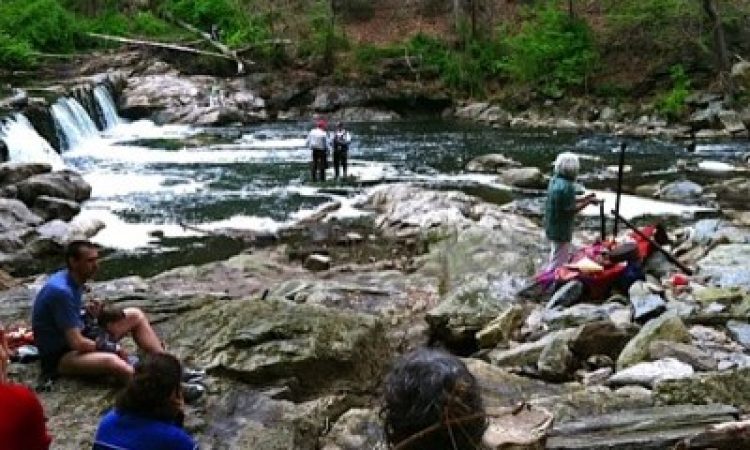
Merián Soto’s Branch Dances, performed seasonally in the Wissahickon Park, don’t just do away with traditional notions of performance, they reorganize whole landscapes. On Sunday morning, April 15, a small audience gathered by Margage Dam, a remnant of the last active mill in the valley, now a picturesque spot near the Valley Green Inn. The crowd included performers, spectators, photographers, fishers, ducks and insects, some who had come for the event and others who just happened by.
Calling this Branch Dance a “performance” would be a disservice to what actually took place: it was a restless happening that mirrored the springtime season – popping up from nowhere, rehearsed yet unpredictable. The ambient gush of the dam’s waterfall augmented the sounds of the sole musician’s distinct instruments – from a sonorous didgeridoo over timid rattles to a massive seashell that sounded like a ship horn. Harold “DidgeriDude” Smith’s own physical appearance – a prominent head of white hair, big beard, tie-dyed shirt and unlaced boots – resembled that of a modern-day shaman, who invited us with his deliberate, scattered sounds into a heightened state of perception.
The dance reconceived a divided landscape as an integrated whole. Separated by the natural barriers of the creek, rocks, woods, as well as by the dam, five dancers were strategically placed in the audience’s purview. Two were on the far side of the stream, Jumatatu Poe still and nearly invisible, camouflaged by his green-brown attire on the wooded slope above the water; Beau Hancock slowly emerging, arms outstretched, from behind a rock. Two more dancers hovered amongst the spectators, Olive Price on a fallen tree; Marion Ramírez at the river bank. Soto herself dared to linger on rocks above the shallow dam. All five balanced long, leafless branches on their heads, arms, shoulders, bellies, and fingertips. Soto let her 20-foot branch rotate like a mobile on her shoulder, while Prince’s feet gripped the fallen trunk she was standing on, and her upper body twisted and swayed. Shifting shape ever so slowly, the dancers morphed my topographical perception of a place I would otherwise hike past without a second glance.
The audience became as much part of the landscape as the artists and the natural environment itself. In fact, the unintended spectator-performers – two middle-aged fly-fishers stationed mid-stream, and a feather-collecting family of hikers (that is, the regular Sunday morning park visitors) – unwittingly completed the most intriguing tasks of the production. Crossing, even standing in the stream no longer seemed so daunting, but rather, an inviting possibility.
After the piece was over, the mother of the hikers asked me whether they had stumbled across a kind of meditation. Both mindfulness and interruption seemed to be included on Soto’s agenda, making me feel impatient during the performance but leaving me with a keener appreciation of my environment after it was over.
Soto has been developing Branch Dances since 2005, showing this performance practice in different parts of the Park, in all seasons, regardless of weather conditions. My sense is that it takes more than one viewing in one location on one spring day to experience the scope of the work, the nature of which demands that audience members be prepared to brave the elements, and more importantly, to find their way to the right spot on the map. However, once there, overcoming natural barriers, such as rivers, and comfort zones, like getting out early on a lazy Sunday, no longer seem so treacherous.
Branch Dances (Wissahickon Reunion), Merián Soto, Wissahickon Park, April 15. Next performance in July. http://branchdances.blogspot.com/