Anne-Marie Mulgrew’s latest work in her program, From Here to Seattle, continues her 25-year Philadelphia dance legacy of whimsical landscapes and stages inhabited with charm and panache. To this writer’s delight, she has choreographed to her own drummer, resisting popular trends and persevering amidst erratic funding.
In a timely reconstruction of Project 2012, created in 1996-97 with composer Peter Price and video artist Vida-Vida (whose red sun-like image projection was unavailable for this showing), Mulgrew drew inspiration from what some mistakenly view as a Mayan calendar prediction of an apocalypse in December 2012. Although Mulgrew informed her Sunday audience that she intended her three dancers for this piece (Joseph Cicala, Leslie Ann Pike, and Kate Rast) to be the last inhabitants of the world, she provided few visual hints of the approaching doomsday in this version, mainly in the stark, projected shadows of her dancers onto a red lit backscreen .
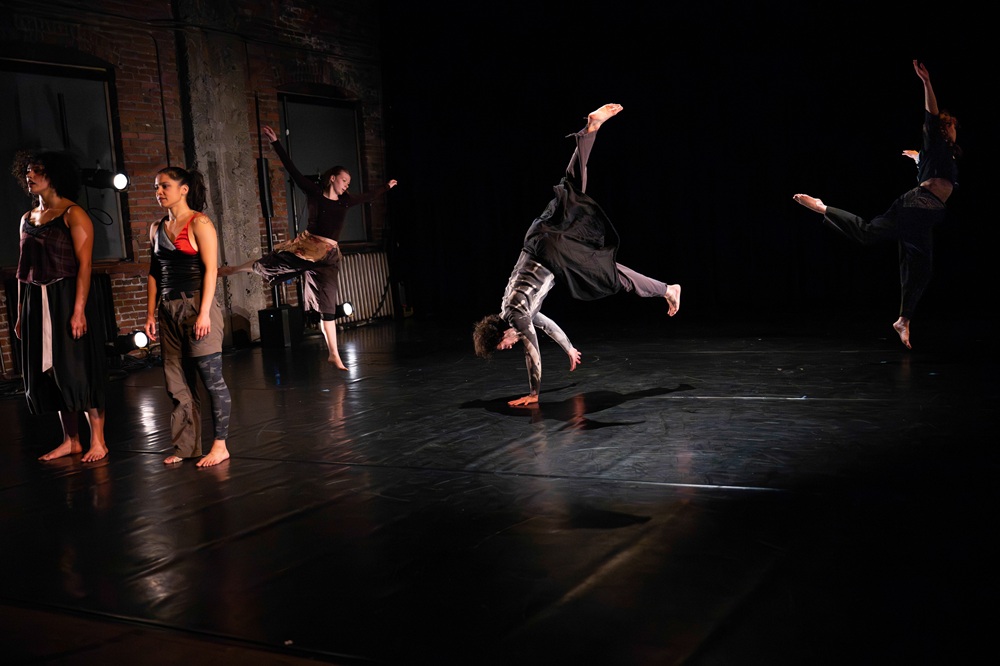
If in their final days, these dancers, decked out in zingy, striped purple costumes (designed by Mulgrew), were choosing to celebrate not mourn. They jumped with boundless energy, turned, ran, and paused for recurring intimacies in embraces that shifted into lifts. When their three heads were at one moment stacked atop one another on their sides, ear to ear, they suggested sacrificial Aztec heads or, a trio of Brancusi heads in repose. Price’s accompanying eclectic electronic music score was suggestive of bells, accordion, and saxophone amidst a broad mix of of sound that supported changes in mood and dynamic among the dancers. In the work’s conclusion, the trio bounced small balls high off the floor in defiance of whatever would follow.
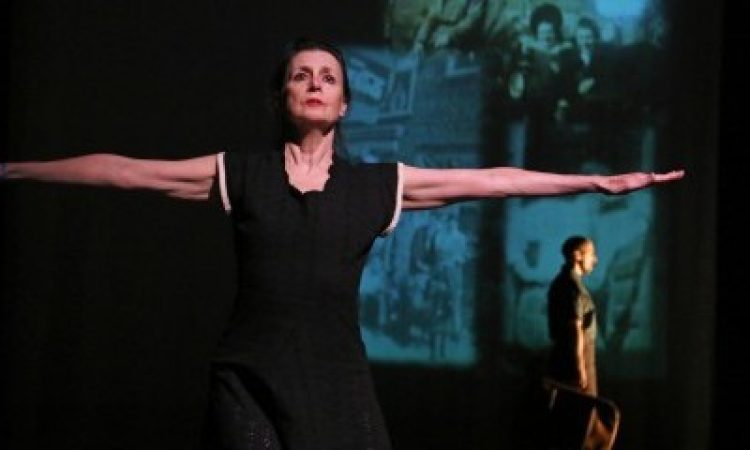
The archeology in Mulgrew’s DIG, a premiere in collaboration with video artist Carmella Vassor-Johnson, mined Mulgrew’s family roots back to her émigré forebears from Poland and Ireland. Their histories and memories fueled the choreographer’s fertile imagination bringing us, for example, a Polish tango with Cicala, Pike and Rast, joined by the company’s newest member, Megan Wilson Stern, who constantly changed partners to applauding on-stage admirers. The choreographer herself kicked off a jig in a section on Ireland. Historic photographs projected on the back scrim and video interviews of her extended family from Japan to Haiti joined the activity on stage. (Stern also appeared dreamily traversing a garden in a Vassor-Johnson video interlude that was a breath of mid-summer urban reverie.) All dancers gave us a vibrant quartet, titled “Remembrances,” whose speed and changes of direction across the stage, sought to capture whole generations and a constellation of memories in one dance.
In contrast to Mulgrew’s lighter, winsome touch, guest artist Deborah Birrane, a 1990’s member of Mulgrew’s company and now the director of Deborah Birrane Dance in Seattle, brought an emotional tempest onto the stage. In The Raven, choreographed by Evan Stone with D.H. Barrage, we heard a recording of the eccentric poet and monologist Richard “Lord” Buckley (1906-1960) reading his poem The Bugbird, a jazz inflected riff in his unique “hipsemantic” style of the original Edgar Allen Poe classic.
Entering the stage with top hat and cape, Birrane soon discarded her 19th Century male trappings. Buckley (whose New York Times obituary had called him the “Hip Messiah”) intoned that it “was a real drug midnight,” and “some cat [was] knocking rhythm at my pad’s door,” as Birrane animated her “raven” in a fluttering, shoulder-less black costume to his jazz-arched, manic delivery. Birrane, who at one point inhaled some imagined weed to the Buckley beat, aggressively embodied the terror and haunting memory of the original poem with a sassy, subversive irreverence engendered by the Mad Lord.
Changing expressive modes, Birrane also offered Waking Dreams, a 1990 work by a former teacher and choreographer John M. Wilson, inspired by Mary Wigman and German Expressionism. Although some might ask why a contemporary choreographer creates work in an aesthetic of a half century ago, Birrane’s communicated an emotional power that overcame the limits of this historical stylization. She forcefully extended arms and torso and folded her body to express extremes of despair and acceptance to a soulful early Alban Berg song with vocalist and piano. Yes, this was a dance of the 40s or 50s, but Birrane’s ability to move her audience rendered this detail irrelevant.
From Here to Seattle, presented by Anne-Marie Mulgrew and Dancers Company with guest artist Deborah Birrane, Christ Church Neighborhood House, May 18-20, 2012. No further performances.