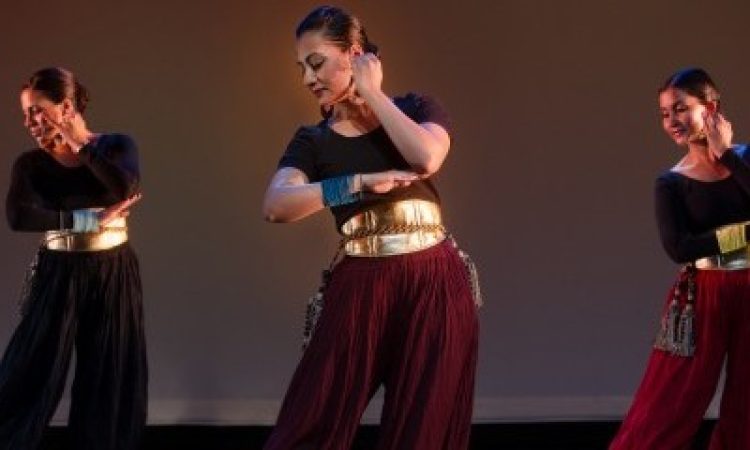
Face, hands, voice, rhythm(s). Unsung Arrivals by the Courtyard DANCERS presented live music and dance at the Painted Bride, demanding that I affix my attention to the lift of an eyebrow, the position of hands as they changed during a series of turns, the syncopations of feet accentuated by hundreds of bells wound around the ankles.
Courtyard DANCERS is a group of “engineers, doctors, lawyers, scientists, teachers and students who aspire to preserve the core and expand the boundaries of classical Indian dance.” This diverse company performed two pieces: “Silencing the Nautch,” a duet that addressed the Victorian-era history of the original dancers of the classical Indian dance form Kathak; and “Unsung Arrivals,” an ensemble piece with live music. In addition to accompanying the latter piece, Aqeel Bhatti mesmerized with tabla and spoken rhythms (bol) between the two dance works while Joel Rehmat provided a stabilizing melody with harmonium and vocals.
During the musical performance, I watched Bhatti’s fingers poised above and then beating the tabla in a blur. His articulate hands brought my attention to the immense variation achievable in the tabla’s tone with subtle changes in form. When he vocalized the rhythms he was about to perform, something clicked: the separate syllables signified different percussive sounds; the positions of the dancers’ arms, hands, and faces offered cues to a story; and both delivered rhythms (audial and visual) that could be attended to and were, at times, hypnotic.
The two dances were conceived and choreographed by Pallabi Chakravorty, a faculty member in the Department of Music and Dance at Swarthmore College. The first was notable for the way it incorporated textual information (on the scrim) about the “anti-dance” reforms in India at the end of the nineteenth century—colonial reforms difficult to wholly condemn since they also prohibited the practice of sati and the arranged marriages of child-brides. The dancing bodies of two women representing “Nautch girls” (the popular performers of the form at the time) were juxtaposed with their symbolic silencing—scarves over mouths and seated. Even their ankle bells had been quieted.
“Unsung Arrivals” featured a larger group of dancers who worked primarily in unison. They began in stillness and effectively used subsequent brief stretches of it to punctuate and create anticipation for their mostly upright, stylized actions—movements that grew faster and more intricate as performers left the stage. When only three dancers were left (Diditi Mitra, Mahasweta Dutt, and Nicole Cox), musicians and dancers united in a swirling rhythmic pattern that seemed to swell their presence although the actual number on stage had decreased.
Although the intimacy of the dancers’ and musicians’ connections were evident throughout the evening, I did not always catch the subtle eye movements, the gestures of the head, and the ever-changing mudras (hand positions)—even from a just a few rows from the stage. The Courtyard DANCERS’ exploration and expansion of Kathak to address modern subject matters rewards close attention to small gesture, facial expression, the pathway of a wrist, the soft slapping sound of feet against the stage. These carefully described moments might express details of a life unsung, but not undanced. I only wish my proximity to the movement and my understanding of its nuances were greater.
Unsung Arrivals, Courtyard DANCERS, Painted Bride Art Center, June 22-23rd.