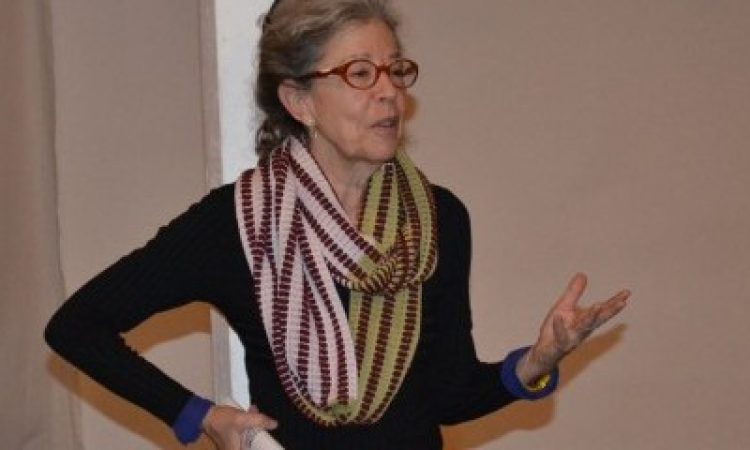
How often does one have the opportunity to attend a lecture by a pioneer of post-modern dance? I dropped everything to make it to Deborah Hay’s “Lecture on the Performance of Beauty.” And I wasn’t the only one. On November 7 the Drake Theater stage was full of a multi-generational crowd of Philadelphia dancers and choreographers.
Hay began making her own dances in the 1960s, part of a revolutionary group of artists who performed at the Judson Church in New York City. They expanded the scope of modern dance irrevocably. The Mascher Space Cooperative brought her to town for a revealing series of workshops and performances in partnership with multiple organizations, notably the University of the Arts and fidget.
Publicity for the event enticed me with the question, “Is it a Lecture or a Performance”? Hay delivered both, alchemist and storyteller that she is, relating the unfolding process of making and performing her solo, “Beauty” (2002). “Lecture on the Performance of Beauty” turned out to be a keystone event in her visit here, combining theory, practice and artistic product, leavened at times, by Hay’s playful humor. Afterwards, there was plenty to think about and savor.
“I ask my whole body to teach me. I am noticing the feedback of my body as I dance. My cellular body is an infinite source of dance, always, even forty years later.” Hay immerses herself in this reflective practice as a primary source of movement. It is a conundrum, an impossible task, and it produces an altered state of being in the body that gives her a stream of non-linear feedback.
“Beauty” was born of anger and a sense of powerlessness in response to Bush administration policies. Hay worked on the piece for one year, through a daily practice of improvisation along a spatial map, consciously rejecting conventional ideas of beauty in dance movement.
“What if every cell in my body at once is able to perceive beauty? What if every cell in my body is able to surrender to beauty each and every moment?” Working rigorously with this type of question is central to her technique in the studio. As she seeks responses, she finds the answer, and then it’s gone, finds it again, then its gone, over and over. The questions provide navigation for the process, one that also asks, “Will the dance arrive?”
Hay played videos of two different performances of the solo. In one, she wore a “post apocalyptic” costume she commissioned, appropriately red and black, with boots, holey stockings, little gloves, and knapsack. After performing in this, she rejected it, feeling too influenced by the costume in the choices she was making as she danced.
She clearly stated her motivation to continue struggling with this solo, her gut level determination to survive as an experimental artist. While practicing in the studio in Austin, Texas, overcome by heat, she removed her clothes and danced the solo nude. It was “animal and pristine.” Clearly, this was the costume for “ Beauty.” Eventually, she performed the solo again, nude this time. That was the second version she showed during her lecture.
The visual dialogue of the two versions, played side by side, was stunning. In one version, appearing as though in a carapace, she listened, moved, stopped. In the other she seemed illuminated from within, revealing an open chest and throat. In both she had an alert presence and varying spells of stillness and activity. Only a portion of the solos played and I longed to see the two selves up there in total, playing out from beginning to end, in carved relief. But I don’t suspect that Hay trades in giving people what they want to see; more likely, her work reveals something they didn’t know they could see.
As I watched the version that was clothed in nakedness, I was reminded of the deep historical tradition of painting “the nude.” I never really responded to these paintings, but watching that performance of “Beauty,” after awhile, I had a sense of why someone would paint a nude. I got it, the profundity of seeing into someone’s body to the slow phosphorescent river of her life energy; to the movement contained below the movement on the surface. That is what I saw in this performance of “Beauty.”
Deborah Hay: A Lecture on the Performance of Beauty
The Drake Theater
November 7, 2012