Can, will, should opera survive into the twenty-first century? – survive as new creation, rather than as performed interpretations of older works? A handful of composers (Rameau, Mozart, Puccini, Verdi, Wagner…) have triumphed through the complexities of opera. Countless others have failed to break into the repertory of opera chestnuts. Will Wolf-in-Skins be one to land such a coveted spot?
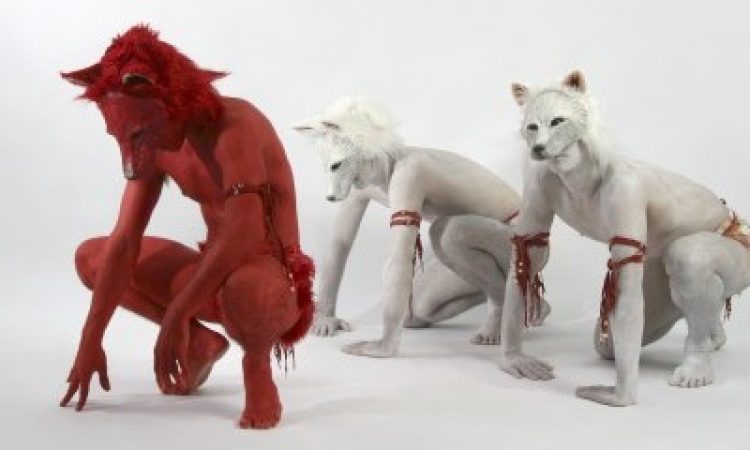
Wolf was shown as a work in progress at Conwell Dance Theatre of Temple University. The first act included a prologue and five scenes, while only a brief excerpt from Act II was ready. The work’s choreography, direction, and libretto are by Christopher Williams, whose program bio quotes the New Yorker dubbing him “the downtown prodigy,” and the music is by award-winning composer Gregory Spears. Striking costumes, by Ciera Wells, Carol Binion, and Andrew Jordan, took us right into the mysteries and flavor of the Welsh legends from which elements of the story were drawn. The pale flesh of the “fay” characters—in parts animal, magical, and earthly—was barely covered in skins, feathers, and gossamer; played by dancers, these creatures were beautiful to watch in the intimacy of Conwell. The human antagonists in the story—singers playing royalty and courtiers—wore colorful, vaguely medieval robes; they frolicked, struggled, and lusted as legends have richly portrayed. A vocal chorus of black-robed, spikey-fingered witches seemed to stir the human-fay interpenetrations that set off the dramatic action, which sprang from the floor of musical support created by the baroque-instrument orchestra arrayed along stage left, conducted from the keyboard by Geoff McDonald. Supertitles on the scrim behind the stage flashed the Welsh and English lyrics, which helped somewhat in keeping me afloat in the bewildering sea of the plot.
Ah, the plot: although I arrived early at the show and dug right into the program, I barely had time enough to read the densely detailed notes about convolutions of love, enchantment, curses, crises, and other complexities intended to weave together the long list of characters. Adding to my confusion, these characters bore names like Gwyn ap Nudd, Drudwyn, Dormarth, LLaethwen, Gwyddrud, Bleiddwen, and Gwrgi—hard to track. The libretto’s mixture of languages (and awkward phrasing of English) was not always illuminating.
The performance provoked me to ponder the power of both myth and opera, forms I love. What makes them work, when they do? Why was I not moved at Wolf-in-Skins, despite the excellent orchestra, the strong singers, and the beautiful dancers? Myths touch on deep and universal issues that cross time and space to plumb the wells of our universal human experience. Opera wraps stories of love, betrayal, and intrigue into fanfares of visual and musical drama, supported by evocative melodies that stay with the listener after leaving the theater. In Wolf I missed the universal “aha!” moment(s) by which myth can enlighten as well as the memorable melodic motifs that bring a character’s pathos or courage to mind.
What did work? Williams is primarily a choreographer, and this was his strongest contribution to the production. His dances—ballet-based, yet drawing on the level shifting and torso mobility of modern dance—evoked character, Renaissance courtly dances, and imagery from ancient iconographic sources. The dancers performed with care and precision, which will surely sharpen with time. The fanciful costumes, particularly for the “fay” creatures, effectively revealed and transformed the performers’ bodies. Like the dancers, the excellent ensemble of singers and instrumentalists will surely tighten with further work. The singers moved well, too: their hieratic gestures and dramatic stage crossings kept their characters in the arcane world of the story. Williams’ choreographic skill yielded moments of true beauty in complex staging that his libretto failed to support.
What could make this work more effective? Simplifying the plot would help considerably. Identifying where the myths plumb soul-piercing depths and where fussy detail and contemporary twists distract from the dramatic trajectory would be useful. Some dance scenes need editing, such as the cursing of Bleiddwen (act 1, scene 1), which went on well after we got the point, and resulted in her being “denuded of her regalia” -downstage right, a spot hidden from most audience members’ view by Conwell’s sightlines.
Wolf-in-Skins isn’t finished, and I feel that this review isn’t either. Perhaps a few more months of revision and rehearsal will bring this work into clearer light. Until then, its potential contribution to a renewal of opera in our time remains hazy.
Wolf-in-Skins by Christopher Williams and Gregory Spears. Jan. 25-26, 2013, Conwell Dance Theatre, http://operaprojects.org/wolfinskins.html.