We were packed in tight, Body Against Body, to watch the Bill T. Jones / Arnie Zane Dance Company perform an introspective glimpse into the choreographers’ early collaborations. Prior to the formation of their company, Jones and Zane were partnered for eleven years, sharing their personal and choreographic lives. Thirty years later, these duets are performed by different bodies, but the dances carry traces of the pair that created them.
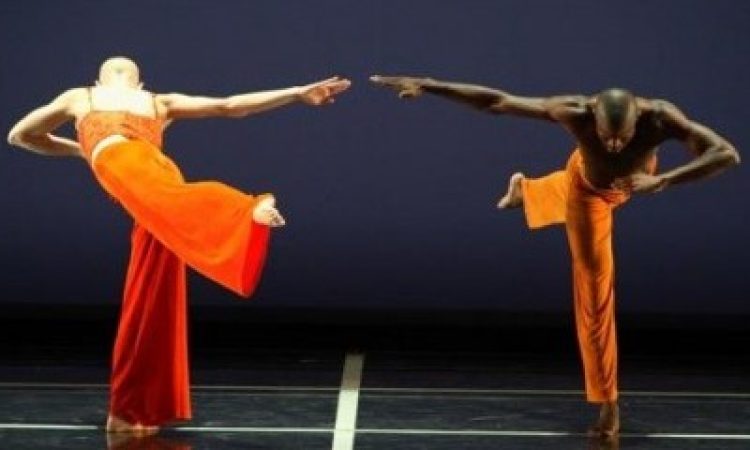
A door onstage bangs open, arresting the sound of a beautiful aria into silence. Two men: Antonio Brown, LaMichael Leonard, Jr. They walk, and soon one looks at the other, a gaze that isn’t returned. They collide into a wild energy of interaction, each body filling the other’s negative space. We hear their breath, grunting with exertion. Suddenly, stillness. They stand side-by-side gazing forward, slowly moving one hand at a time into an embrace. It’s a tender yet vulnerable moment,which breaks violently into a sequence of partnering. The duet resolves with the pair banging through the door. Lights out.
Lights up. There’s a new partner! Talli Jackson joins a now exhausted Leonard, Jr. for the same duet. But something’s different; this pair isn’t as collaborative. Jackson’s breath is harsher, heavier—gritty with anger and frustration. I feel uncomfortable peeking into this relationship, as if I’m a guest at a dinner table watching the host couple fight about something trivial. They work through the same movement, but the dance is altered by this thick tension. Duet x 2 (1982) gives a glimpse of the intimate honesty of the Bill T. Jones / Arnie Zane partnership as it was as a duet, a relationship in life and on the stage.
A naked woman darts onstage, short fiery hair flinging as she dances a wild frenzy for seven seconds of Stravinsky’s Rite of Spring. She sprints off, the music cuts to silence. And so begins Constant Replay (1977, revised 1991). Jenna Riegel, still naked, returns calmly, turns her head and turns it back. She accumulates an arm gesture, a lunge, a sharp breath—I recognize these movements as the wild frenzy we saw moments ago, slowed down motion by motion. Also nude, the remainder of the company joins her in her task as she inches her way around the perimeter of the stage. (The other dancers are Brown, Jackson, Shayla-Vie Jenkins, I-Ling Liu, Erick Montes Chavero, and Jennifer Nugent.) They leave one by one and return partially clothed, accumulating personality with each costume addition. Still Riegel remains firm, a clock—bare, linear, and constant in her rhythm. Her steadiness is a comfort to me.
The final duet of the evening, Blauvelt Mountain (A Fiction) (1980), jumps frame-to-frame, cutting from one interaction to the next. Jackson walks into a pool of light, flirting with the audience. He pushes away an invisible figure, recoils as if smacked in the face, and stumbles as if kicked in the back. Chavero whispers a secret—they look accusingly at the audience. Placed within other sequences of movement, these moments repeat with increased speed, as if we’re watching a movie reel. I hear laughter of recognition from the audience as the pair whispers and stares. I take pleasure in each repetition as I form narrative out of images that were once abstract.
Body Against Body: It’s a title that implies intimacy and comfort, but also danger and conflict. I felt impacted by the honesty of these dancers, their bodies and relationships under the scrutiny of the audience. Years ago, Jones and Zane took on the dangerous task of performing their intimacy onstage, and the influence of that relationship is still visible in their work thirty years later.
Body Against Body, Bill T. Jones / Arnie Zane Dance Company, Painted Bride Arts Center, February 21-23, 2013.