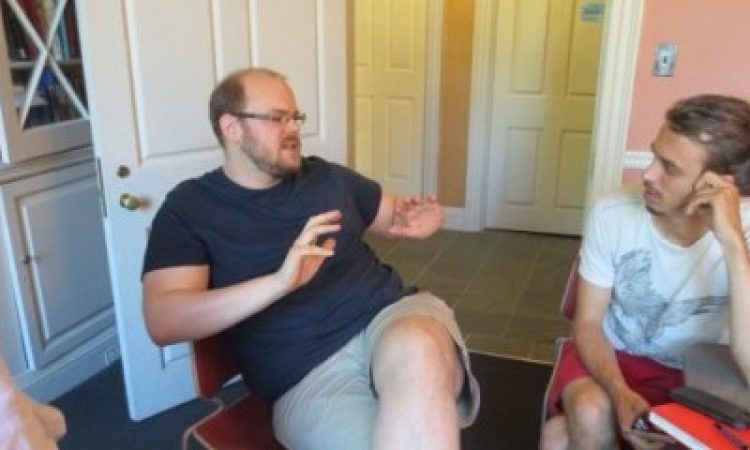
Andy Horwitz is the founder of culturebot.org, a New York-based cyber forum for critical conversations, cultural news, events and ideas from NYC and around the world. ThINKingDANCE invited Horwitz to speak with its writers in early June and to share his views on changes taking place in arts communication, writing and accessibility. I am still digesting his rich insights and thought-provoking views on technology and its impact on how we see and experience art.
In addition to Culturebot, Horwitz also has the distinction of being the first person to blog about 9/11. Nearly 12 years later, it’s hard to fathom that transmitting information via blogging hadn’t quite caught on. Yet Horwitz’s two-block proximity with un-obscured sightlines to the attack, and his recognition that the internet could convey observations in real-time, hooked him on the potential of this medium. His fascination with blogging continued while working at Performance Space 122 where, in 2003, Culturebot was born. Horwitz’s tenure there afforded him unique access to a thriving arts culture. By capturing what the artists were doing, from the early stages of the creative process to the finished outcome of performance, he was able to create, as Lisa Kraus expressed, “an ongoing, historical document that had the power to enhance community and encourage dialogue.“ Since its founding, Culturebot has become a dynamic voice on the New York City art scene, with its mission, according to the website as, “the idea of critical horizontalism, a framework for arts engagement that proposes criticism as creative practice, reassesses spectatorship and engages with artists’ process over time.” Today, Culturebot continues as an entity separate from PS 122, having split off in 2007.
I was fascinated with Horwitz’s views on how our access to the arts today correlates with our increasing access to digital media. Technology and computers allow for a different kind of engagement with arts writing that often invites the response of its audience. For example, both Culturebot and thINKingDANCE encourage readers to give critical feedback of the performance itself and to challenge the writer’s viewpoint. This kind of forum for sharing ideas and opinions creates broader access to critical input. In this more open setting, arts writing is the beginning of a dialogue that welcomes performers and viewers alike to share their insights along with that of the writer. It’s not just the dance writer who gets to write about dance: anyone with enough interest in the topic can weigh in.
Horwitz pointed out that we used to live exclusively in the world of physical objects but that computers allow us to interface with our communities in a different way, transcending time and space. One doesn’t necessarily need to go to a theater or museum to view a performance or an exhibit. The internet allows us to move through a larger galaxy of information, educating us as to what is available and hopefully, making us more discerning. For instance, if you plug in Ravel’s Bolero on YouTube you can pull up multiple renditions of the piece. Just a short time ago, access like this was unheard of.
Horwitz stimulated me to consider how we at thINKingDANCE fit into the complex fabric of dance culture in Philadelphia. As dance writers who use technology to advocate for dance, what do we write about in dance, and more importantly, how do we write about it? Horwitz posits that newspaper reviews are more about consumer advocacy (buy this, don’t buy that) and that this kind of writing is dying out. With print journalism on the wane, what does this traditional medium offer dance artists and how is it different from what we do at thINKingDANCE? These questions are not just about print vs. cyber media; they are about a broader philosophy that embraces critical discourse. Philadelphia’s performers, audiences, producers and institutions all have a stake in being heard.
June 1, 2013. Andy Horwitz, all-day forum for thINKingDANCE at Christ Church Neighborhood House
http://www.andyschest.com/WTC_Diary.html