Alie Vidich likes to journey through space and spend time outside. She is a hyper-imaginative 28-year-old artist who swooped off a bridge and fought the city of Philadelphia for permission to turn that bridge, a parking lot, and a small patch of grass into a performance venue. Vidich finds value in togetherness and diversity. In 2012, her work CONSTANTS led audiences through an interactive performance along the Schuylkill River, illustrating the Lenape People’s Story of the Four Crows. Since that experience, she has established a deep-felt appreciation for the Schulylkill River and the beauty of “ephemeral summer.” These personal interests evolved, leading into her creative process with INVISIBLE RIVER in August 2012.
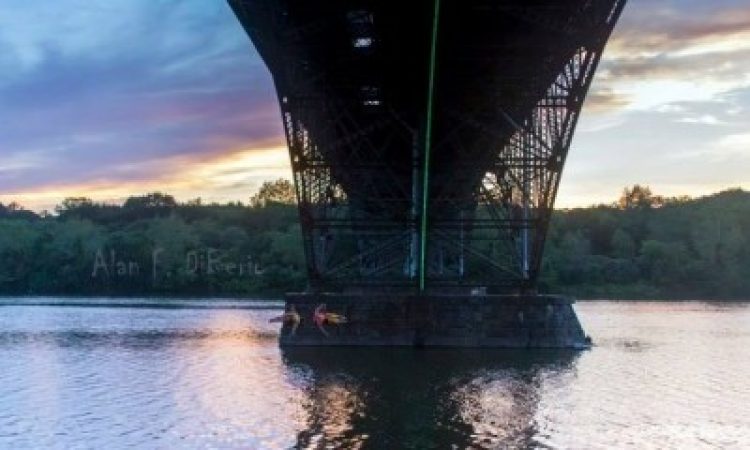
Alie & the Brigade, Vidich’s company, co-produced INVISIBLE RIVER with The Philadelphia School of Circus Arts. This partnership was especially reflected in Vidich and Evan Hoffman’s aerial duet as they swung and hung from the Strawberry Mansion Bridge. The co-choreographers were acrobats, a visual sensation.
With a leap of immense courage, the two sprung from the top of the bridge and aviated like a pendulum. From the audience’s riverside view, the placement and angles of the dancers’ limbs, extremities, and heads formed rigid structures. Together they spindled into symmetry and lingered in the air as sculpted shapes, effortlessly rocking before shifting with agility into a new posture. They reminded me of spiders, gracefully vacillating and gliding down a single thread of attachment.
As they descended towards the water, their bodies straightened, rotating parallel to the water. They steadily composed elongated curves, contracting and expanding like a sheet of paper caught in a gentle wind. Through their mirrored, juxtaposed movements, Vidich and Hoffman exhibited a series of elegant, harmonious images.
The entire experience reminded me of air, rather than water or rivers. The dancing was delicate and flowing. The music was ethereal. Breeze rustled the trees’ leaves and blew across my face. Vidich and Hoffman’s masterful maneuvers under the bridge caused me to imagine them in the water, floating through stillness, gracefully morphing into new positions. By the end of the performance, the dancers paused only inches from the top of the water before releasing with a small splash and swimming to shore.
More than two minds and bodies made this Alie & the Brigade’s production a success. The “Brigade” part of the company identifies itself as a dance theater group that thrives on the richness of human experience, specifically in a spiritual and social perspective. They use atypical physical presentations to inspire their art. Vidich directs, conceptualizes, performs, and choreographs, but she also relies heavily on other members of the project’s team.
Jeffrey Russ directed the chorus, a group of nine singers and dancers dressed in white who sang the eerie tones of Elliott Harvey’s musical compositions. This group began the performance, walking in sync through dense crowds in the Kelly Drive parking lot and guiding attendees toward the bridge. There, the audience found vibrant sculptures created by the Cultural Arts Program at SpArc Philadelphia. Spectators flooded this space, enjoying food and drink provided by Cosmic Café and Little Baby’s Ice Cream. Artists of all genres and areas of Philadelphia converged at this scene, along with creative thinkers, performers, risk takers, entrepreneurs, technicians, and even chefs!
Vidich’s constant communication via social media leading up to the event was enthusiastic and grateful, despite ominous weather and challenges posed by a permit-happy city. She initially planned for a four-show run, but the Saturday shows were cancelled due to permit costs. On the day of dress rehearsal, Philadelphia police forces and a Marine unit protested the performances, claiming that there were unpaid permits and safety precautions. Vidich had to negotiate, fundraise, and ultimately invite the Marine Unit to patrol the water during the show in order to make it happen.
Philly harbors a growing number of site-specific works, which add not only to the conversations about art, environment, and culture, but also contribute to its history. Performances like these are advancing ideas about dance, encouraging audiences to experience dance in a fuller way by incorporating their own experiences. In this case, the feel of the warm, earthy ground, the smell of a picnic dinner, and the sounds of the streaming river added layers to Vidich’s incredible out-of-the-box show.