Or so Paul Taylor would have us believe in three of the four dances he presented in his Philadelphia season at the Annenberg. Different bugs in different worlds with different raisons d’être, but bugs that pair up, mate, fight, and die for love.
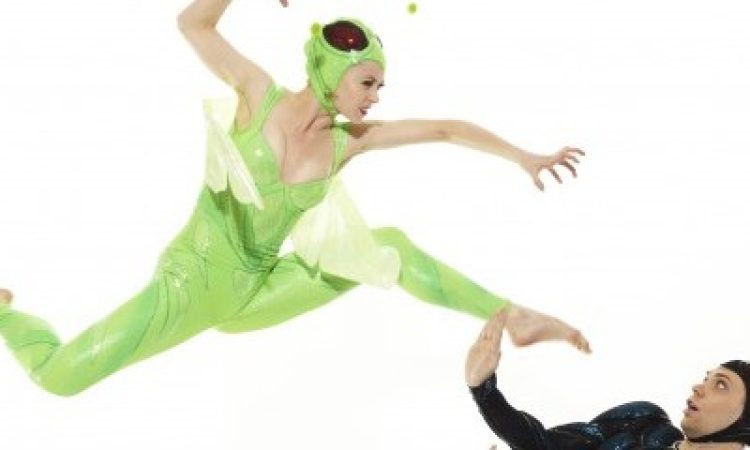
The most ludicrous of these worlds was that of Gossamer Gallants (2011), in which six guy-flies and five ladybugs mug, buzz, jab, flex, and chase one another around and off the stage. Initially, the fireflies happily fall for the chartreuse-clad ladies swishing and shimmying before them, but by the end of the dance, these flirtations turn deadly as each lady tracks down her prey and captures not just his heart but his lifeblood. Sounds serious? The dancers play the humor full out, finding a hilarious match between Smetana’s “Bartered Bride” music and Taylor’s hopping, heroic, humming movement. Picture a bright-green ladybug kickline celebrating its victory over its supine victims, and you catch a glimpse of Taylor’s humor.
Fibers (1961), the oldest work on the program, is choreographed to Schoenberg’s atonalities. It opens with a creature crouched behind a tree-like drape upstage right. He emerges to reveal a figure much like those “phallic” men of Graham’s heroic period who marched around right-angularly in tight trunks and bare chests (see Deborah Jowitt’s 1973 essay, “The Monumental Martha”). But Taylor’s men—another joins the first figure for an anguished duet of chopping arms, sharp lunges, and contracted spines—wear colorful patterns on their crotches, brightly contrasting bands across their chests, and pointy-headed masks that suggest creatures from another planet. Two females, dressed in all white except for black stripes here or there on their unitards, initiate a quartet of creeping, thrusting, jabbing circles punctuated by sudden attractions, then equally sudden partings of the plain-colored ladies and brightly hued men. Birds or bugs in ritual mating dances? The logic that drives their encounters is known only to them, but their fascinating patterns ultimately leave the lone male again crouching behind his tree amid an empty plain.
The strongest work of the evening was the 1979 Profiles, to music by Jan Radzynski. The quartet of the previous dance seems in this work to have matured, to have shed their wild colors and fraught encounters, and to reveal their inner motivations and interconnections. They are surely bugs now, sticky, vibrating, pursuing their mate-and-survive trajectories. They unite in a circle of shared movement before one female sinks to the floor, used up after the ritual climax, as her mate quietly contemplates her. Here, the bare stage and simply patterned whitish unitards allowed Taylor to create a world entirely through his choreography and the substantial dance-power of his company.
The evening opened with Taylor’s season premiere, American Dreamer, to the sometimes hokey, sometimes romantic, and sometimes hokily romantic tunes of Stephen Foster. A bare ballet barre upstage, some old-time freight trunks, and plain chairs set on stage left create a space that is part traveling performing troupe and part Frontier (Graham’s Americana classic of 1935), softened by the addition of Appalachian-Spring (Graham, 1944) bonnets. But the movement is dominated by cutesy mugging, histrionically reaching arms, scolding wives, cartwheels, and a big-bang finish with the entire cast downstage center in eye-candy symmetry. I will confess that the bus I rode from Lancaster (my home) to Philly to see the show got lost and by the time I arrived at the theater, I had missed the first sections of this dance; but the folks sitting around us, when we finally took our seats, assured us we hadn’t missed anything to regret. Taylor can be dark—think of Speaking in Tongues and Big Bertha, for example—but the repertory he picked for his Philadelphia audience was decidedly light, bright, and, at its best, whimsically entertaining.Paul Taylor Dance Company, Annenberg Center, University of Pennsylvania, Thur.-Sat., Oct. 24-26, 2013.