Rhythmic hip-hop beats accompany my footsteps as I approach my seat at Raphael Xavier’s The Unofficial Guide to Audience Watching Performance. Presented within First Person Arts Festival—an organization devoted to “transforming the drama of real life into memoir and documentary art”—Xavier’s work is autobiographical, focusing on his long relationship with break dancing. The work fuses breaking with theater and humor, along with poetry by Leigh-Mirel-Nelson, guiding the audience into Xavier’s story.
The stage is set up as a classroom; the audience members are the students. The lecture begins:“Cultural transmission is the way a group of people in a society tend to learn and pass on information. Think of it as dancing.” Windmills, freezes, turtles, spiderman, body swipes, up-rocks—it starts as a vocabulary lesson. Xavier demonstrates a movement phrase, breaking it down at a pace that drills it into our brains. We see it repeated occasionally throughout the hour-long work. A young admiring B-Girl sits in front of me, “ooh-ing” in appreciation and mumbling the names of the moves that she recognizes.
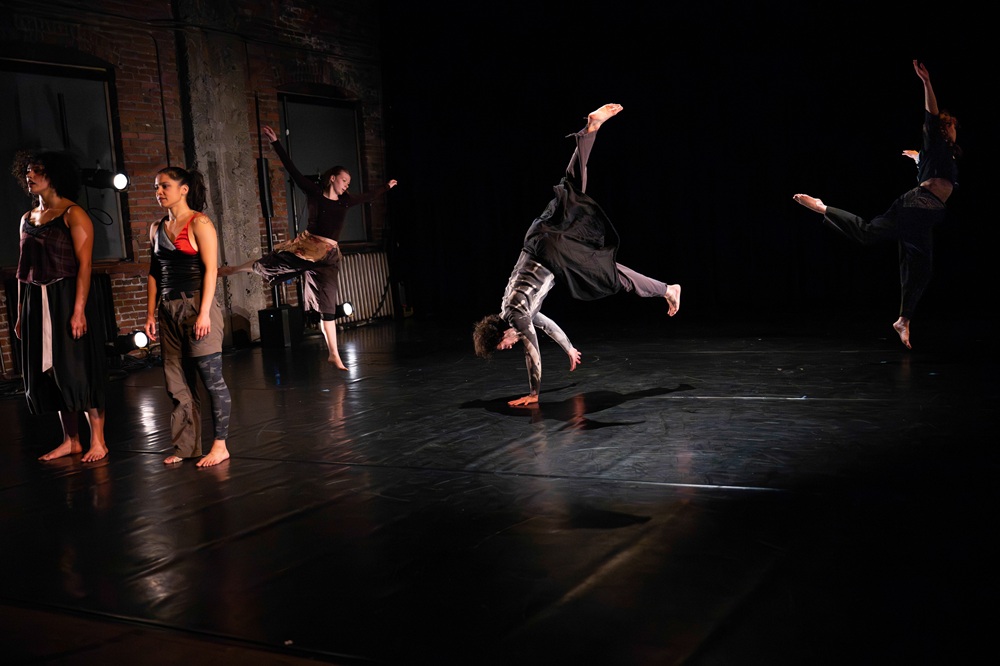
Cameron Beckham and Jerry Valme join Xavier on the stage. They symbolize younger versions of him, hungry for the center of the cypher, always yearning to learn. Each dancer has his style, taking chances to go off on his own, always returning to the unison choreography. Xavier speaks the text, accenting words like a slam poet, while the youngest, Beckham, devours the cypher, inverting his body with quick centripetal momentum. I can see the honesty in Xavier’s focus and intention. He invites us into his personal discovery, allowing us to imagine his stories growing up as a breaker. “Nothing could stop me, my body was like origami.”
They hold their weight on their hands, their feet locked in the air, their heads resting on the ground. They freeze in this position for what feels like five minutes as three audience members are prompted to approach the stage and take pictures of the tangled positions. How long can they balance without wavering?
In the post-show discussion Xavier speaks about his experiences breaking on the stage. A breaker since 1983 and an alumnus of Rennie Harris Puremovement, Xavier distinguishes between performing hip-hop on the stage and on the street. In contrast to the one-upmanship of a breaking street battle, onstage performances mostly showcase the tricks of the form, like head spins and windmills. Performing in these showcases requires constant energy and “hype,” and Xavier would often be burnt out by the third or fourth show. His goal for creating this work is different—it isn’t about amazing the audience, though his performers are so talented that this is inevitable. It is about creating a work that audiences understand. It is about homing in on the purity of the breaking form, slowing down the momentum to show the mechanism of each movement.
In an attempt to create understanding between audience and performers, Xavier instructs us, “Imagine what it’s like being me in the moment.” I take a crack at it:
I approach the circle of light, an invisible cypher luring me into its center. My eyes are on the middle as I pace the perimeter, a predator stalking its prey. It is empty space. A playground. I jump in, transferring my weight from feet to hands, back and forth, up and down. My footwork is clean and my body calm and composed. I don’t miss a beat and I stop on a dime, freezing with my legs suspended in the air. I’m sure they can see my effort, but I play it cool, ignoring the hot sweat dripping into my eyes. I am fearless, but I am always learning, always pushing my own limits. Nothing can stop me, my body is like origami.
The Unofficial Guide to Audience Watching Performance, Raphael Xavier, Painted Bride Arts Center, November 13 and 14, www.firstpersonarts.org, www.raphaelxavier.com