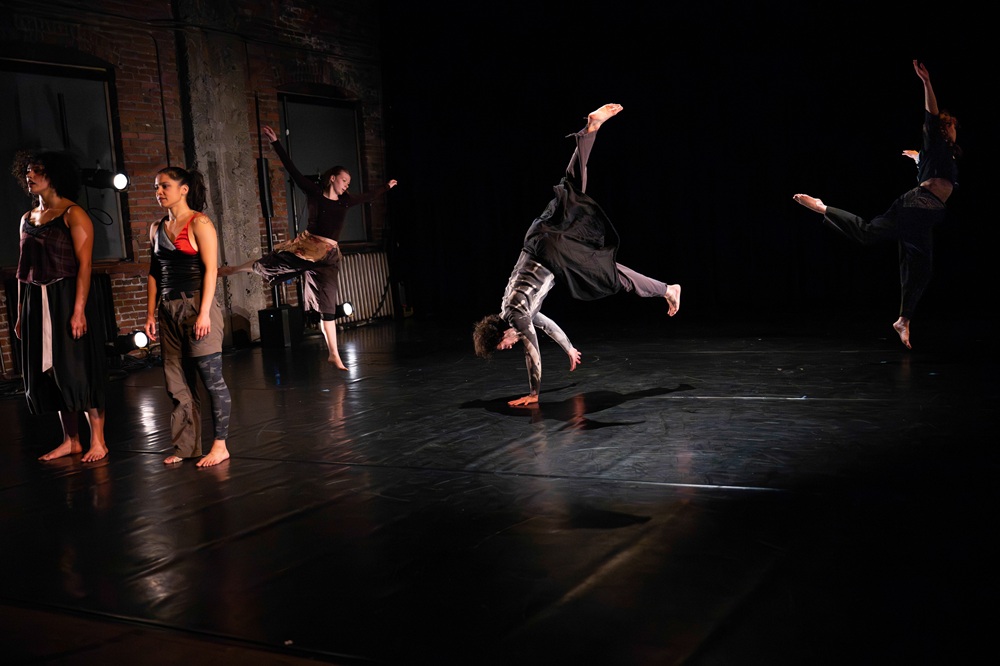
Keigwin + Company’s audience at the Annenberg Center made up for the many empty seats with their enthusiastic responses—laughter, sighs and energetic applause. Alternating between conversational gestures and rigorous dancing, the performers portrayed recognizable situations: a married couple on their wedding night in Mattress Suite, a pair of doe-eyed sweethearts in “Love Songs,” flashy showbiz tricks in “Girls.” Set to the popular tunes of Aretha Franklin, Nina Simone and Frank Sinatra, among others, Larry Keigwin’s choreography fashioned a string of vignettes that delighted the audience with its comedy and honesty.
Each duet in “Love Songs” introduced a relationship: one young and playful, another clingy and seductive, and a third co-dependent and intimate. The audience giggled and gasped at all the appropriate moments, delighted by the lighthearted romantic comedy. Side by side, the dancers step-touched to the music. Emily Schoen and Brandon Cournay side-glanced at each other—she sharply averted her eyes, embarrassed, while his lingered longer, gazing at her figure before turning back towards the audience.
Jacklyn Walsh clung to Matthew Baker’s side as he, burdened and annoyed, appeared onstage. He flung her off, but she quickly latched onto his leg. He dragged her across the stage before she finally released him. Standing upstage left, he glared at her, seated downstage right. As the trumpets cut out of the music, Aretha Franklin’s solo voice sang, “Baby, I love you” and Baker subtly thrust his pelvis toward Walsh, daring her to “come and get me.”
In the third duet, Ashley Browne entered the stage backwards, reaching each long leg behind her, her body at an impossibly horizontal angle. Kile Hotchkiss held her up in counterbalance, his hand resisting her weight. They leaned on each other, flowing in and out of daring lifts, sharing each other’s weight with trusting intimacy.
One girl, two girls, three “Girls”—three floating heads splashed into a sparkling blue curtain of streamers suspended from above. The waves of blue obscured the dancers as their disembodied limbs magically appeared where least expected. Jumping out from behind the curtain to roll, run and extend their legs, they moved in unison, like backup singers harmonizing. The Sinatra songs accompanying them added to the air of showbiz and stage tricks, as did the scenic design, which was at least as eye-catching as the choreography—a purple cascade of shimmering streamers lowered to the stage, followed by red. Each new color layered the space with more light and reflections. Then, in a grandiose gesture, all colored curtains flew up into the rafters revealing the tumbling waves of gold hidden behind the original blue curtain. The audience gasped, delighted, and applauded at this final appeal to flashy aesthetics.
“Triptych,” the only work on the program that strayed from theatrics, was abstract by comparison. The performers danced with expressionless faces, their arms swinging side to side like metronomes keeping time with the percussive music. Though the dancers’ movements were precisely timed—they moved in perfect unison—the work seemed out of place in an evening of love and relationships.
Throughout the performance, I found myself responding with the audience, chuckling at the funny moments and nodding in approval at the dancers’ virtuosic pirouettes and balances. The evening’s works didn’t push the boundaries of dance; they didn’t question gender norms; they didn’t ask in-depth questions that lingered after the final black out. Instead, Keigwin’s musical choreography entertained and diverted the audience. His narratives could be read at face value, interpreted and enjoyed in the moment. It was showbiz—well executed, popular and easy on the eyes.
Keigwin & Company, Annenberg Center, University of Pennsylvania, Nov 21-23, 2013, www.keigwinandcompany.com