Lancaster, Pennsylvania—a town rich in visual art, supportive of a wide range of music, home to a treasured puppet museum and theater—is largely bereft of professional dance. Schools, private studios, dinner theaters, collectives of long-time dancing friends are available, but for most Lancastrians, the opportunity to see live professional work in our town is typically a once-a-year (at most) event when one or the other of the area colleges puts its attention and budget to making such a performance possible. This year will be richer than usual for our community: not only has Millersville University brought Brian Sanders’ JUNK to its Winter Center on the school’s main campus, but MU will also partner with Franklin & Marshall College to present the Isadora Duncan Dance Company, led by Lori Belilove, later in February at MU’s downtown site, the Ware Center. The question for Lancaster arts presenters has typically been, Will the community come out for professional dance? They did for JUNK, and they seemed to like it just fine.
Act I of Sanders’ program was set in an urban wasteland of trash cans, discarded doors and window frames, the odd bicycle wheel or two. The scene shifted in Act II to a summertime garden party, with trellises, lawn chairs, sprinklers and hoses, even a rubber ducky. Although the program listed six separate dances for the first act, and only one for the second, both shared a stop-and-start snapshot pacing characterized by the choreographer’s evident fascination with objects—or junk, as the program note pointed out. The compositional pattern typically introduced the dancers and the piece of junk to be explored (a scooter, plastic booties, a big blanket, and so on), turned the dancers in every possible direction on, in, around, through, over and under the prop, pulsed the movement to pumping rhythmic music, and—when the ideas were used up—cleared the stage during a blackout before the next scene. The settings provided opportunities to collect each act’s particular set of junk rather than serving as grounds for narrative unfolding. In fact, the evening offered little in the way of dramatic or dynamic arc, and the musical choices were, for the most part, within a narrow range of loud volume, quick pace, and monotonous phrasing. Sanders showed some musical attentiveness in the second act, when he played cleverly with tango and jig rhythms, but musicality was not a high point of the evening.
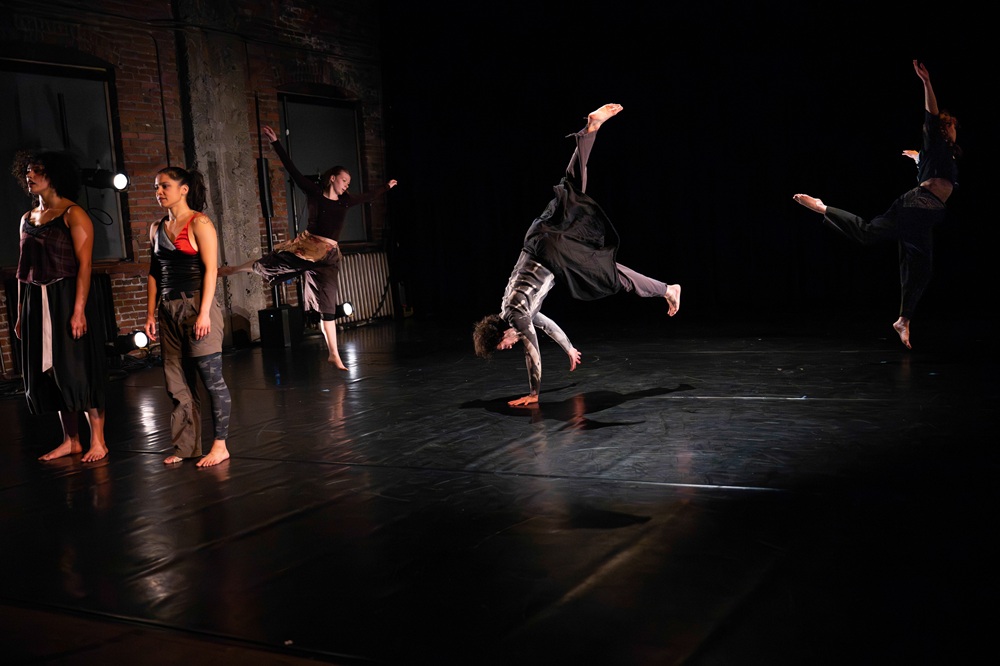
The audience quickly picked up on what the high points were, however: daring physicality and man-machine mobility. In familiar Pilobolus- and Momix-fashion (Sanders performed with the latter troupe for ten years), dancers used their costumes, props, set pieces, and one another as springboards for counter-tensions, acrobatic jumps and spins, trapeze-like daring, and high-stakes balances. In Act I’s “Two by Cycle Mobile,” John Luna and Billy Robinson—two of the company’s outstanding performers—spun, climbed, hung, and flew from a suspended bicycle contraption, their top hats, tails, and white jumpsuits alluding to vaudeville or circus days. Luna notably had a way of making the showy encounters with objects approach poetry, particularly in “The Grid,” a solo with what appeared to be a discarded window frame that suggested at times the dancer’s almost Christ-like ascension. But such moments were often shattered for me by audience members bursting into applause to acknowledge a movement trick—multiple spins, daring falls, seemingly impossible balances.
The audience, indeed, was a bubbly mixture of the local dance and theater crowd and families bringing their kids to live performance. Bravo for them! One dance friend who chose this occasion to expose her four-year-old daughter to live dance for the first time reported to me that her little one was riveted throughout the show—a good sign for encouraging her to risk another, perhaps more subtle, dance performance.
Brian Sanders’ JUNK, The Winter Center, Millersville University, 60 W. Cottage Ave., Millersville, PA, February 1, 2014.