”Feet”, the aptly named program which alternated about equally between two companies was a cultural handshake between dance styles; one that originated in India and the other from North America. Although culturally worlds apart, Usiloquy Dance Designs and The Lady Hoofers Dance Ensemble shared percussive footwork as the central part of their movement form. I liked this thoughtful programming juxtaposition.
Usiloquy Dance Designs presented six works in the Bharatanatyam style, a dance form that originated in southern India over 3,000 years ago. Once a part of ritual worship and royal patronage, it was nearly wiped out by British rule in the early 20th century, Fortunately, it survived and it is part of Usiloquoy’s mission to expose and educate audiences to this dance heritage. The company featured solos and group works for its five female dancers; Aney Abraham, Mira Sophia Adornetto, Paramita Datta, Pavi J. and Artistic Director, Shaily Dadiala.
The evening opened with Dadiala in Mahaganapathim, a devotional piece based on the Lord Ganesha’s many virtues. With feet stamping and hands in prayer position, she moved her arms in sweeping arcs. Her hands and feet painted red made the gestures of her extremities appear as crimson punctuation marks in the telling of this movement story. (As part of the Bharatnatyam tradition, one of the purposes for this coloring is to bring the dancers’ focus to these areas of crucial articulation.) The bells about her ankles offered a pealing aural texture in conjunction with the recorded music. There were a few moments in this dance where Dadiala seemed disconnected from her center and unstable on her feet, leaving the powerful footwork necessary for this style undernourished.
Vagdevi Mamava featuring a duet for dancers Mira Sophia Adornetto and Pavi J. is a more recent work. The music composed in the 17th century is based on melodies of Irish/Scottish descent and is dedicated to the Goddess of Speech “Vagdevi”. The two dancers shaped and moved their hands as claws that gave this expressive dance visceral coloration.
Dressed in beautiful saris of blue, green and marigold, a third dancer, Aney Abraham joined the preceding duet to create the trio Kamalasana Vandita. What struck me most about this piece was the music Hungarian Gallopede which sounded much like an Irish hornpipe. Married with the bright saris and hallmark footwork, this piece demonstrated (as the program notes explained) the cultural crossover that took place between East and West in the 1800’s.
The Lady Hoofers, under the direction of Kat Richter was founded in 2012 and shares a similar mission to that of Usiliquoy. Through educational outreach and performances it hopes to revitalize the Philadelphia tap community and raise rhythm tap’s artistic profile. In addition to Richter performers included Katie Delhagen, Beccah Edelman,Theresa DiSipio, Gina Ianelli, Johanna Lockwood, Becky Mastin, Meg Sarachan, Amy Smith and Ali Zdrojewski.
Snow Day, choreographed by Smith, a graduate of Temple University,began with a rhythmic conversation between dancers, DiSipio and Mastin and featured a scarf that they playfully snatched back and forth via escalating one-upmanship. They were joined by Delhagen, Lockwood, Ianelli and Zdrojewski. With lighting suggesting falling snow and the over-used holiday music of Vince Guaraldi (think A Charlie Brown Christmas) we were transported onto a skating rink where triple Salchows were replaced by twirls and tapping feet. In spite of my weariness of ice and snow, even the theatrical kind, I found this wintery skating theme a clever device to showcase these seven dancers.
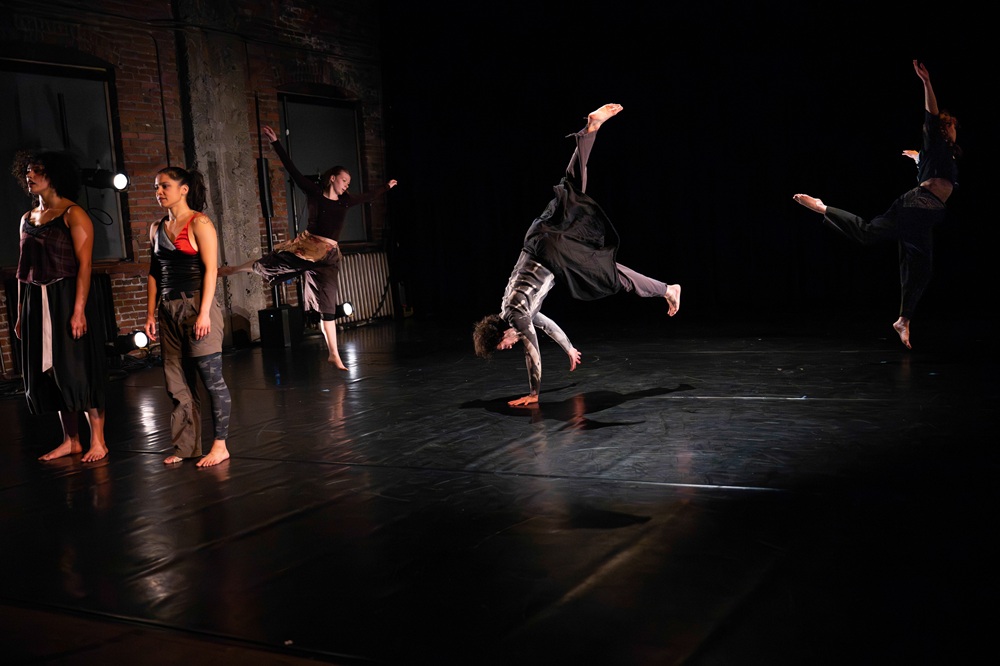
Choreographed by DiSipio, Soles in the Raw, was my favorite of the pieces that The Lady Hoofers presented. In their bare feet the dancers were able to drop their weight further into the floor, giving the movement more depth. I heard subtleties in the footwork that shoes would have obscured making this piece more about listening and less about sound.
Both Usiloquy and Lady Hoofers are relatively young companies who are dedicated in their respective missions. The stamping footwork of Bharatnatyham is part of a greater presentational whole, while the tap that the Lady Hoofers practice—the appropriately named rhythm tap—emphasizes the sound itself. While the one is more about dance as a theatrical medium, the other revels in the body as a musical instrument.
Usiloquoy Dance Designs and The Lady Hoofers, Painted Bride Art Center, February 22 and 23.