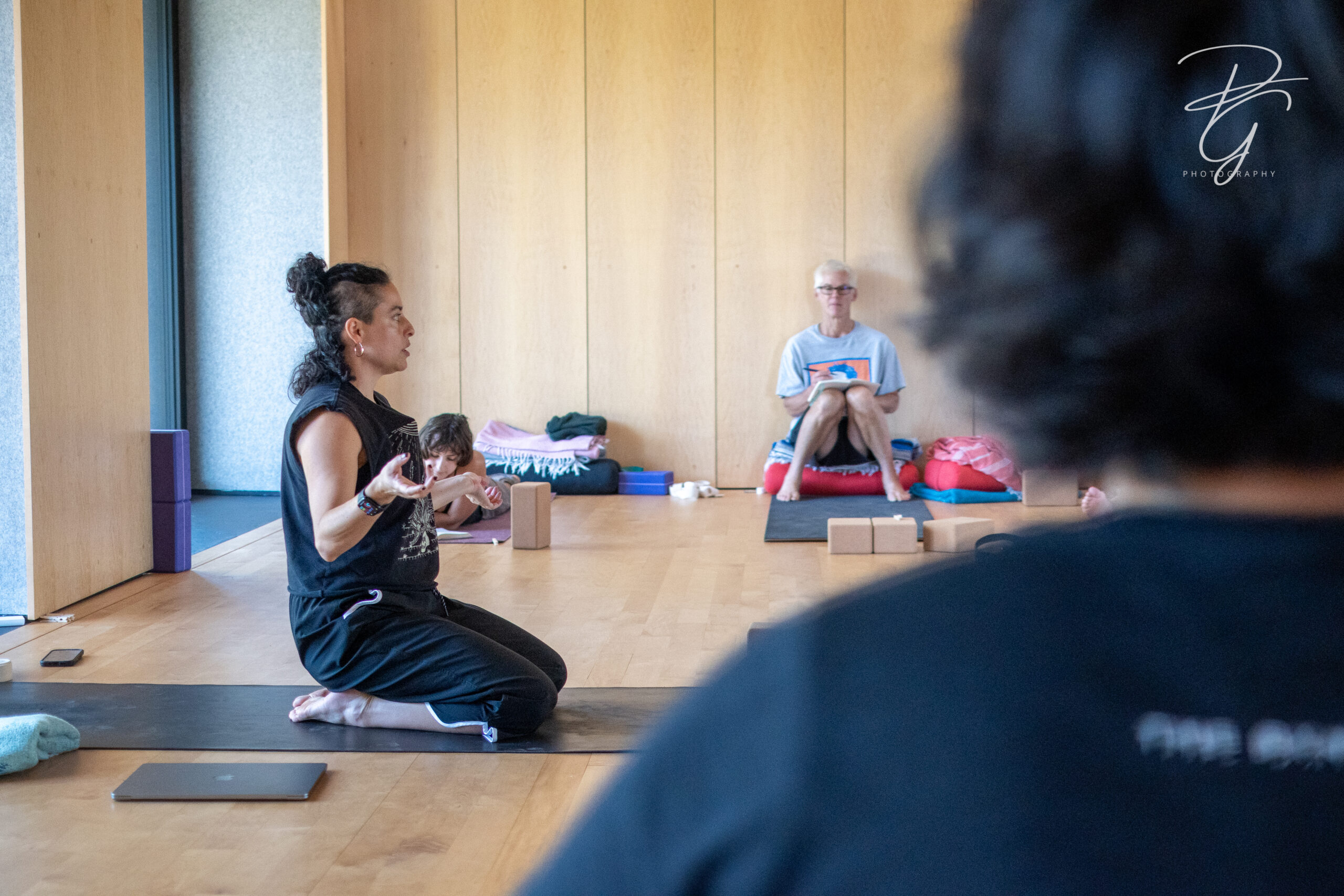
If you were in a room of professional dancers representing all genres, what would you ask them? This was my recent circumstance as a participant in the workshop that was a part of a weeklong residency with Bharatanatyam dancer Malavika Sarukkai, presented by SRUTI. Dancers with backgrounds ranging from contemporary, postmodern, breaking, somatics, percussive dance, acting, qui gong, tap, Bharatanatyam, theatre of the oppressed, Kathak, ballet, and more came together for a day full of introspection and cross-pollination. We were asked to introduce ourselves with a question.
We asked about ideas such as specificity and letting go, finding freedom within a form, culture and diversity, accessibility, spirituality, and social reform, among others. Our questions were revealing: what we asked gave some insight into our background and our interest–why we wanted to be a part of the workshop. The day featured Sarukkai alongside other facilitators: choreographer Kun-Yang Lin; Germaine Ingram, a jazz tap, rhythm and musicality expert; and Cunningham and post-modern dancer Valda Setterfield.
In writing this, I find it difficult to distill only one central idea, because so many pieces of the day are buzzing around, intersecting, becoming entwined in my mind. An illustrative example of the workshop’s tone is a concept from early in the day: Ingram, citing jazz musicians and Thomas DeFrantz, enlightened us about the break–a fundamental aesthetic in African American forms, where the pulse of a rhythm is interrupted by a flash of contradicting ideas. It is an unexpected, uncontrollable place where the flow of a work (or our communal sense of its pulse) is disrupted. Sarukkai likened the break to the silences in the rhythms that are so important in Bharatanatyam.
Hari Krishnan, who teaches the form at Wesleyan, added that historically, Bharatanatyam has had empty spaces, and it is the duty of a talented dancer to fill the empty spaces. The dancer must befriend the unknown and jump into the abyss of the solid structures the form’s framework provides. Sarukkai is famous for exactly this–in her dancing, she deconstructs the tempo and pace, surprises audiences with contemporary thinking in the classical form. “The excitement is in the break,” she says, in using it to bridge the gap between the audience’s perspective and the dancer’s experience. Ingram confirmed the same is true in her practice, stating, “the break is not just a transition but a very alive space–a way of grabbing the audience. And grabbing myself!–saying, ‘be present!’”
The potential of the break became a point of consensus among both participants and facilitators alike. No matter what our form, the freedom in that moment–its potential for expansion, exploration, dissolution, anticipation, even anarchy–united us as dancers. This active stillness was a commonality. Setterfield performed a simple but profound solo comprised of postures strung together, transforming into personages found in Edward Muybridge images. Lin showed footage of his dancers furiously engaged in their own rhythmical gesture phrases. Ingram on video, silhouetted in a windowed alcove, stomped, swayed, sang, and stammered to a 21-beat meter accompanied by a violinist. The pregnant pause also imbued the excerpts performed by Sarukkai, who transformed almost beyond recognition into raging 10-headed demon kings banishing their foes or shy, delicate women who tremor then open and warm in the presence of gods who love them.
This and so many other layers provided common ground. We spoke anatomically, of an upright spine, body weight slightly forward versus the soft muscle tone of release technique. We spoke poetically, of how a river surrenders into an ocean, like the journey of a seeker which is inherent in the symmetrical balance of Indian classical dance. We spoke about form–the power of simplicity, meters and counts, the larger meanings of unison movement. We spoke about artistry, and how a true artist goes beyond the gesture, using their whole body to communicate and personalize beyond the language of a dance.
But most of all we spoke a common language–that of our bodies. Body language is universal. Beyond our own culture or that of the form, we understand the rage in the stomped foot, wild eyes, or clenched fist. We see the gentleness and affection in the slow, soft embrace. And in the pause just before? No matter what our background or training, we, as dancers, see the potential for both in that moment.
Malavika Sarukkai Residency, presented by Sruti, The India Music and Dance Society, April 6-12, 2014. Professional Dancer’s Workshop held at the Painted Bride Art Center, April 10.