In Tender Buttons, her book of intensely modernist (and some would say nonsensical) prosepoems, Gertrude Stein wrote, “A large box is handily made of what is necessary to replace any substance.”
A theater is a large box. The Performance Garage is, certainly—even more than some. But what is necessary? In Necessary Efforts, the mixed-bill production by The Naked Stark, the answer offered is the work of making.
What substance did these necessary efforts seek to replace, or represent, or refer to? Or did they purposefully not so seek?
In Beau Hancock’s Mooring Field, he tethers two dancers (Marie Brown and Melissa Chisena) to each other, to the center of the stage, to repeated movement phrases, and to the study of the three esses: syntax, specificity, and stamina.
If I fail to say the dancers’ near-unison execution of minimalist phrases and gestures in different facings and configurations was riveting, it is only because I spent a long time trying to figure out why it was.
In flesh-colored 60s era not-quite-matching jumpsuits, the duo created different visions of the same fluid material. They were together but themselves, Chisena’s energy drawing in the audience while Brown’s precision created a tabula rasa—a blank slate upon which I could feel myself projecting meaning: about femininity, about futility, about domesticity and seduction-as-pleasure/seduction-as-chore.
The tremendous whitespace of the piece, the margin of stage around the tightly scripted dancers, the lack of jumps or turns or physical contact or traveling movement—all of it might have left me feeling trapped. It had the opposite effect. The work felt expansive.
Chisena and Brown kept close quarters, as do those who journey far in the confines of boat or plane or space- or relationship. Repetition in those situations is inevitable, and it begins to mean differently. The same words or actions gain nuance—slight changes in tone or bearing (or facing or tempo) become important. Mooring Field had this effect. It fed upon its limitations and grew.
Shannon Murphy’s solo work, City Bird Sings The Car Alarm was a more wide-ranging and uneven labor. Murphy played upon the art of burlesque, beginning by batting fake butterfly lashes to the rhythm of mockingbird song. When she released a dress to the floor only to reveal a near identical copy beneath, the audience tittered. Sloughing off black lingerie like so many skins, Murphy ratcheted toward a strained emotional crescendo, a placeholder for something not quite gotten-to.
Earlier on, when she peeled off one of the lashes from a distorted eyelid and offered it to a member of the audience, he reached to take it. She quickly withdrew the offer with perfectly calibrated sass—the kind of bravado that masks vulnerability. I wish I’d glimpsed more of this type of swerve between her mania and unprogressive undressings.
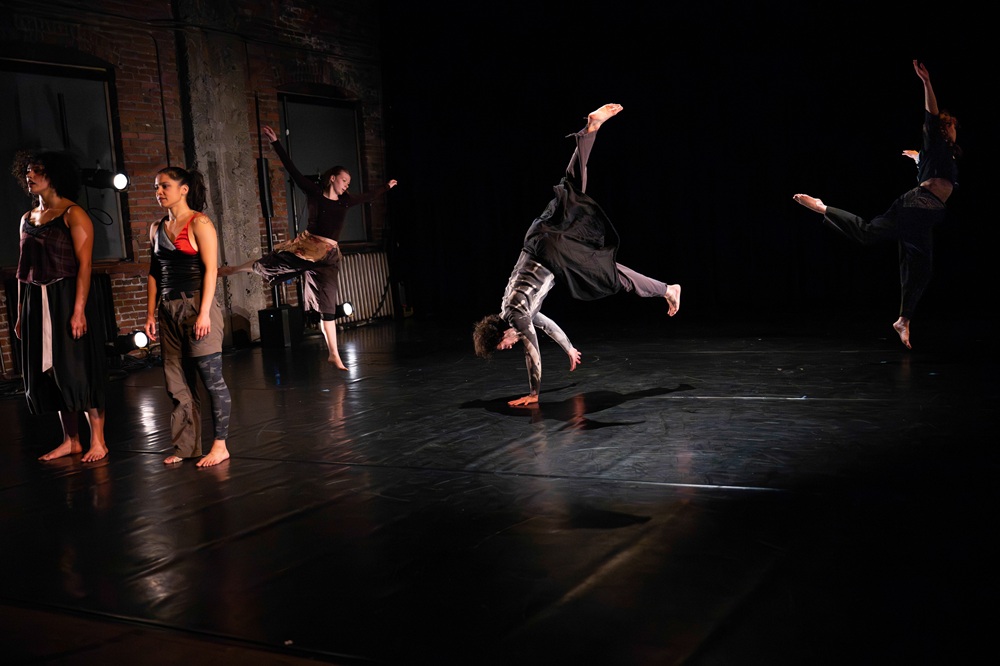
In Stranger Shells, Megan Stern meanders through a short searching solo with waltz-like phrasing and melting floorwork. Stern dances as if she’s made a deal with gravity: she’ll give into it more than other dancers/choreographers, but only if it—in turn—buoys her up like a drifting reed on the ocean of marley. A moment when she pauses while inverted, her fingertips reaching just there was startling in its sudden calm.
In Invisible LUs seven women are eventually edged out of the performance space by the chairs they set up: wooden chairs—traditional and modern—and one leather armchair imperious as a dead father. Although I was drawn to the fan-like swoop of the recurring movement phrase and the dancers’ weight-sharing interactions, the props kept intruding on my attention. Who was meant to be there? The dancers never sat. The dancers were the substance being replaced by these physical representations of absence, crowded out by so much nothing. These were bad chairs.
At the end, the dancers joined in the music being made offstage. The women took their places in a different environment, ceding much of the visual field to the inert bodies of furniture. The last chair placed on the stage by the last dancer was either doll- or fetus-sized. It was hard, I admit, to be quite as mad at that chair—which kind of made me mad.
Gertrude Stein wrote, “A large box is handily made of what is necessary to replace any substance.” Does the substance replaced matter? It can. To me, it does. Making boxes, however, is clearly the necessary thing—and the best boxes can not only hold any substance an audience may bring, but also offer it back to them in gift.
Necessary Efforts, A mixed-bill production by The Naked Stark, The Performance Garage, September 12-14. http://fringearts.com/event/necessary-efforts-3/