“Oil and water; those are the two that separate when you mix them, right? Because they have two different densities?” My roommate confirmed. It seemed ironic that the recurring image in my notes from (re)Union was one of division. Yet, my reaction to the miscellany of pieces by Venus Dance Company, REXDANCE, and Underground Danceworks (UDW) was written on almost every page: why separate the emotion from the movement?
A stuttering roll through the body, originating in Carrie Brzezinski’s right ankle, opened the evening. The kinks worked their way through her back like a row of dominoes cascading up her spine. “Beginnings” was the first in a series of short pieces featuring the dancers of Venus Dance Company, in collaboration with visual artist Anthe Capitan-Valais, whose live-motion drawings were projected on the backdrop. Charles Tyson’s choreography felt stream-of-consciousness, though not unpleasantly so: I visualized the thoughts bubbling up, coming to fruition, and fading away into another. The piece was sewn together by the motif of Brzezinski’s left arm cutting into her backspace, clipping the audience at eye level, and her right leg darting to the diagonal.
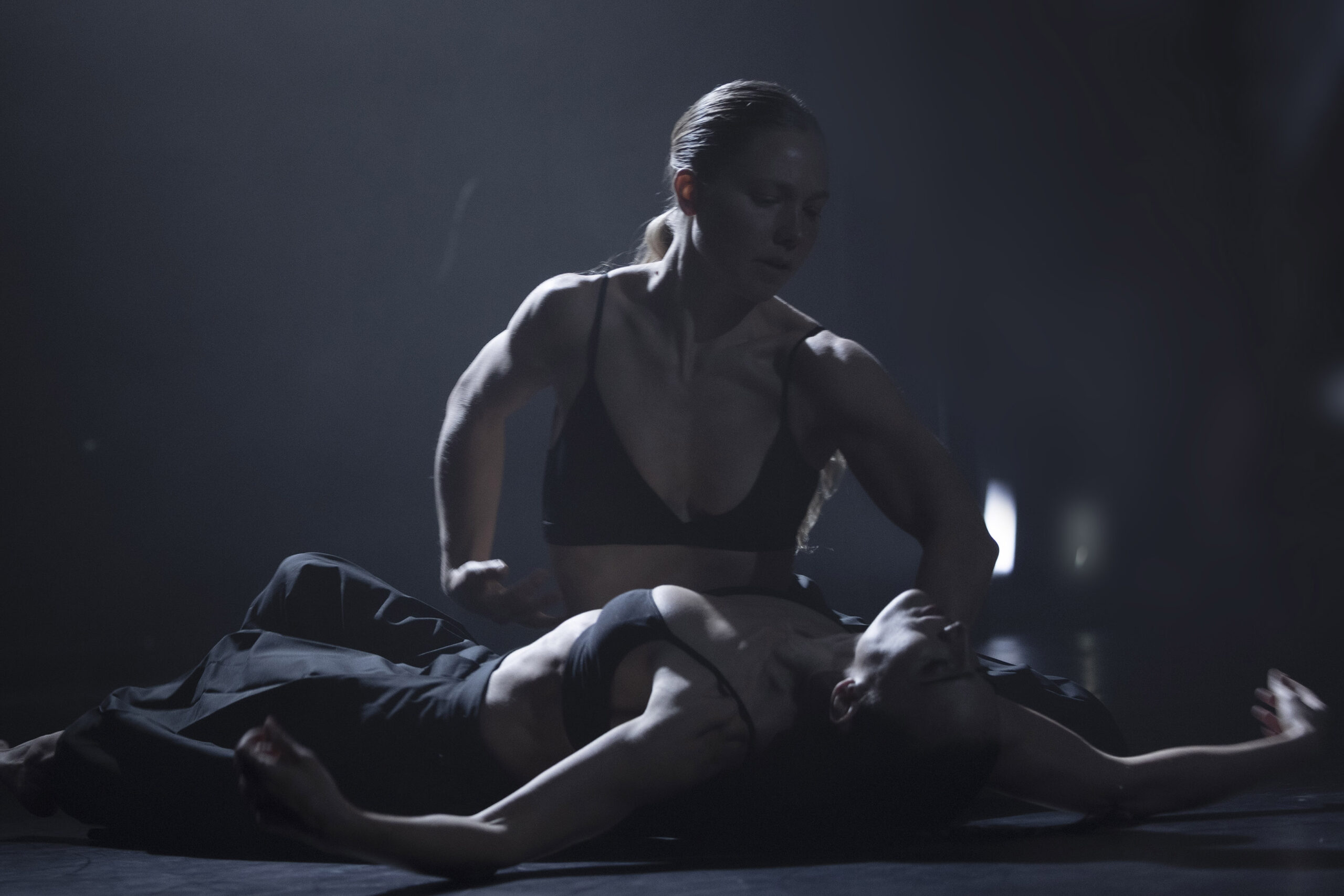
The choreography was strong in its aesthetic complexity, so why deflate it with the dancers’ moody, vacant looks into some nondescript distance? I was baffled. In one moment, dancers yanked each other by the arms across the stage in an apparent attempt to hinder one another; in the next, they bourréed downstage with arms in lofty V’s. No transition connected the melodrama to the movement. I could feel their different densities: the weighty anguish of the drama and the airy transparency of the movement. Worse, the choreography amidst the pantomiming seemed superfluous: thrown in for show but adding no depth emotionally.
The second half of the evening showed more promise both choreographically and conceptually. I exhaled a long “Yesssss” during the REXDANCE solo now. Melissa Rex strode onstage with the most defiant look on her face before swinging around and marching right off again. She re-entered, interspersing latitudinal gestures of the limbs with that same look: testing us, demanding, “Do you dare me?” Rex had me in the palm of her hand; I would have dared her to do anything. I didn’t miss music.
Of UDW’s work, I was most drawn to a grouping called triptych, introduced with the phrase, “This next work began as something completely different,” smartly projected onto the screen. The first of three sections, “Phrase 1,” was the kinetic equivalent of a cat’s hiss—slightly threatening, yet somehow demure. Stephanie Vasta countered drawn-out atmospheric music with agitated twitches in the second section, “Movement Study (With A Bench)”. She was agile and precise, throwing her torso into a backbend with a leg extended, then suddenly clutching the bench and scampering across the stage.
Tyson’s full company re-emerged to transition into the third section, “Steph-in-a-Box,” as they formed a wall around Vasta and inhibited her attempts to break out. Gaining momentum, she not only battered the body-barrier but allowed them to sweep her in an overhead lift that just teetered her on the edge of freedom. Though I failed to connect the first section and the others, I was satisfied by Tyson’s fearlessly quick choreography.
What are choreographers saying about dance as an art form if they separate the movement from the emotional content? I am no crusader against dramatic movement in a dance piece; what frustrated me was the separation between the theatrical gesture and the dance movement. While these might not be entirely homogenous artistic forms, can’t they be mixed together, combining their best elements to create something whole?
(re)Union; Venus Dance Company, REXDANCE, Underground Danceworks; Conwell Dance Theater; November 7-8.