The capacity crowd that turns out for BalletX’s fall season despite the bitter cold, emerges from the theater in high spirits buoyed by the strong dancing and choreography from three disparate choreographers.
Jorma Elo, resident choreographer for the Boston Ballet, combines excerpts of classical music – Berg, Mozart, Monteverdi and Bach – in his Gran Partita, taking us on a sensual and expansive journey of sound, movement and image. In a pre-show conversation moderated by thINKingDANCE editor-in-chief Lisa Kraus, Elo explained that he uses music to provide the structure for his choreography, allowing the dance total freedom to flow in any direction in relationship to that structure.
A diagonal wedge of light creates a sharply defined black and white world, highlighting the dancers’ leggy outlines as one, then a second appear, working the shadow and light. In contrast to sharp diagonals of light, lighting designer Drew Billiau also creates a gorgeous wash of grey that eliminates the corners and shape of the stage. Total film noir.
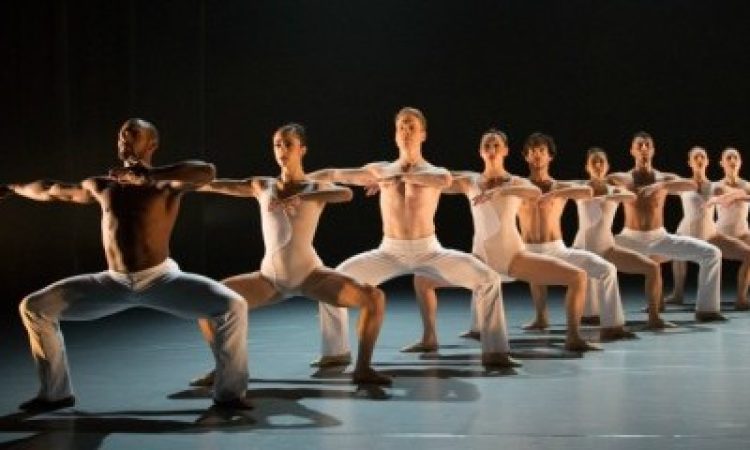
Gran Partita’s balletic movement vocabulary paints a constantly shifting landscape. In a large group section the dancers carry a theme of gently waving hands and arms, finishing phrases with arms overhead and a soft wrist undulation. They end this section on their knees, facing upstage, arms a raised field of sea grass. In the most allegro section the dancers push beyond a comfortable tempo and create a dance of sinew and angles. Scratchy violins give a bugs-on-the-skin feeling and the dancers are highly silhouetted by two wedges of light from opposite corners. This sublimely chaotic scene unfolds like a Hieronymus Bosch painting. Exquisite dancers Francesca Forcella and Gary W. Jeter II bring everything together in a duet of novel lifts and balances. The loveliness of their attentiveness—winding, unwinding, wrapping around each other and the space—summons the divine.
Where Elo creates space for unearthly beauty, Olivier Wevers’ Instantly Bound, confronts us with mortality, loss and separation, with rounded spines and compressed body language. A spotlight illuminates a crumpled dancer lying exposed. Figures stand on the fringe, motionless. Some appear bereft, some uninvolved, thrown together in contemplation of this scene. Wevers’ program notes explain that the work is inspired by loss and the formation of community around tragedies. Stark electronic accompaniment occasionally carries a machine gun sound. There are quiet and motionless patches contrasted with a communal rhythm picked up by all. A final duet seems to bring transcendence through connection – if only for the moment.
Joy emanates from every note, step and wriggle in Matthew Neenan’s Increasing. Choreographer and company all seem to find radiance in the luster of Schubert’s’ music, played live onstage by Curtis alumni. Pedestrian movement mixes with classical ballet technique in the name of play. Dancers relate to each other with nods and awkward clown movements and also get to plumb their virtuosities — super deep plies, rubbery spirals, breathcatching spins in the air. Movement phrases that begin in the ballet idiom easily shift to a more relaxed movement language, like repeatedly slinking the heels down for spins.
Neenan worked on the choreography as a parallel art to the music, as he explained in the pre-show talk; this meant, he said, that the dancers don’t count every beat. The happy result, which avoids the sometimes regimented feel of matching the music, is the appearance of no restraint and all flow – muscle, wing and humor.
As a lasting impression of the evening, I was especially moved by Gran Partita, by the riskiness and confidence Elo showed in laying the elements of the piece together and by the challenge to the dancers to push the boundaries of endurance and artistry.
BalletX Fall Series, Wilma Theater, Nov. 19-23.