Sometime in their past two to three years of conversations, which started at UCLA where Michael Sakamoto was getting his doctorate and Rennie Harris was teaching hip-hop, Harris asked Sakamoto to define butoh. “Chaos, contradiction and crisis,” Sakamoto replied. “Okay,” Harris responded, “that’s hip-hop.”
This commonality led the two—one the hip-hop master who first created hip-hop dance theater, and the other, a younger butoh-based performance artist—to bring their conversations, world-views and performance chops into one cypher of cross-cultural connectedness.
Butoh arose out of the post-World War II Japan of national defeat, Americanization, and a societal malaise that has continued through the decades. Its early creator, Hijikata Tatsumi, conceived it as embodying chaos and an early manifestation, ankoku buto, meant “dance of darkness.” Its grotesque gestures reflected a society in decay and dissolution. If the roots of hip-hop are viewed broadly, disenfranchised African-American and Latino youth created this amalgamation of ’60s and ’70s urban street dance forms as they confronted desolation and poverty and bore a legacy of centuries of institutional racism. Like the butoh artists of Japan, they upended the conventions of dance while responding physically and spiritually to their conditions.
The ‘body in crisis’
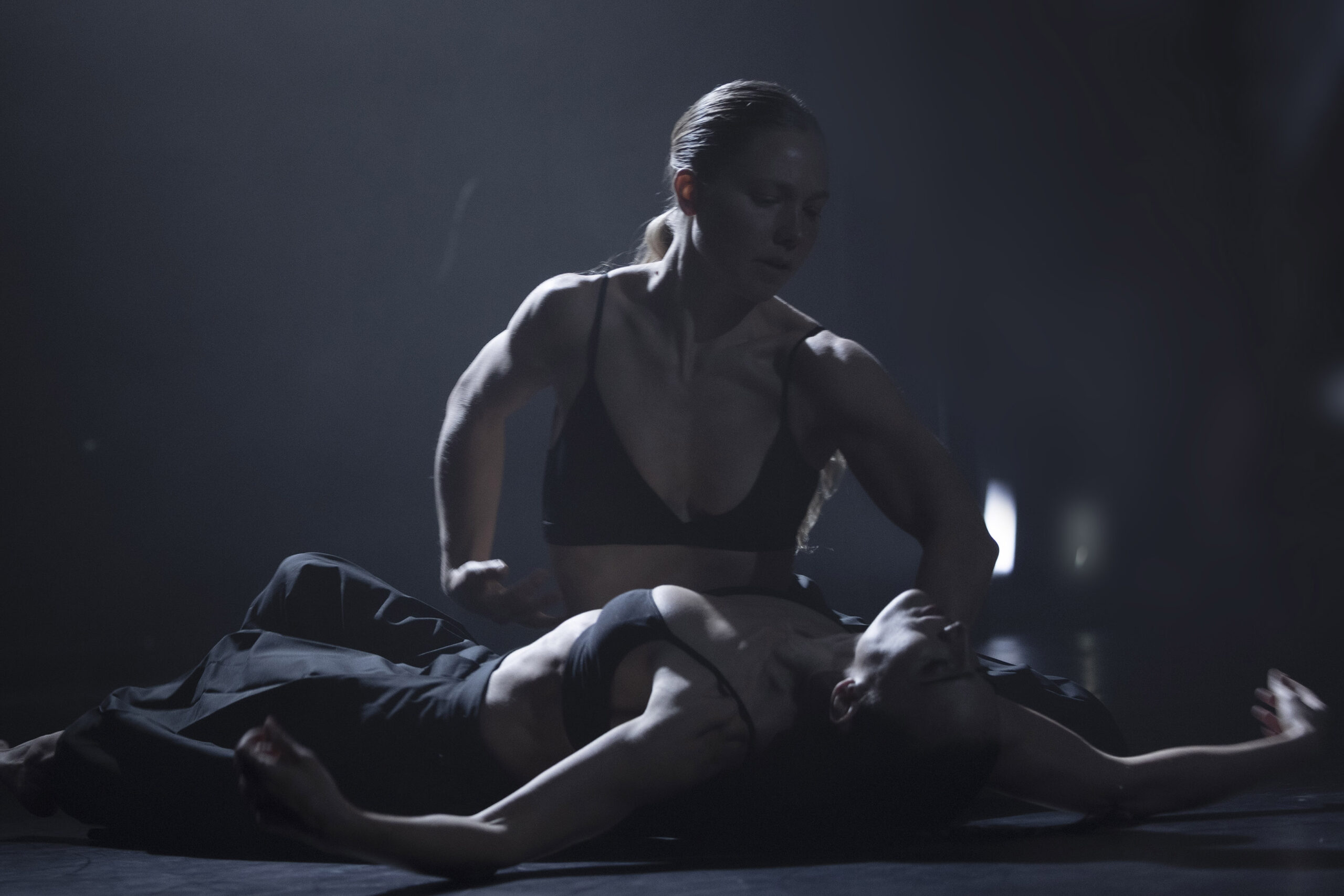
These commonalities may not be that apparent to people familiar with both modes. Perhaps in recognition of this, both Harris (decked out in an LA baseball cap, dark sweatshirt and pants covering his large 6’2” frame) and Sakamoto (thin, wiry with a red-checkered do-rag covering his head) began their dance theater duet, Flash, at the Painted Bride. They both were seated diagonally from each other at the far sides of a spot-lit center stage, often avoiding eye contact, distanced, uneasy, maybe suspicious. Harris asked, “How do you find structure culturally?” as he crumpled his large body, head a kilter, and locked one arm under his chin. Sakamoto, a popper in LA in his youth, moved with angular, disjointed breaks at knees, elbows and neck. He spoke of “things falling through your fingers as sand: it’s gone,” and introduced his concept of butoh as the “body in crisis.” Harris’s rejoinder: “Hip-hop always is in a crisis state.” He concluded this first section saying, “I always wanted to battle butoh artists,” humorously referencing both his respect for butoh and the unbutoh-like, competitive strains in hip-hop.
Harris related after the performance that his first connection to butoh came via a book of butoh masters that a former Philadelphia dancer, Roko Kawai, showed him in the early 1990s. He recalled exclaiming, “That’s popping!”, and admired butoh’s “shape-shifting in body and spirit to create illusions with the body.” Harris brought butoh aesthetic consciously into his searing solo, Lorenzo’s Oil (1995) after seeing a dead body floating in the Schuylkill River. His jerking, spasmodic muscles and freeze-framing of his states of terror revealed an inner anguish as well as an external oppressiveness. These also stood as brooding hallmarks of his earlier signature work, Endangered Species (1992). Hip-hop scholar Jeff Chang observes this cross-cultural use of popping and locking to embody similar emotional states in his essay, Dancing on the Through-Line: Rennie Harris and the Past and Future of Hip-Hop Dance. Harris is described as being “most interested in a ‘through-line’ in movement as a place where cultures cross.” Harris says, “I’m interested in those kinds of connections, and then challenging [the audience], and then playing with the through-line.”
Childhood trauma without healing
Harris’s and Sakamoto’s separate, sequential dances with spoken and recorded monologues focused on autobiography, especially of their youth. Sakamoto was the LA kid who was placed into foster care at birth by his teenaged parents. He related to me in an interview before the performance that his first remembrance as a child was of low-flying LA police helicopters, termed “ghetto birds,” shining their searchlights through windows into his crib. Menacing helicopter sounds appear intermittently in the Raphael Xavier and Sakamoto sound design for Flash.
With isolated jerks of his limbs and head, Harris recalled beginning as a paid dancer at age 14, stating, “I was no different from a prostitute.” Previously, Harris’s Endangered Species revealed his own childhood as witnessing and being the victim of physical violence and molestation, leading him to his depression and violence against others.
If butoh and hip-hop share roots in societal dislocations, Flash helps convince me that the “body in crisis” also has its origins in the chaos and traumas of childhood and family for which there may never be healing. This was especially apparent in the overriding sadness and pain evidenced in Harris’s twisted body shapes and anguished cries, all casting a spell over his performance. His rendition of Over the Rainbow was off-key and macabre. “From the moment you’re born, you’re in crisis,” he observed after the performance; “the body responds to changes in consciousness and the environment, but the body remains in crisis.”
A mask and a silent sobbing
Sakamoto was in almost nonstop, continuous, fleeting motion, every limb popping, with a particular focus on facial expression: disembodied smiles and grimaces of surprise, questioning, scorning, anguish and terror, a theatrical mask that added a stylized and alienating affect to his dances.
In contrast, Harris appeared more nuanced, and circumspect, with isolated and considered movements that could just be nervous flicks of the wrist or a silent sideways shuffling of feet. His performance more powerfully embodied his life and narratives with paroxsysmal jolts of muscular contractions in his popping; frozen moments of locking that accentuated, at one moment, the stark presence of a dysfunctional, dangling arm suggesting partial paralysis; his wide-open mouth and extended tongue, that reminded me of the war victims in Picasso’s Guernica; and a silent sobbing. According to Harris, who is 50, this was the first time he danced in performance in 10 years. He revealed himself still to be the hip-hop master, but with his virtuosity reserved and honed here solely to project emotional states.
Harris and Sakamoto’s dance ended with a ballad of desire, loss and desperation: “Little” Jimmy Scott’s cover of the Prince song, Nothing Compares 2 U. Their solos of slowed-motion popping and constricted bodies merged into unison movements of mutual pain. Two different cultures and worlds found their dance of darkness together.
Flash, Rennie Harris and Michael Sakamoto, Painted Bride Arts Center, December 12-13.