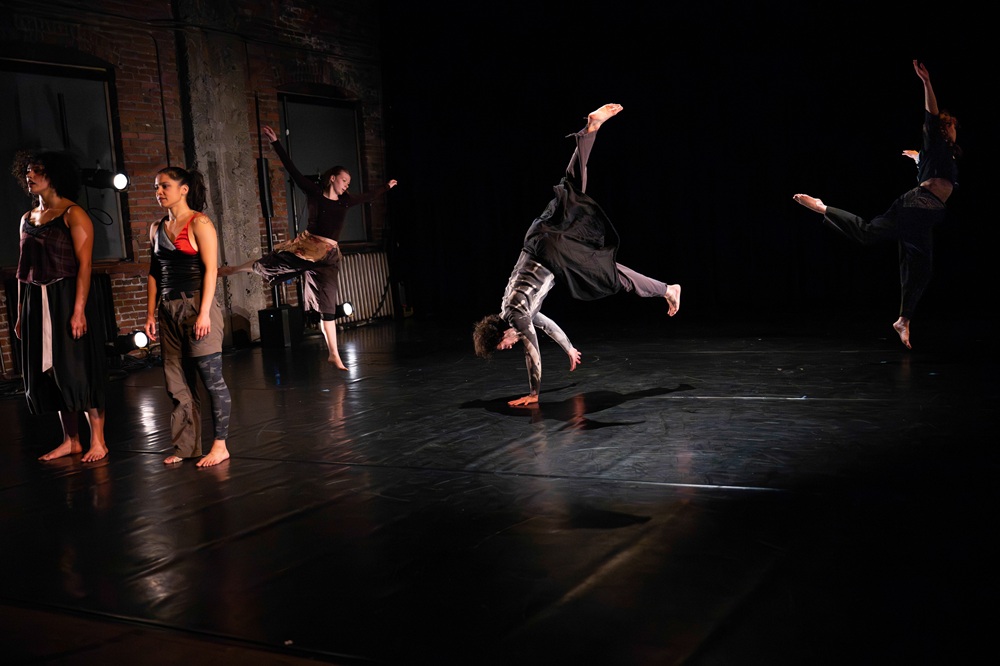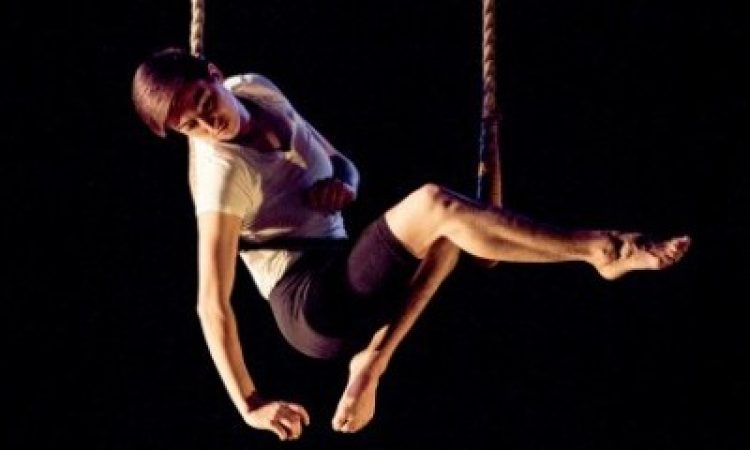
Emily Dickinson wrote, “Tell all the truth, but tell it slant” and closed that short poem with the lines, “The Truth must dazzle gradually / Or every man be blind —” I wanted to be dazzled by the Philadelphia-based Tangle Movement Arts production, Tell It Slant, at Christ Church Neighborhood House, but only a few of the pieces carried me near bedazzlement. The works, mostly choreographed by the performers, offered a range of approaches to aerialism. The production featured a crew of women—the program states the group’s “emphasis on queer and female experiences”—performing on trapezes, ropes, rings, and fabric swaths, and sometimes grooving around one another on the ground. Sampler, the outstanding piece in act one, was choreographed and performed by Los-Angeles-based aerialist Sal Nicolazzo. Perched on a trapeze suspended downstage right, Nicolazzo was visually counterbalanced by a line of four petticoat-clad women upstage left, standing still with their backs to us. Nicolazzo balanced tentatively as a voice-over text reported to us the story of a young English woman whose early nineteenth-century sampler, held at the Victoria and Albert Museum, records her story of loneliness, domestic service and abuse, and spinsterly life raising her sister’s daughter. The precarity of the movement, its slippages and awkward balances, and Nicolazzo’s investment in her performance made the trapeze a meaningful vehicle for the story the dance told. The quiet women standing upstage were simple and right. The second act’s strongest work, The Falling and the Catching,
featured Lauren Feldman and and Megan Gendell together on one trapeze. Both are listed as “Guest Artists” in the program notes, and appear to work primarily in New England. Their level of accomplishment, in both choreography and execution, lifted the show’s performance polish and movement complexity. In “The Falling,” Feldman and Gendell shaped, held, supported, interwove, and counterbalanced one another to the music and lyrics of “Falling, I Think I’m Falling … in Love with You.” Appropriately about love and falling, the movement’s combination of good humor, tenderness, and trust conveyed the story along with the lyrics of the song. The two performers, capable and invested, seemed genuinely affectionate with one another, and comfortable with the risks and embraces in the choreography. Both Thompson and Aid explored balances and supports afforded by the circus equipment, exposing each performer to us in different facings, inversions, stretches, and folds, using every joint and body part. Presenting such work up close, in the intimate space of the Neighborhood House, gave the audience a chance to see every finger, glance, and weight shift. It also allowed the choreographers to use not only the air but the ground as well—the mundane floor. And that was where the work revealed its weakness. Performers who looked powerful suspended from the ropes seemed insecure, unstable, unpolished in the simple dance and acting scenes set on the ground. While this was true even for the more accomplished soloists, the group works were, generally, the least effective, lacking clear intention or asking that the performers mime and mug scenes that had a lot going on but little of interest. The solo aerialists had more opportunity to show their blending of strength and flexibility, resulting in moments of arc, twirl, stretch, and inverted beauty that were lovely to behold, if fleeting. Throughout the show the simplicity of the costumes yielded focus to the movement itself, while the complex operation of preparing the equipment between works was deftly handled by cast and crew. No music or sound score was listed, let alone credited, in the program, although a range of sound was used—often pop songs, sometimes instrumental works, and two dances had recorded voices telling stories. Stronger (and acknowledged) sound supports would contribute much to the quality of Tangle’s programs.
Tell It Slant, Tangle Movement Arts, Christ Church Neighborhood House, March 12-14.