Imagine growing up your whole life understanding one thing about your family, and then discovering that it’s not true. It is the family secret: unknown, ancient, buried, discovered by you, the archaeologist with a personal stake in the treasure. Under Her Skin is an excavation of Jeanine McCain’s family secret. She discovers artifacts of her great grandmother, teasing apart the relationship between her and her abandoned daughter. Delving into her unknown history, she invites us into her process of discovery through visual installations, oral history, projections and movement.
McCain primes us with an “invitation”—a program tucked in an envelope containing a chocolate, a map, and a prompt: Does your family have a secret? From the beginning, we are engaged with concept. The Performance Garage is lined with antiques—pictures, clothes, wooden boxes filled with her family’s past. Recordings of McCain telling her great-grandmother’s story accompany us as we walk around the stage before being seated. She dances center stage in a red dress, crumbling and tearing newspapers, laying them on the ground and carefully stepping from one sheet to the next. We are invited to write down an ancestor’s name that later in the performance will be spoken—conjuring the histories of the audience.
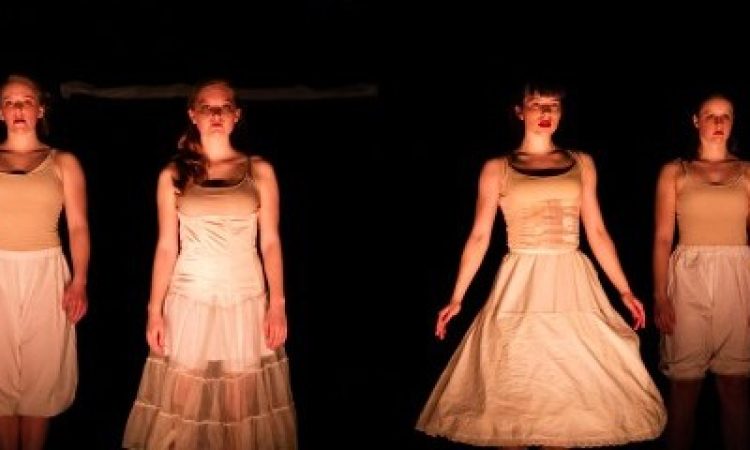
Six women wearing white slips stand before the audience, staring confrontationally before dropping into a rhythmic cannon. Bending over at a shallow angle, they turn over their hands and clap. They sweep their elbows back along their sides, following their hands with their eyes, all while exhaling harshly, “hut, hut, hut, hut….” This rhythmic phrase is repeated until one woman accelerates and frantically finishes in a scream.
As one woman paces behind the group, she commands, “Left, right, left, right, left…” The remaining five women pose femininely, like army women pin-ups. They turn upstage and march, exaggerating their steps as they travel, gradually breaking into laughter. According to her story, McCain’s great-grandmother joined the Women’s Army Corps after secretly birthing her daughter (McCain’s grandmother) without having been married. This image of women marching into laughter was the most effective of the evening: it communicated the complicated experience and portrayal of women at the time of World War II.
I’m curious to know if McCain feels finished with this work. Some of her choreographic choices were very strong in portraying the images of her family’s past. Other choices seemed to stray into abstraction, which communicated less to me viscerally. However, right from the beginning, the experience of this multi-media performance was very engaging. She created an environment conducive to discovery and nostalgia, and when the lights went out, I was left wanting more.
Under Her Skin, Jeanine McCain, The Performance Garage, September 4-5.