How do you feel when you see the word NIGGER?
What are white people allowed to say without sounding racist?
Does comedy eliminate the seriousness of a situation or does it provide a means of accessibility?
These were some questions I had while watching Underground Railroad Game.
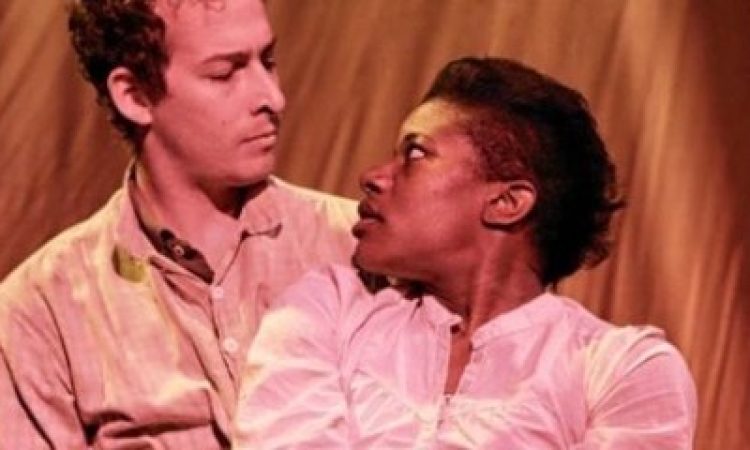
Created and performed by Jenn Kidwell, a black female, and Scott Sheppard, a white male, Underground Railroad Game was a warped satire that used humor and witty banter to deal with the politics of race and sex.
The play’s first act introduced the audience to a runaway slave and a seemingly altruistic Amish man dressed in characteristic farm attire. The story launched into a dynamic exchange that established Sheppard’s work in the historic Underground Railroad. Spanning time and featuring multiple characters, Railroad took us from the 1700s to a history class taught, today, by the frenzied duo.
As Miss Annabelle, Kidwell channeled a funny, storytelling indoor slave who would eventually undress to reveal her naked flesh.
A slave—exposed.
A black woman—exposed.
A white man resting his head on the black woman’s exposed abdomen.
I saw the black woman willingly using her body as a place of comfort for him;
it was then that I felt Kidwell and Sheppard were taking me on a journey for which I had severely underpacked.
Another scene simulated a slave on the auction block, except the person atop the block was Sheppard, a white man. Kidwell examined every inch of his body, from his fingers to his scrotum. In this fantasy role-play, Kidwell asked Sheppard to repeatedly yell “Nigger”—to me an insensitive joke about the experiences of black men and women. While it might be said that this exercise gave the white man a taste of his own medicine, I contend that it’s easy to play a game, but he’ll never experience the negative aftermath of such an occurrence.
Underground Railroad Game gets a B for attempting to dissect the construct of race and shed light on a tainted history that we can confront in order to effect change. Race is undoubtedly one of the hardest issues to address and while Underground Railroad Game forced us to ask many questions, it offered few—make that no—answers. With no tools or ammunition to prepare us for opening Pandora’s box, we are left right back where we started.Underground Railroad Game, Jenn Kidwell, Scott Sheppard with Lightning Rod Special, Christ Church Neighborhood House, September 2– 6, 9–12, http://fringearts.com/event/underground-railroad-game-9/