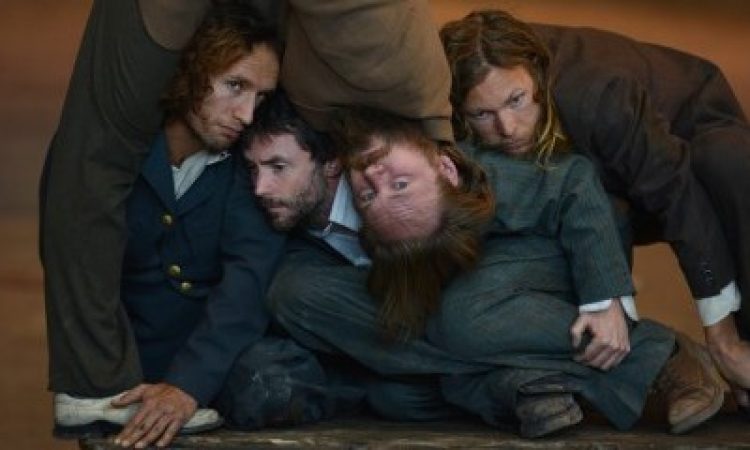
Combat, cooperation, glares, spitting, slapping, sarcasm. Despair, distress, giggling, boredom, support, togetherness. These were the wavering actions and emotions of four men, dissidents of the former Soviet Union, as they examined their relationships to one another, their homeland, and their futures. Their feelings and intentions might have been frequently vacillating, but they were always allies.
There was one of three shows from Jo Strømgren Kompani at this year’s Fringe Festival. The Scandinavian company presented dance-theater with elements of slapstick comedy, utilizing “nonsensical ‘Sovietic’ language. Through fictional vocabulary, the characters relied heavily on their tones and inflection in tandem with nonverbal communication.
Two characters stood on the stage, staring absently into the distance, as the over-capacitated theater continued to fill. They laughed hysterically, making an already dismal environment more uncomfortable. A third entered the scene. Suspicion, curiosity, and distrust emanated as they awkwardly avoided each other’s threatening glances. Amusement at a shared sight united them and they were bound like brothers thenceforth.
The three shifted attention to a large box on the stage. They peeked inside, then rolled it over multiple times before lifting it in the air and shaking out its contents. “Thud!” A fourth man spilled onto the floor, curled in a ball. Regardless of the others’ poking, prodding, and pulling, he remained frozen in fear. After comedic attempts at unraveling him, he jumped to his feet, hissing and hitting. He, too, was eventually accepted into the group, though always vaguely identified as an outsider. They continually mocked him for mispronunciations and played pranks behind his back. Yet, especially in their dancing, there was ongoing support, evidenced in balletic lifts, by how they physically carried one another.
Another crate held nesting boxes, which the men unstacked in a diagonal line extending between corners of the space. One found images in each of the boxes, which he collected and held close to his chest. He bowed to the smallest box before gently dancing with it in a cradling position. The boxes were strategically reassembled into a vertical column, where they remained until the end.
Towards the conclusion, they began to shout, frantically condensing the boxes into a jumble and pointing into the distance. Their energy lowered as they approached each box with heaviness, as if viewing coffins. The outsider was especially remorseful, perhaps because of losing family in his homeland. He stepped into some boxes and walked around others, as if navigating his family tree, again cradling the final, smallest box. Ideas of future deaths, fear of the unknown, and walking forward from the past resonated.
The radio onstage existed as a fifth character, emitting horrific sounds of screaming, news reports, static noise, and music. One of the men was shocked to find he couldn’t change the station—an indication of the government’s omnipresence. As they continued on a journey between familiar culture and new land, they endured apprehension, pride, sorrow, and confusion. Their struggles with their deeply embedded heritage bound them together as they stepped towards an unforeseen fate.
There, Jo Strømgren Kompani, FringeArts, September 9-12, http://jskompani.no/.