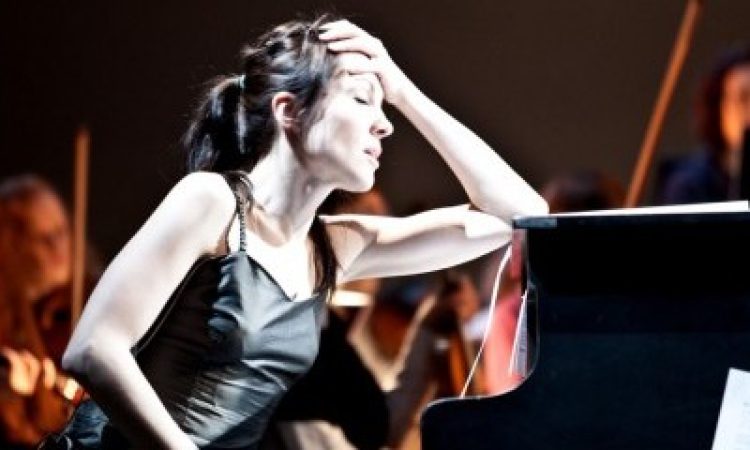
Despite the title—Chopin Without Piano—the first thing co-creator/performer Barbara Wysocka does upon entering the stage at FringeArts is sit down at a grand piano. She looks down at the keys, as if preparing to play. Conductor Bassem Akiki raises his hands, and as The Chamber Orchestra of Philadelphia begins the bold, boastful opening chords of Frédéric Chopin’s Piano Concerto No.1 in EMinor, Op. 11, Wysocka’s head moves heavily with the music, following notes and phrases, awaiting her entrance.
Four minutes of orchestral performance pass by, Wysocka waiting with a musician’s neutrality. Finally, a tense pause is broken not by the jarring piano entrance that Chopin wrote, but by Wysocka’s first words: “Exposition of the majestic theme.” “It has to be played fortissimo,” she adds.
She continues to narrate: “the left hand continues to lull us to sleep while the right dramatizes / phrases become unfocused / a tritone appears.” (All quotations and line breaks are drawn exactly from the script provided at the performance.) Instead of Chopin’s piano composition, we hear the piano part narrated.
Wysocka is part fluent lecturer and part virtuoso. She portrays the lecturer’s intellectual impatience, delivering the speech with artful variation of rhythm, speaking at some points too many words in too little time, rapping them out with incredible rapidity, playing the variations of rhythm and mood in Chopin’s composition. She builds up the speed to such heights I cannot help comparing her to a percussion instrument, a double-bass drum solo. Then she cuts the speed, and smiles knowingly at us as she continues, sly and smug as a slap-bass riff.
“Everything I have seen abroad seems old, unbearable / what once seemed great is now common / and what previously seemed common / now seems awkward, extraordinary, too great, too tall.”
The performance, co-created by Wysocka and director Michał Zadara, is broken into sections that follow the sections of Chopin’s musical score. Over the second section, the Larghetto, Wysocka abandons the trope of narrating the piano, and instead performs as Chopin himself, reciting portions of his letters.
The words carry a tone of self-pity, which Wysocka doesn’t play up. Rather, she performs the sickly composer’s intellectual arrogance, cleverness, and boredom—sarcasm with a razor-sharp smile. “Paris — each breath is sweet — / at every step a poster for venereal disease.”
Wysocka portrays a Chopin who has left Warsaw out of disgust and claustrophobia. This weak, angry man becomes a battering ram she smashes against the anti-intellectual nationalism—“That immortal Polish thoughtlessness!”—which claims the composer as a pillar of Polish greatness. Later sections trip between personifying Chopin and further interpretive monologues. “He took the fatherland into his arms,” she quotes sarcastically, “and transformed it into magical rhythms.”
“Why!” she cries. “Who are we / people listening to Chopin or playing Chopin / why do we go on doing it / what is our culture doing by playing and playing / Chopin over and over again?”
By replacing Chopin’s piano concertos with monologues of their own devising, subverting the composer’s primacy, Wysocka and Zadara also nod slyly to the ultimate irony: that we cannot ever play Chopin. Even the conductor of a traditional concert, by default, asserts his or her will over Chopin’s, simply by taking him in hand.
Chopin Without Piano uses music in its dramatic application to reveal the way cultural revolutionaries are treated as cultural capital by appropriative governments. The art that is censored in one totalitarian regime is candy-coated by the next. (See, for instance, Hitler’s deep appreciation of Frederich Schiller, or the Germans’ and the Czechs’ fighting over Kafka.) Zadara and Wysocka, guerilla-style (the program proclaims this a “guerilla piece”) sneak into the gilded halls of nationalism to plant a bomb at the base of Chopin’s milky-white statue.
Michał Zadara & Barbara Wysocka, Chopin Without Piano, FringeArts, October 28-31, http://fringearts.com/event/chopin-without-piano-3/2015-10-28/.