Los Angeles is infamous for its traffic. The evening of work that LA-based company BODYTRAFFIC presented at the Prince Theater felt congested.
In The New 45 by Richard Siegal, two dancers performed a duet to jazz music by Oscar Peterson and Harry Belafonte (to name a few). Their dancing was frenetic as they embodied the instrumentals—the plucking of an upright bass, the buzz of a cymbal, the staccato punch of a vocalist scatting. Trying to sell fun, they did not appear to be having fun themselves. Guzmán Rosado performed a solo that grounded the work, pulling together loose ends. Rosado’s focus and control reined in the distracted energy of the piece. Much of the movement—a kind of triplet, crouches, undulations—were taken from African diasporic vocabulary, but performed stiffly, lost in translation.
Despite this, the talented performers of BODYTRAFFIC worked with what they had, as was also the case in Fragile Dwellings (Stijn Celis) and A Trick of the Light (Joshua L. Peugh). In both, the choreography felt familiar and recycled, revealing a strong, versatile contemporary company performing a stale repertoire.
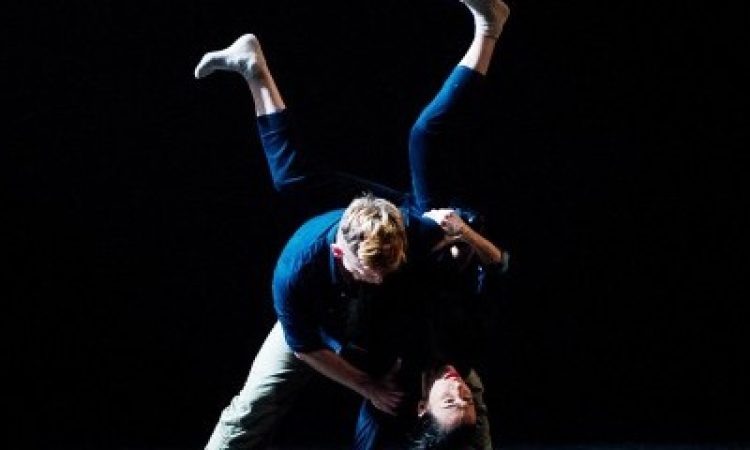
Victor Quijada’s Once again, before you go was a much better fit for the company. James Gregg entered the space, looking like a video played in reverse. He moved through elements of breakdance, capoeira, jooking, locking, and popping. Two men joined the lone dancer, followed by a single woman. The dancers were slipping and sliding on the floor and on each other; with each movement, they carved through space, warping it as they traveled through. The lighting went dark: they were finding their way, mobilizing, ready to set forth on a journey—destination unknown. It didn’t matter; I wanted to go with them. They found the light as they walked through darkness. With one touch, the female dancer took the three men down. Slipping and swirling on the floor, they moved swiftly like scorpions, but smoothly like mercury. We were in the midst of a trippy dream—perhaps a vision one might have just as fever breaks. To a languid, echoing piano tune (by Jasper Gahunia), it all slowed down. They floated through each other and the space, and then away.
In A Trick of the Light, three couples slow danced to ’50s music. One pair broke off, throwing each other around—reminiscent of Twyla Tharp’s duet to Frank Sinatra’s “That’s Life.” A man entered and tapped another on the shoulder, taking his turn to dance with the woman. I saw the passing of time, as we move from one partner to the other in the course of life. Endless combinations of duets and solos appeared and disappeared, a wild ride without proper punctuation—a circus of limbs and turns. Later, Guzmán Rosado appeared downstage, wrestling with a thick rope as he attempted to lead a dog—or perhaps a human—onto the stage. He disappeared into the opposite wing. As the end of the rope emerged, so did Rosado—on the same side he had just entered. Later, a man and woman wearing ’50s undergarments performed a duet, approaching each other tenderly, delicately, careful not to break one another. A woman entered atop a man’s shoulders, blowing confetti on the pair in underwear as she swanned past. They exited, and the circus returned: too much, too long. The dancers jauntily hopped around a silver mylar curtain. One dancer climbed a ladder to dangle a disco ball above another couple. As the man dipped his partner, a sign that read “The End” appeared. The lights cut, leaving us in a ’50s daze as the music continued to play. The only problem was that I had stopped listening about two songs ago.BODYTRAFFIC, Prince Theater, November 4-8, http://princetheater.org/events/bodytraffic