Day one of < fidget >’s 6th Annual Fall Experimental Music Festival is called Space, Pulse, Pat-tern, Presence, but it could easily be called Disorientation. Four short pieces, though they differ wildly in tone, form, humor, movement, and medium, use deliberately counterintuitive elements to evoke mystery, suspense, and even confusion.
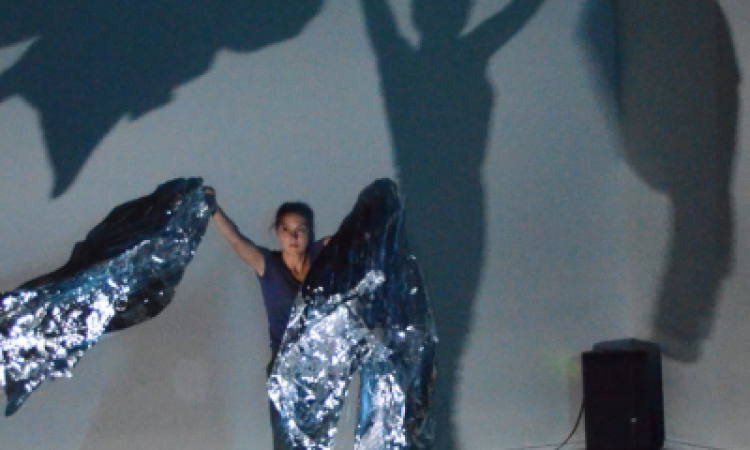
dark matter, a video by Zornitsa Stoyanova with live music by Michael McDermott, opens the night. Silvery foil paper, crumpled into the shape of a cave, stands on the stage. As the lights dim, Stoyanova enters, performs a short dance exploring the way this material moves, then lays out a sheet of flat foil. She shines colored flashlights on it, which reflect in spots on the walls, casting organic, cellular-looking refractions. As she explores, jagged mountains and valleys, or rows of bone, seem to make up the smooth, sheer surface of the foil.
In the video, a symmetrical image of what looks like a small, dark cave is struck by a pulsing light, begins to expand and contract kaleidoscopically, and bursts open when a segment of leg appears—a dancer inside the foil. Just as the image starts to coalesce into a body, that body moves quickly toward the camera, and we lose it. Dancing bodies, through fragmented video, are reduced to visual elements and the impression of motion.
The second work is SP3, a work-in-progress collaboration between curators Peter Price and Megan Bridge. Price has composed an acoustic, cha-cha-sounding percussive track. Its chaotic texture, with instruments weaving rapidly in and out of the lead position—now wood block, now cymbal, now snares—stands in direct contrast to its regular, deliberate rhythm.
Twelve dancers begin by strolling with feigned casualness, simply replicating the pulsing beat. One dancer excises herself to perform a short, pop-and-locky solo, and quickly the dance be-comes a series of variations on this. Stationary performers execute flowing movements of the arms and core, punctuated regularly with seizing joints. This comments on Price’s contrast be-tween form and improvisational flow, and reaches back to the magnetic pull between form and chaos in Stoyanova’s video.
Bromp Treb’s outlandish clown act could not be more different. He introduces the second half of the night by stomping around the room, outrageous ducklips planted on a scrunched face, as he takes long, exaggerated strides and whips his mic cords spastically. Treb plays a spaced-out\electronic musician with a healthy helping of Jack Black high-kicks. The first song has barely any “music” in it. Treb whacks a wood block with a drum stick and jams silently to inaudible vibrations, drawing tension out of nothingness.
id m theft able (that’s one name, pronounced “ID-dum THEFT-a-ble”), a stout, viking-looking man with a huge red beard, stands behind a rickety table bowing at the middle under a panoply of noise-making instruments. He begins to speak quickly, the same words over and over: “lately when I come to these things” in different variations—“lately lately lately lately, lately when I come to, lately when I come to, when I come to these things” etc. Employing a vast toolbox of elements—pitch, unvoiced sound, tempo, beat, repetition, and noises like clicking and snorting and pulling at his lips—he builds an acoustic word-symphony of incredible variety.
Without warning, he crashes into an electronic clamor. The noises created with his table of toys changes with intense rapidity, and unlike Treb—who could hold a single electronic device and twist it for long seconds, digging into a single sound—theft able’s hands move with unreal rapidity among the many devices.
Suddenly there’s a pause, and nothing but the sound of children recorded on an old record. This lasts maybe two and a half, three seconds, then is cut off by more noise, but the moment drips with stillness and importance. theft able has created a sound world that moves too quickly to believe, where melody and even tempo are difficult but not impossible to find, with almost constant surprise in the changing of a kind of sound, the introduction of a new toy—so any stillness feels like profound peace.
Disclosure: Megan Bridge is executive director of thINKingDANCE
Fall Experimental Music Festival, < fidget >, November 6-7. www.thefidget.org/