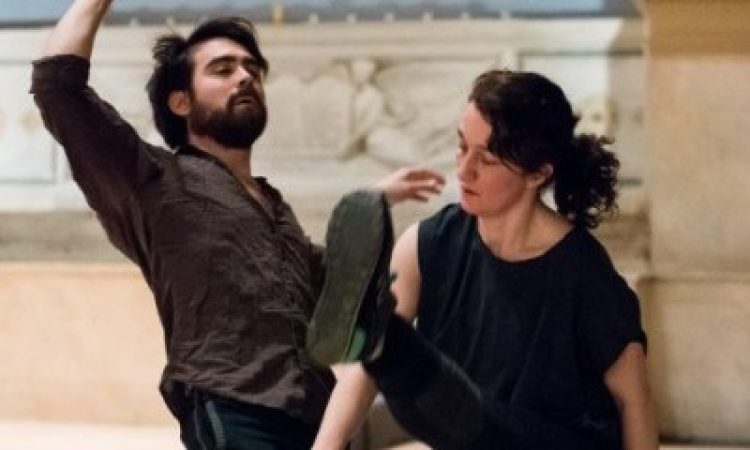
Photo: Ian Douglas
Photo: Ian Douglas

Jeanine Durning’s “inging” & “to being”

Editor’s note: thINKing DANCE is excited to be sharing articles with our friends at Culturebot. Please let us know how you are enjoying the conversation.
___


 “I’m gonna show you my soul, there, the sole of my foot,” she says.

“…she says, as she faces her frontal plane towards your sagittal plane,” she says.

“I mean, Judson has left the building, right? Did I just say that?” she says.

I must be paraphrasing.

Jeanine Durning doesn’t weight any phrase more than any other in inging, and I wasn’t taking notes. (I am adamant that a person should not take notes during performance.) Rather, her stream-of-consciousness quite literally streams. We are riding the rapids.

In inging, Durning speaks, without stopping, without script, for roughly 30 minutes.

I first caught wind of inging, “part-spoken word performance, part reverie, part dance, part oral biography, part meditation and psychotherapy,” when Durning performed the work as part of American Realness in 2013. What caught my interest was the title.

inging; A more delightfully succinct description I can’t imagine. The language-based suffix that describes being “in the process of,” being the process itself. The word-equivalent of a Möbius strip.

Read the full article by Rennie McDougall at Culturebot.

___

Originally published October 7th, 2015 at culturebot.org.

By Rennie McDougall

Share this article

PARTNER CONTENT

Keep Reading

The Leaders Behind the Headlines: Conversations with the Kennedy Center’s [Terminated] Dance Programming Team

Ashayla Byrd

What happens when political agendas take precedence over a nation’s desire to feel seen and supported in artistic spaces?

A group of five individuals, dressed in business attire, all gather together for a selfie in the velvet-carpeted lobby of the John F. Kennedy Center for the Performing Arts. Jane, at the front left, is a white, brunette woman with a medium pixie cut. Clad in a magenta blazer and black turtleneck, Jane dons a bright, bespectacled smile. Grinning behind Jane, Mallory, a white woman with dirty blonde hair, wears a black and white gingham dress and holds a silver clasp. Malik, a tawny-skinned Black man in a black button-down and trousers, stands beaming at Mallory’s left. Allison and Chloe, dressed in a white button-down and a floral dress respectively, lean into the photo, offering their smiles as well.
Photo courtesy of Ashayla Byrd

Long Live the Queen

Brendan McCall

It’s 1963 and 2025 and Richard Move IS Martha Graham

Lisa Kron, playing dance critic Walter Terry, has short brown hair, is dressed in a tan suit and wears thick-rimmed glasses, sits with their legs crossed and a notebook on top of their lap. Opposite, Richard Move as dance icon Martha Graham sits regally in a long dark dress, their hair up in a bun, and their eyes highlighted with dramatic eyeliner. Between them, is a small table with a vase of white flowers, and behind them are two women in a unison dance shape: bowed forward, with one leg extended high up behind them.
Photo: Andrea Mohin