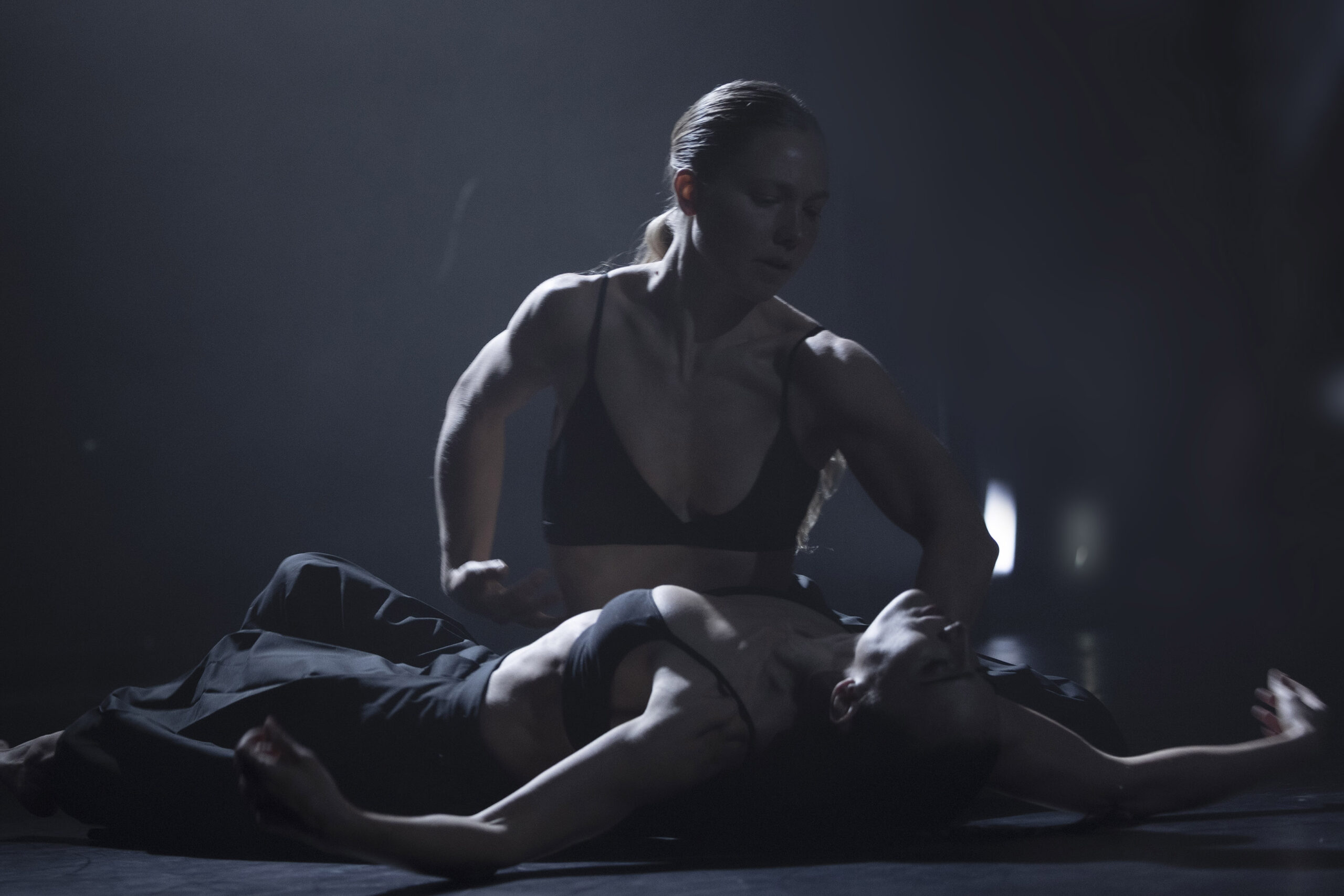
Before there are bodies in Czechoslovakian-born choreographer Pavel Zuštiak’s production of Custodians of Beauty, there is thrumming, resonant sound by Christian Frederickson, and frenetic, abstract video projection by Simon Harding. And when bodies do first appear, they are barely recognizable as such. Subtly lit by Joe Levasseur, and separated from the audience by a gauzy scrim, they move as an indistinct mass, abstracted, amorphous, and hazy. Watching them is like witnessing a birth, yet from a great distance—romanticized, and with none of the bloody details present. The bodies continue furling and unfurling, flesh peeking out from dark folds of fabric.
The image disappears abruptly in a blackout, and when the stage reappears, it is transformed, now crisply visible and seemingly barren. The absence of both bodies and the diaphanous barrier of the scrim is unexpectedly flustering, the shift lending a clarity that makes it impossible not to see the reality of the place, not to notice the reality of my body—here I am, in my seat, at the American Dance Institute, in Rockville, Maryland.
Palissimo Company, Zuštiak’s NYC-based platform for interdisciplinary collaboration and research, was in residence as part of the American Dance Institute’s Incubator Series, in which artists are given a full week in the theater to work with collaborators and technical design elements. For Zuštiak, who describes this new work as an equal layering of dance, set design, sound, and lighting, time to hone technical elements is key. I visited mid-week, sitting in on cue-to-cue rehearsals, watching as the tedious process of refining theatrical elements gave way to brilliant confluences of sound and light.
Zuštiak says that early influences on Custodians of Beauty were Alva Noë’s book, Action in Perception, which posits that perception is not something that happens to us, but is an embodied action, and Susan Sontag’s essay, “An argument about beauty,” which redefines beauty as a “gladness to the senses” rather than as some pinnacle of bodily perfection. Custodians of Beauty, a title that comes from a 2009 speech by Pope Benedict XVI in which he praises artists for their diligent work in preserving beauty in the world, highlights perception and our unique experience of it.
Late in the work, there is projected text of a conversation between two people leaving a show. One describes a transcendent experience that left them shaking, taken away from their body—I didn’t realize I was crying until it was over—while the other was unmoved, and thought of nothing but their own body—I was thinking of dessert through the whole thing.
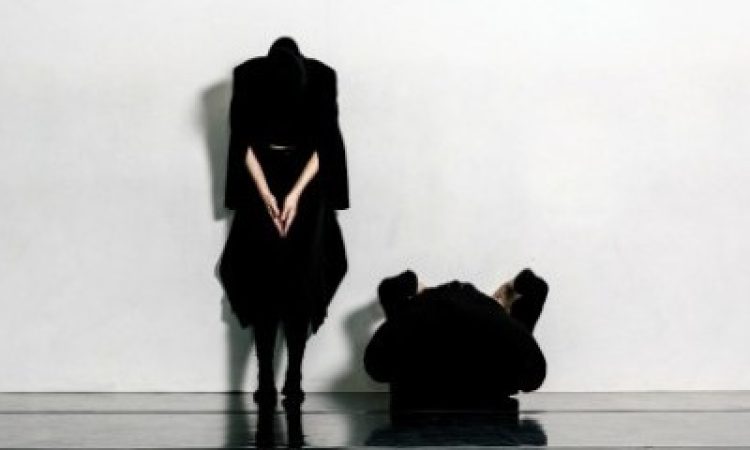
Rather than creating a hierarchy between transcendence and earthly presence, Zuštiak’s work gives equal weight to both. Dancers Nicholas Bruder, Emma Judkins and Justin Morrison are oscillating beings. First, they are otherworldly, darkly cloaked in costumes by Ásta Bennie Hostetter, insect-like as they weave their limbs through each other in symmetric patterns, before transforming to everyday folks in practice attire, adjusting their underwear and appearing fazed as they peer out into the audience.
These contrasting images create tectonic shifts in my own body. I surrender to their persistent and provocative beauty, my attention rapt with images unfolding onstage. And equally, there is the consistent reminder of my own presence, my own sensory existence and temporal and spatial positioning. This is facilitated by Zuštiak’s and the designers’ manipulation of sensory stimuli. Levasseur’s lighting is in turn dark and dramatic, and then bright and diffuse, spilling over the audience and exposing us in our seats. Lush velvet dividers (by Harding) are moved throughout the space, traces appearing in the fabric grain each time they are touched. At one moment in the work, there is a loud spurt, followed by fog moving steadily towards the audience. It’s like watching a tide rolling out over our heads. As the wisps billow towards me, I have a deep sense of time, the fog taking just as long as it likes.
Custodians of Beauty, Pavel Zuštiak and Palissimo Company, American Dance Institute, Rockville, MD, November 20-21.