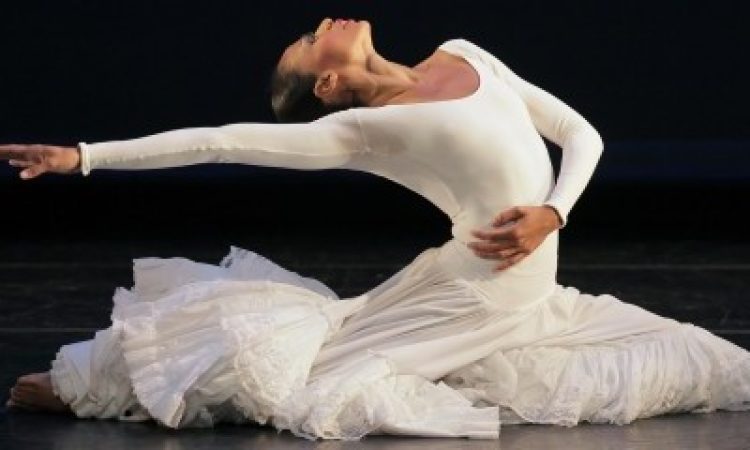
“Live in the shadow, stand in the light.” That is the advice Alvin Ailey American Dance Theater Artistic Director Emerita Judith Jamison once gave current Director Robert Battle. Battle shares this sentiment before introducing Jamison at the New York City Center Theater at a New Year’s Eve performance celebrating her 50 years of leadership and inspiration. Jamison eloquently thanks the Ailey family and its legendary founder prior to a reflective evening that includes her own choreography, A Case of You, and Ailey’s Blues Suite, Cry, and Revelations.
Blues Suite, a suite of 10 blues songs, choreographed in 1958 and considered Ailey’s first masterpiece, begins the evening. A train horn, a large ladder, and dancers with fans, feathers, and umbrellas paint the scene of an oppressed southern town. Glenn Allen Sims’s torso shudders in his solo, “I Cried.” Hope Boykin, Jacqueline Green, and Ghrai DeVore depict a woman’s struggle in “House of the Rising Sun.” DeVore repeatedly contracts her torso and reaches her arms out in a struggle to leave the house within which she is confined. In a later section the women flirt with their male counterparts through slow and sultry vignettes and more buoyant cabaret-style duets. Slowly, the jovial mood shifts as the dancers return to constrained gestures and wide, grounded stances in a reprise of the opening section, “Good Morning Blues.”
Jamison’s 2005 duet, A Case of You, excerpted from her full ballet, Reminiscin’, is perfectly danced by Hope Boykin and guest artist Clifton Brown. Brown, a former company member, evokes meaning with simple arm gestures that flutter and then stop abruptly as he pauses and turns to glance lovingly at his partner. Boykin shines with her signature daring turns and jumps, literally across the stage, into Brown’s arms as the audience gasps. With their tender touches and longing embraces, these two artists portray a love story anyone can understand.
Ailey choreographed Cry (1971) for Jamison and dedicated the work as a birthday present to his mother. Jamison became renowned for this solo that honors black women everywhere—especially mothers. With the strength and maturity of a 20-year veteran of the company, Linda Celeste Sims performs this work beautifully. Sims’s technique is always superb but it is her engagement in the journey of this work that sets her apart. She lays a cloth on the ground as a precious gift, clenches her hands in agony, screams, and reaches toward the audience, and I believe that she is every woman: mother, daughter, sister, lover, protector, and survivor.
Ailey’s 1960 signature work Revelations concludes this performance, as it has company concerts around the world for over five decades. Ailey’s belief in the individual and the human spirit allows the choreography, simple and unadorned by contemporary standards, to transcend his southern U.S. roots, which inspired the work. A pyramid of bodies in strife, a baptism by water, a repentant man, and a joyful celebration portray triumph over, or in spite of, oppression. Revelations leaves the audience with a sense of hope for the future.
In each of these works we are reminded of the human spirit’s capacity to overcome hardship and pain. Upholding historical repertory while integrating contemporary works is what the Ailey Company does best. While I was previously tempted to review an all-new works program that Ailey is presenting later in the season, I am thankful I chose this celebration instead, for now my spirit is uplifted as I enter this new year.
Alvin Ailey American Dance Theater, New York City Center, NYC, December 31, 2015, www.alvinailey.org