Don Quixote is known in the ballet world as something of a war-horse, an old chestnut, a formulaic classic. Yet, for Pennsylvania Ballet, it is a company premiere. Delightfully, PAB director Angel Corella brings to life this work, tried (for some, too much) and true (to Marius Petipa’s mid-nineteenth-century view of Spain). Corella brings to this restaging his deep connections to his native land and to the classical ballet tradition.
The story is something like Rossini’s Barber of Seville intercepted by Cervantes’ Don Quixote—but as French poet and critic Théophile Gautier remarked, in the first half of the nineteenth century, “the literature of the legs” is rarely the real matter of ballet. Rather, it can be excused as—well, as an excuse for visions, for beauty, for resolution, for pyrotechnics. These, constrained by an Apollonian aesthetic that absorbed the political, cultural, and moral turbulence of its age, shaped ballets that can speak to us today.
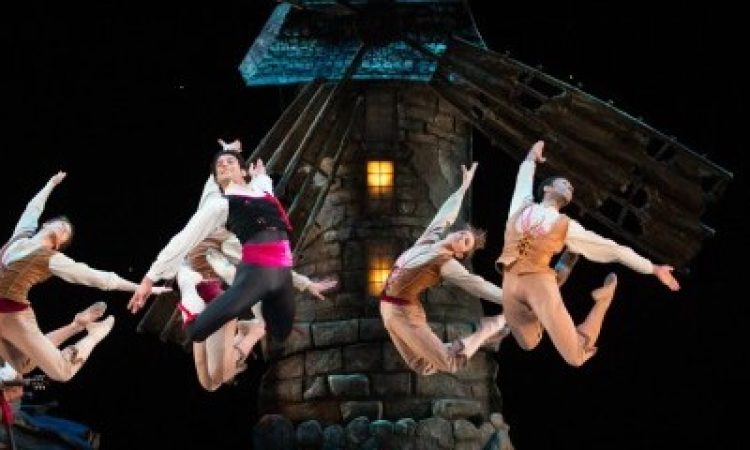
And such is the case with Corella’s staging—“after Marius and Lev Ivanov”—of the full-length Don Q. The work is lushly beautiful, enriched by Corella’s insistence that the sets and costumes (Ralph Funicello), and even the dancing and music reflect the reality of the Spain that the Madrid-born Corella knows first-hand. I want to spend a moment on the details of those elements. Take the sets, which move between a village square—replete with taverns, archways, and flowers draping over garden walls—and a star-studded night sky (lighting by Michael Korsch) pierced by a windmill turning its creaking arms. I’ve lived in Spain, and I could see it on that stage, could almost sniff the bougainvillea and feel the dry heat of Spain’s summer. The costumes had plenty of flounces and brilliant colors, embroidery and flying fringes, contrasting the austere, earthy tones of the village and landscapes. Finally, in the “Gypsy” scene, Corella brought guitar-player Patricio Acevedo and cajón-player Arturo Stable on stage with Don Quixote, Sancho, and the Gypsy dancers (in the performance I saw on March 6, they were led by Amy Aldridge and Arian Molina Soca), underpinning the hints of flamenco movement that spiced the dances.
And the dancing? It was delightful, from the pantomime characters to the virtuosic leads. At each show of the run, the same performers took the character roles—Charles Askegard as the dreamy, deluded idealist, Don Quixote; R. Colby Damon as the short-of-stature-but-big-of-heart Sancho Panza; Matthew Neenan as the foppish, foolish Gamache, who thinks he can win the village beauty Kitri with his wealth; and Jon Martin as Kitri’s tavern-keeping papa, eager that his daughter make a remunerative match. The dancing leads rotated; on the Sunday, March 6 matinee, Lillian DiPiazza danced Kitri and Aaron Anker (substituting for Ian Hussey) was Basilio, a poor but daring young barber in love with Kitri. They clearly had a ball with the roles, hamming up the jokes on the fop and the father, flinging off their multiple turns, brilliant allegro steps, intricate partnering, and bold balances with daring and aplomb. The secondary leads also danced with verve and flair—Lorin Mathis heading up the matador crew, with Amy Holihan as his partner; Aldridge and Molina Soca featured among the Gypsies; and Holly Lynn Fusco as the giggling, teasing Cupid, luring Don Quixote, in a dream, to his ideal beloved (Dulcinea?). In the tradition of Giselle and Swan Lake, the idealized vision of womanhood is danced by the same ballerina (DiPiazza in the show I saw) who plays the earthy peasant girl Kitri.
If you’ve taken ballet classes much, you’ve heard piano renditions of some of the Minkus tunes featured in the score, transformed for barrework into accompaniments for tendus, petit allegro, and pirouettes. It was a delight to have the score brought to full orchestral life by the PAB orchestra, under the baton of Beatrice Jona Affron.
I’ve used the word “delight” a lot in this review. That’s the flavor Corella’s staging of Don Quixote left me with. The audience, in its exuberant standing ovation, seemed to agree.
Pennsylvania Ballet, Don Quixote, March 3-13, Academy of Music, www.paballet.org/don-quixote