In the audience at the premiere of The Ballad of Trayvon Martin at the New Freedom Theatre, weeping mothers watched as the events that led to the death of the young teen played out. I wanted to think that some were sobbing because of their knowledge of America’s history with race, but a part of me knew they cried because of their own personal fears—their own personal stories.
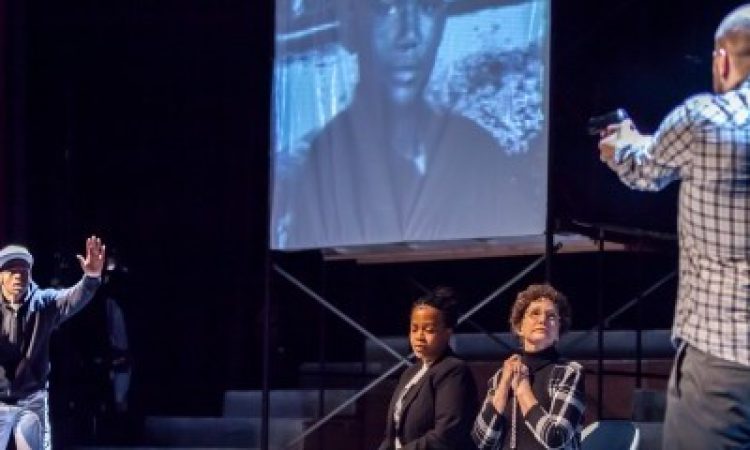
On the day it was made public that George Zimmerman, the man charged and acquitted for the murder of seventeen-year old Trayvon Martin, placed the weapon used in the tragedy on an auction site, the New Freedom Theatre lifted its curtains for the world premiere of The Ballad of Trayvon Martin. Directed and choreographed by Rajendra Ramoon Maharaj, the stage production was a biographical trifecta of Martin, Zimmerman, and America. For some, old wounds were re-opened, for others, new ones were inflicted.
Co-written by Maharaj and Thomas J. Soto, this docudrama was inspired by the events surrounding the death of the young teen, and was told from multiple perspectives making the narrative richly textured.
Dressed in black hooded sweatshirts, black sweatpants, black sneakers, and baseball hats, dancers Julian Darden and Stanley Morrison introduced the story by charging down the aisles. Positioned in front of closed curtains at center stage, Darden and Morrison’s youthful bodies were dynamically expressive, as they deliberately punctuated different accents in the music, and then seamlessly floated through each transition.
What struck me was that Darden and Morrison were not just hip-hop dancers, but their appearance reflected what is sometimes feared by white America—black men in hoodies. On stage they were admired, but on the streets their attire would make them the targets of discrimination.
When both young men parted the curtains, the sound of a gunshot was heard; it became a recurring sound throughout the play, making the sound both a confirmation of Martin’s death and a reminder of the ongoing conversation surrounding gun control.
Onstage, Amir Randal, playing the deceased Trayvon Martin, was met by Emmett Till (the 14-year-old African American lynched after reportedly flirting with a white woman), who welcomed him to a place with stairs. As Till’s brief funeral played out, it was hard to ignore the guttural sobs from the audience. Through my own tears, I acknowledged that The Ballad of Trayvon Martin was not just a museum piece, but also a mirror, a crystal ball.
While the eulogy of Martin was no laughing matter, director Maharaj sprinkled doses of humor to lighten the load the audience had to bear. Performer Donna Cherry’s portrayal of an aloof Kim Kardashian reciting a tweet she posted after the tragedy was dead on. Cherry was deliberate in both her vocal rendition and body language, making sure to soften her tone to a whisper and simultaneously accentuate her derriere by arching her back.
The cast was kept busy by performing multiple characters throughout the evening, but it was young Randal’s portrayal of Martin that riveted. He was charming when interacting with Angel Brice (who played his mother) and equally appealing but with a rugged edge when relating to his father, played by the gifted Shabazz Green (who also played President Barack Obama, Rev Al Sharpton, and Emmet Till).
The Ballad of Trayvon Martin felt like a black man’s tribute, sung to remind him of his blackness—the fear of which has placed countless bodies in graves, causing black mothers to clutch their chests in anguish. A retelling and a wake up call, The Ballad of Trayvon Martin was well sung.
The Ballad of Trayvon Martin, New Freedom Theatre, Rajendra Ramoon Maharaj, May 12 – May 22nd, www.freedomtheatre.org,