On a recent trip to my home state of Vermont, I attended a Vermont Performance Lab (VPL) Open Lab event, hosted by Marlboro College. In the past, finding myself in such a rural place had delineated a clear split from making, performing, or thinking about dance. My dancing body existed in urban spaces, my hiking/swimming/biking body in rural. I welcomed the collision of these formerly separate entities. The Open Lab featured works-in-progress by Ain Gordon, Sara Smith, and Jennifer Monson, three of VPL’s resident artists. While each work was distinct in content, aesthetic, or practice, the artists were connected through the shared state of being in the midst of an artistic process. This seemed enough.
Settling into my chair for the first of the showings, I noticed that I felt light, happy for permission to cast aside the weight of judgment, of a keenly-tuned critical lens. Through my witnessing, I hoped to help the artists receive what they needed. After all, it’s a slog to make work. VPL seems committed to exposing process in service of fostering exchange between artists and local communities, thereby cultivating a mutual understanding that helps these communities value artists’ work. Each artist presented close to an hour of material; by the end of the day, I felt overstuffed, but nourished from the feast.
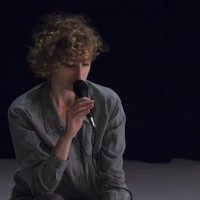
Writer and theater director Ain Gordon presented material from Radicals in Miniature, a monument to radical creatives living in the ’70s, many of whom died of AIDS. Gordon, with collaborators Josh Quillen and Talvin Wilks, layered text, sound, and image to weave captivating storytelling. At times, words echoed and obscured other words, jumbling the story in a way that mirrored the act of remembering. From his seated position, Gordon occasionally made sparse gestures, some of which were crafted elements of the narrative, while others seemed purely functional in the context of the showing. When he cued sound with a deft lowering of his arm, he blurred the performative and pedestrian, process and product. I hope such functional gestures remain in the final version of the work, due to premiere in June 2017. I wonder, when is a work finished?
Sara Smith, interdisciplinary choreographer and librarian based in Greenfield, Massachusetts, (I was happy for the inclusion of a regional artist) presented material from Florence Rice Hitchcock and the Theory of Soft Earth, a multidisciplinary performance work centered on a fictional nineteenth-century geologist. Dancer Candice Salyers etched space with precise limbs, while Smith ran projections and sound that told of Rice’s ambitions to become a geologist and her wonder at the mysteries of the natural world. Glitches in the projection arose, which, at an event where product was the expectation, would have been disastrous. However, in the context of the day, the subsequent pause in the performance allowed me to turn to my neighbor and start a conversation. I valued the moment no less than those when I was moved by Smith’s rich storytelling, or the satisfying clunk of an analog slide projector juxtaposed with Salyers’ smooth arcs across the small stage.
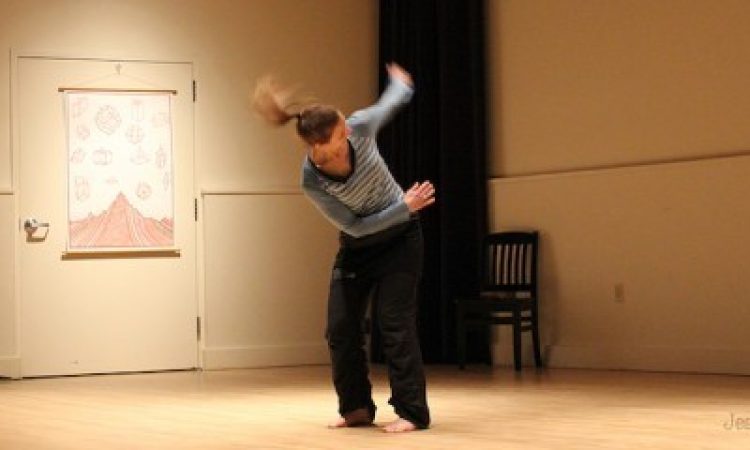
The last showing of the day offered material from in tow, led by Jennifer Monson with harpist Zeena Parkins, and a diverse cast of collaborators from various disciplinary backgrounds. Natural light streamed into the studio as performers began their first movements amidst cardboard rectangles covered in off-white paper, scattered along on the floor. I felt invited to view the dance as I would a vista from a scenic overlook—my vision wide and soft, occasionally zooming in to some small, strange action, first caught peripherally. The dance gained momentum from its quiet start, with performers messily tearing paper from the rectangles and gallivanting impishly. Amidst the growing chaos, I zoomed in on Monson. As she wavered on one leg, playing with a piece of shredded paper in a square of afternoon sunlight, I thought to myself, this will never happen again.
Viewing process—with its mistakes, fleeting experiments, and chance occurrences—helped erode persistent hierarchy between process and product. I enjoyed myself more at VPL’s Open Lab than at any recent tightly rehearsed premiere. I drove north, feeling a sense of admiration for the artists, so wholly entwined with and committed to their work.
Open Lab, Vermont Performance Lab, May 28.