It is the rainiest of days. Gloomy and wet, I am at the Latvian Society to see RealLivePeople Presents, featuring choreographers from Australia, North Carolina, and Philadelphia. I am immediately greeted and directed to a large armchair containing all matter of colorful objects – some toys, some tie-dye shirts. I choose a container of soap bubbles and I’m told to keep it until the end of the evening.
As the show begins, Gina Hoch-Stall walks on stage. Her smile mirrors the warmth of the lights illuminating her. After a brief introduction, she dances her Audition Solo – a three minute piece, featuring luscious movement and her gaze slicing the space with razor sharp attention. Her spine opens upward to soon dive down, ending legs up, each toe sensing the trajectory of her movement. Brief recognition of emotions dance on her face as she moves fast with delicious, toffee-like elasticity, clearly having an internal dialog. An exuberant and gifted dancer, she manages to keep her charm and individuality through this highly choreographed piece.
The second dance, Rift, is by Nicola Bullock, from North Carolina, and Vicky Kapo, a native New Zealander living in Australia. Two parallel, forearm length sticks are placed center stage. As they walk toward each other to reach the sticks, I note that Kapo is visibly older than Bullock. In an elaborate dance of pull and tug, they become enemies, playmates reaching for the same toy, or women using the sticks to find water. I am drawn to Kapo’s relaxed body and full movement, reflecting her “indigenous heart” and the “half child and half ancient” description in her bio. The sticks become part of her arms gesturing as if performing a rhythmic ritual. From her bio and her darker skin, I presume she is Maori. Her presence reminds me of the culture’s connection to the land and is contrasted by the more reserved presence of her younger Caucasian partner, Bullock. Maybe it’s my fascination with the colonization of New Zealand and Australia that makes me read this as a comment on race and history.
Finding a precarious unison, both women watch each other, trying to mirror every motion and become the same. They end with Bullock laying face up on top of Kapo, their arms circling together in an echo of the water-seeking sticks’ motion from earlier. I think of race, colonization, and conflict, but also how we all attempt to synchronize with each other and with nature. Seeking to find flow and peace, the younger American, Bullock rests on top of the older New Zealand native, Kapo.
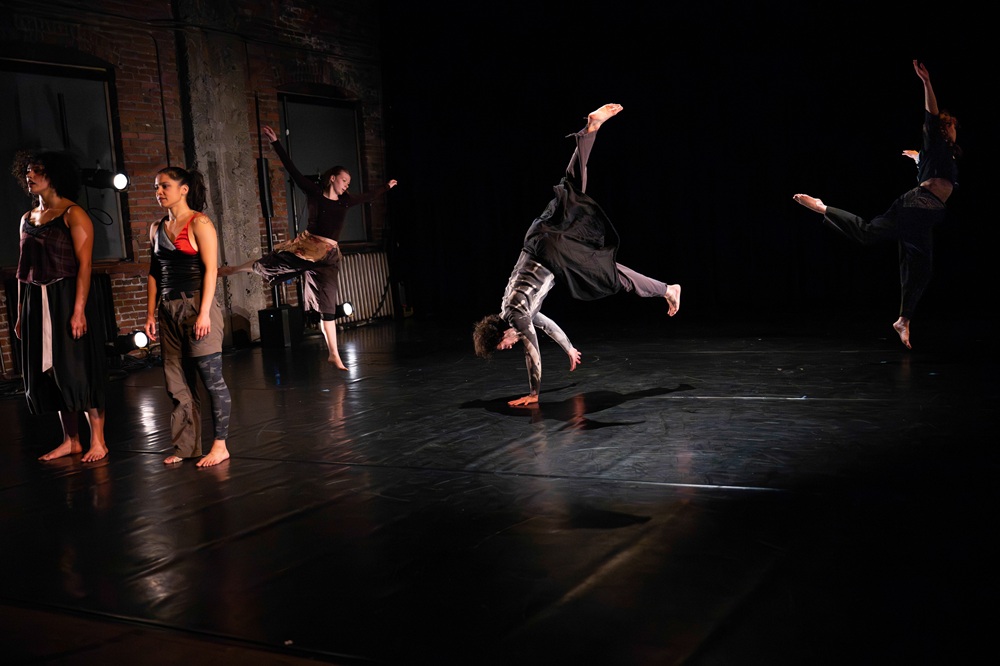
Hot Air by Shannon Murphy of idiosynCrazy productions has me mesmerized. Leanne Grieger, Marisa Illingworth, and Meredith Stapleton stand. They stare unblinking, low light illuminating their torsos. Dressed in transparent disposable rain coats, they are topless underneath. As if their joints are starting to give out, the bodies collapse and reset in their upright pose. They inch forward. Creepy rag dolls from an 80’s horror flick–the exposed breasts, distant gazes, and sounds of plastic haunt me. Are they packaged meat or a revered object, wrapped to be preserved forever? Too soon, for me, they start dancing as one of them says “one.” The rest follow in canon, at times finding unison.
I am rapt by the pink glitter smeared around their lips and down the center of their neck. Soon they shake their bodies allowing sound to come out in muffled moans. It is disturbing. Alternating between the shaking moans and a forced arched stomping, they are all blond, all white, just like Barbie. In unison, left arms lifting, palms upturned, they gesture in invitation – their gaze and intention withheld. Everything changes too fast – I want to keep watching.
Next is precipice, a solo by Vicky Kapo. Again, she starts center stage holding the two sticks from before. Addressing us with a gentle matter-of-factness, I see her as she is. Low- fi techno music plays at her command. She stretches her limbs, her arms indistinguishable from the sticks – a contemporary tribal dance calling up past and present. This solo feels like an iteration of the duet we saw earlier. But this time, I see her exact intention and clarity of movement, her fluidity and grace.
Gina Hoch-Stall and Scott McPheeters perform Presenting: You first, with the hope for reciprocation (Part 2). They start by summarizing Part 1 for us. This re-telling takes longer than the “actual” Part 2 dance and is a mixture of formal structural components like phrasing, solo, partnering, and alternating duets. Hoch-Stall and McPheeters stop often, talk to each other and the audience, sometimes smiling, sometimes prefacing the dance with words like, “This is the fabulous solo.” Presented in a casual style through technically proficient bodies, the summary of Part 1 breaks all of my expectations. Their bodies slither around each other, finding inverted positions. Limbs organize into angles and arcs moving with jaw-dropping elasticity. It is alive, new, and thrilling, and I dare not blink.
Finally they dance Part 2 – two improvised solos back to back. This is when their playfulness dissipates and a more serious theatrical presence emerges. I miss the aliveness of the shifts between dancing and social body of Part 1.
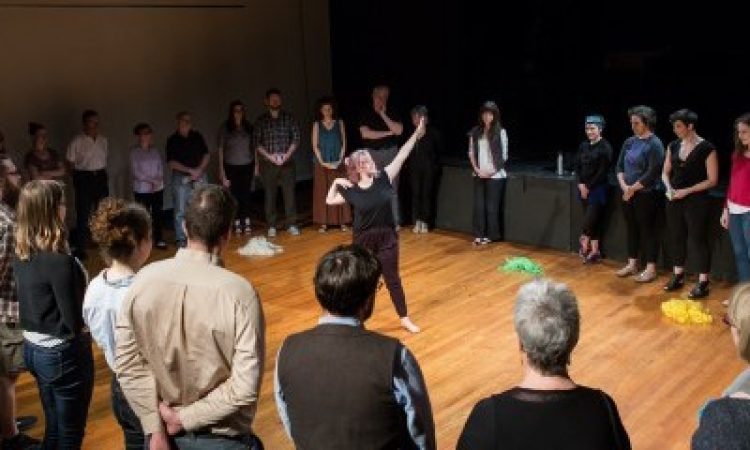
PREvolution by Australian Tessa Kate Broadlby is the last piece. She stands in the center, her gaze cast down as if sleeping. Her legs covered with a shiny black fabric, she holds a mountain of colorful wigs–only her face visible. She is an urban mermaid. One by one, the fake synthetic hair falls down her torso. We are invited to come on stage in a circle. Enclosed by the audience, the petite Broadlby announces and then does her self-proclaimed “fabulous” dance to Rihanna’s Diamonds. She directs us to move closer to or further away from the center depending on how comfortable we are with her statements: “talking on the phone,” “performing in front of people,” “managing money,” to name a few. Before we know it, she has guided us in groups, and each group holds one amoeba-like wig. Eyes closed, we are encouraged to feel the fibers of the hair and practice letting go. I focus on the tickling sensation of our pink wig, allowing it to fall down as if letting go of my childhood. Our eyes open and the piece ends.
RealLivePeople Presents stays true to its name. Issues of identity, race, and our communication with each other resonated through all works. Personal and inviting, the evening left me with a new hope for dance and its connection to the outside world.
RealLivePeople Presents, Latvian Society, May 20 – 22, http://www.reallivepeople.org/