The performance begins, appropriately enough, with what appears to be a technical difficulty. The three dancer/choreographers walk to the center of the space, lit by a projector casting large polka dots, evocative of a pixelated screen. An audio file plays, but far too quietly to transmit the words spoken. The dancers remain frozen as the sound stops and the familiar “blit blit blit” of an Apple volume key is heard. The track restarts, still inaudible. Eventually, Becca Weber steps out from her center point in the dancers’ triangular formation to make adjustments on the MacBook and projector placed in the center of the first row. If this was all planned, it is convincingly executed.
The audio that follows is a recording drawn from the eight months, with sixty-plus rehearsal hours, in which artists Lora Allen, Megan Mizanty, and Weber collaborated remotely from their respective locations in Philadelphia, New York City, and Coventry, UK. This evening is their first time working together in the same room.
The recorded dialogue is of the artists attempting to hold an online rehearsal via applications such as Skype, Google Hangout, and Rabbit. They are having problems connecting, though. They can’t hear audio from one of the collaborators.
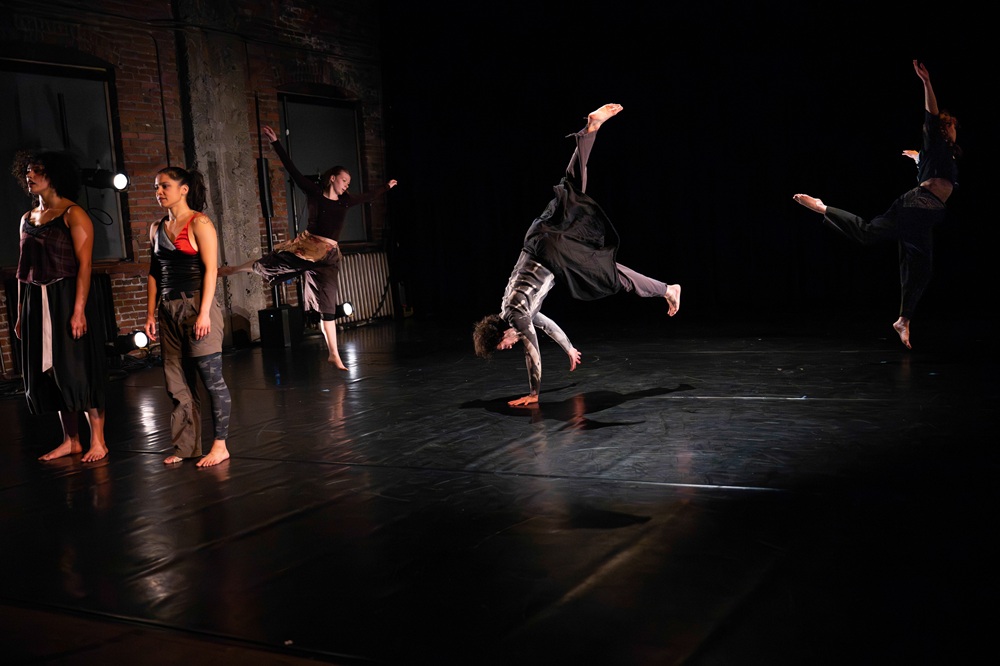
As we listen to them try several means of “turning it off and back on again,” we watch the dancers form a line, kneeling upstage. Arms in front of themselves, they make small staccato movements with their hands. Although they avoid mime and imitation, I picture each at her own separate computer terminal. I even imagine cubical walls between them. This piece calls attention to its means of production. That is the work’s primary, if not only, reference and it serves as both a springboard and a limit for the content.
Still on their knees, the center dancer reaches out her arms toward the heads of the performers on either side of her. The three sway and rock in syncopation until one of the dancer’s palms reaches another’s head and their two movements become interconnected. As she makes contact with the third dancer, we hear excitement from their recorded voices; the app is working.
The sound crescendos and the dancers explode into movement. Weber and Allen, extending their arms at shoulder height, revolve them around their torsos like those of a clock, then wave them in circles like baby birds. Turning, they drop to their knees, then reverse direction to spiral back up from the floor. Through all this they remain impressively in synch, both physically and energetically. In front of them, Mizanty passes impulses throughout her body, shifting her weight from one hip to another and extending her legs and arms into space, curving around her standing body through a series of fluid transitions and dramatic redirections.
This work explores and provokes questions about if and how physical and embodied information can be transmitted across great distance. The answer, for the most part, seems to be yes, via live video and email. As I watch, however, I find myself most interested in another set of questions: What is it that’s been transmitted? What else is happening in the space—new, untreated, and unforeseen? How are these two groups of things integrated in the moment of live performance?
Perhaps the most thought-provoking material in the performance is the artists’ work with contact, touch, and haptic perception. Here we see a forced intersection between the planned and the unknowable. The contact has been choreographed, but the haptic perception and responses remain unrehearsed and unexperienced until the live performance.
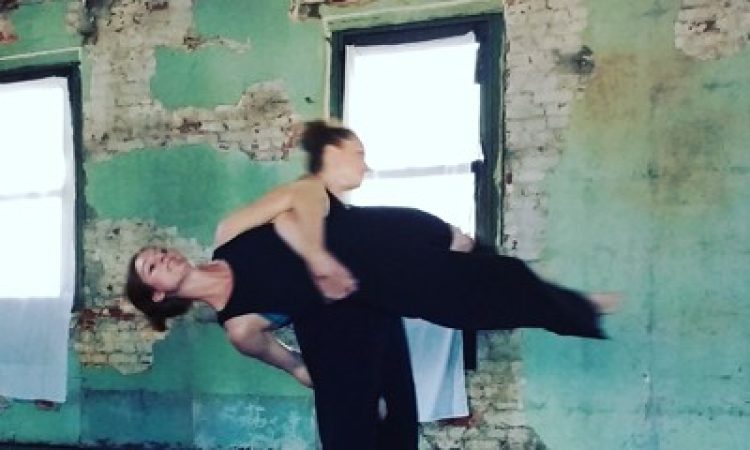
One dancer, on her belly, places her leg on another’s shoulder and the two rise off the floor together, one dancer’s shoulder holding a share of the other’s weight. This sequence is later repeated with Mizanty stepping in as the dancer with the extended leg. As the two rise together, Mizanty’s leg rises faster and visibly off the other’s shoulder. This was the most exciting moment of the performance for me. Mizanty, a visibly skilled mover, had rehearsed the moment alone and rose on her own without receiving the support offered by her finally-present collaborator. In an exploration of possibility, it seems that the limits of achievement provide the most enlightening information.
This two-day run comprised Phase Two of three for Project Trans(m)it. Phase One premiered, also at The Iron Factory, in October 2015. The next phase will expand to incorporate collaborations, likely musical, with other artists. The project’s culminating performance will premiere at the Edinburgh Fringe Festival.
*Becca Weber is a writer, editor, and member of the Communications Team and Editorial Board for thINKingDANCE.
Phase Two, Project Trans(m)it, The Iron Factory, August 13,14.