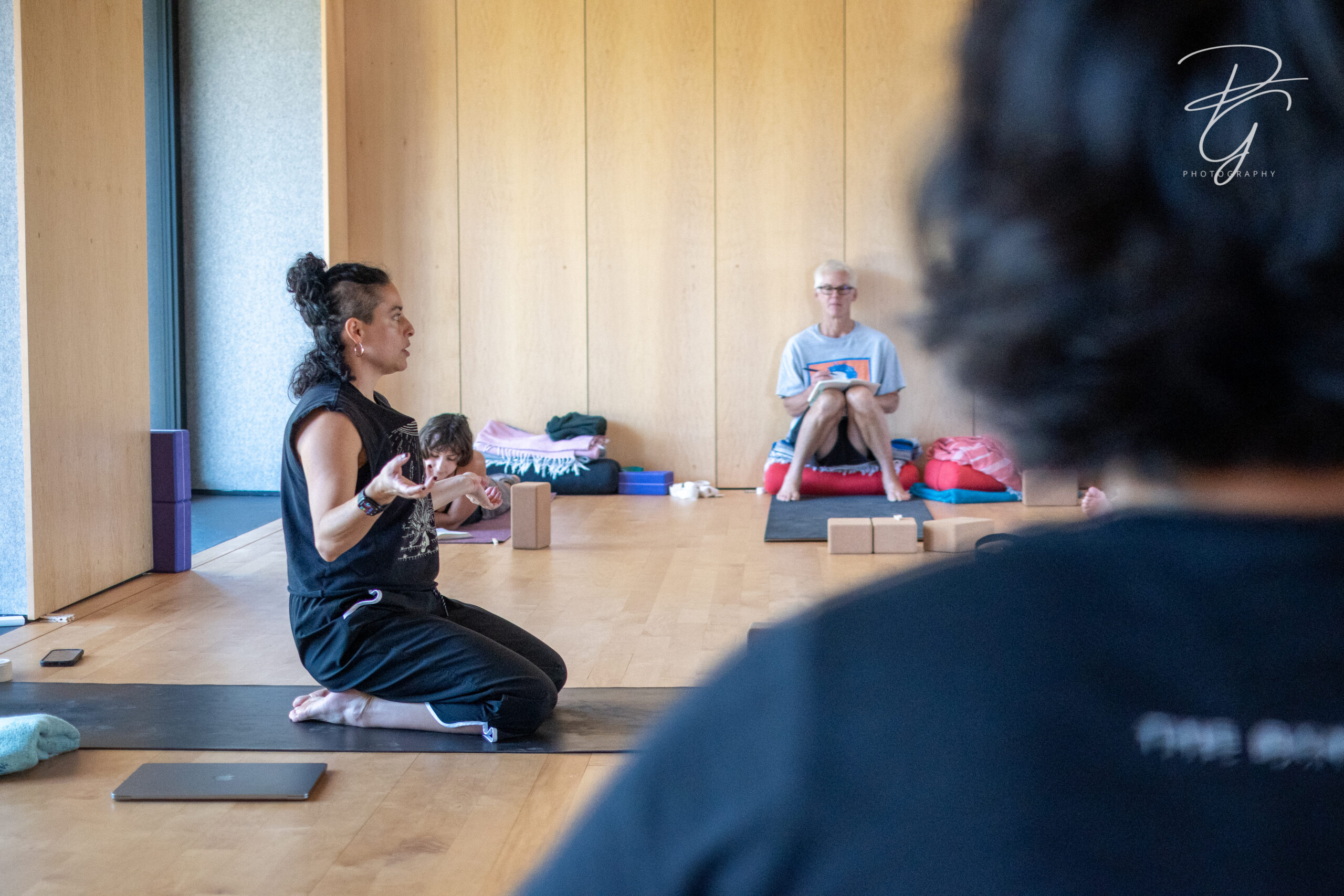
Open Space is a white box just off of 7th and Girard. It’s about twice as long as it is wide, seemingly ex-commercial, with few embellishments except for acoustic panels installed in the ceiling. Tonight, the space is shaped gently by a marimba, a drum set, a cello, and a few tapestries and pillows arranged on the ground for seating.
With Flint & Steel, this year’s Fringe offering by experimental music and dance group duende, actually consists of seven separate pieces, each by a different choreographer. These pieces blend tail-to-mouth: though there are distinctions between them, specific explorations which ebb and flow, it is not always clear where one ends and one begins, so the 45-minute evening feels like a series of acts in a single, unified performance.
Percussionist Ian Rosenbaum approaches the marimba. Two mallets in each hand, he lays down a melodic field of sound, rhythmic and unadorned, an uneasy stasis from which small variations in tone become striking.
Chloe Felesina and Gary Jeter take hold of one another, negotiating contact. They grab and then release, grab and then release. Felesina leans over Jeter, running the length of her arm across his abdomen, their four legs rooting them into the ground. They spread across each other’s bodies like parasitic vines, then separate again to connect somewhere else. Their spines are sinewy and roiling, their necks crane towards the ceiling, and their eyes roll upwards, emphasizing that this is a dance of skin and sensation.
Then they sit down, leaving Rosenbaum playing alone. He records himself playing and loops it back, a uniform sheet of sound, then begins to layer complex syncopations over it. He simplifies his playing, merging with the looped recording, and then diverges again, falling into and out of contact with himself in a solo duet.
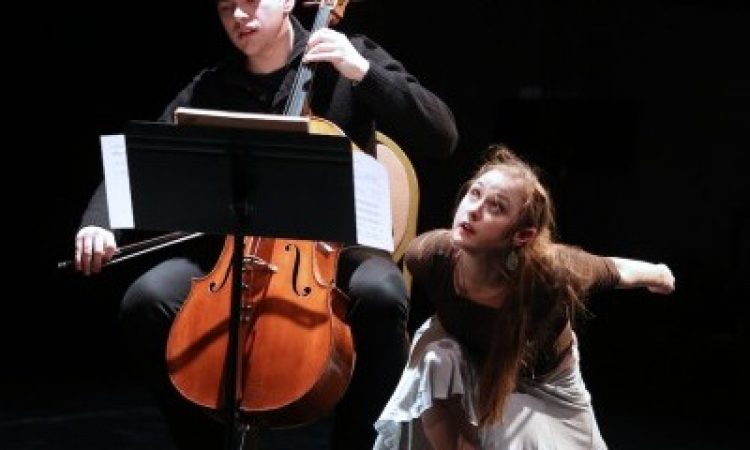
Gabriel Cabezas joins on cello, and music and dance hand off focus, like a jazz quartet, each performer taking turns as soloists and accompanists, and in various pairings. Rosenbaum crosses to the drum set and strikes the snares twice in rapid succession; the dancers fall to the ground, panting heavily, and sleep out the next section: an apocalyptic race to crescendo between drums and cello.
The cello screams, the drums bellow. Finally Cabezas puts down his cello, approaches the drum set, picks up a mallet and leans over Rosenbaum, staring into his face as he pounds a snare like a war drum. Cabezas speeds up, and Rosenbaum follows the acceleration then slows again. They play at different paces, joining and contrasting, making a new kind of chaos, a new kind of noise.
With Flint & Steel, duende, Open Space, 1014 N. Marshall St., fringearts.com/with-flint-and-steel/.