In Ta-Nehisi Coates’s Letter to My Son, he writes, “You are growing into consciousness, and my wish for you is that you feel no need to constrict yourself to make other people comfortable.” I thought of this quote as I watched four tall black men playfully intertwined in a knot of overlapping limbs and torsos on the small patch of gallery floor in front of me.
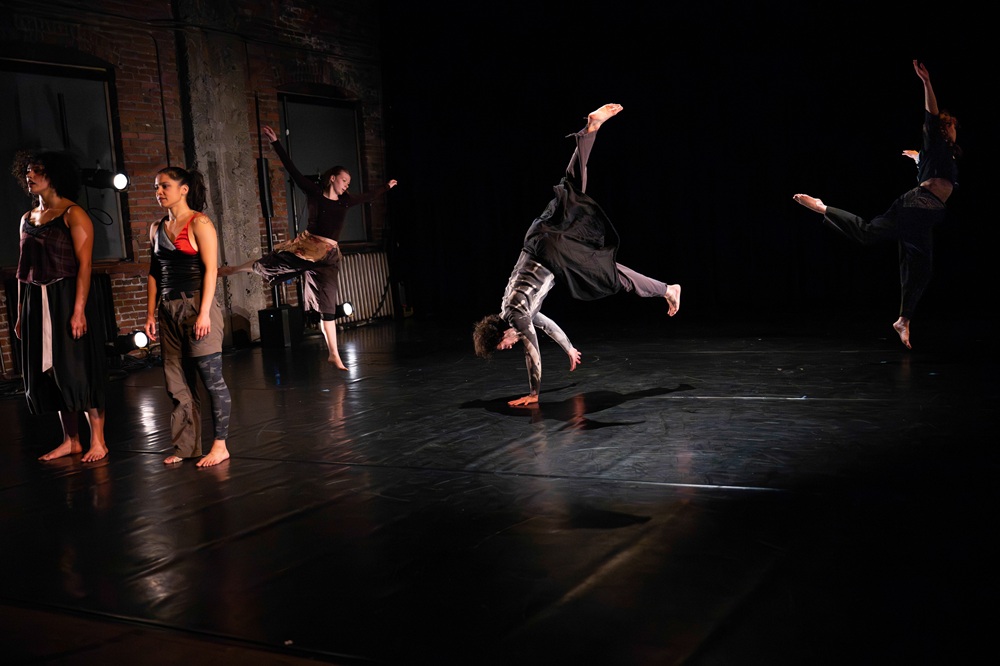
At 1 p.m. on a Thursday afternoon, I walked into the upstairs space in the Institute of Contemporary Art to watch an improvisation structured by Cynthia Oliver and performed by Duane Cyrus, Jonathan Gonzalez, Shamar Watt, and Niall Noel Jones. This 20-minute movement laboratory was presented as part of ICA’s Endless Shout—“a multi-artist performance project exploring collectivity and improvisation.” Three times a day on Jan 11th, and then again on the 12th, the public was invited to witness Oliver and the dancers’ process as they developed sections towards a full-length piece, Virago-Man Dem. The piece will be premiered at the Gibney center in NYC this fall and then come back to the Painted Bride next spring. In collaboration with her performers, through movement and spoken word, Oliver seeks to present a more replete depiction of Caribbean and African-American black masculinities—as they are experienced rather than as they are commonly represented.
Historically-fraught as the exhibition of bodies in a museum setting can still be, the ICA provided an effective frame for this glimpse into Oliver’s process, one that prompts reflection on curation, on modes of representation, and on the incomplete nature of seeing itself.
The small audience in the gallery sat on long benches around a small patch of flooring. The four men entered together from a corner of the gallery and made their way around its periphery. They wore fairly colorful street clothes and shoes; they might have been grad students at Penn or residents of the West Philadelphia neighborhood surrounding. The sound of cymbals initiated more stylized movement—quirky waves and smiles from Watt, low-key pop-and-lock type arm gestures from Gonzalez and Cyrus. I couldn’t see Jones, directly behind me, and indeed, the inability to see everything going on became an integral part of my experience. What I am given to see is never the totality of what is there. The men sat on benches beside audience members, or on the floor in front of us, acknowledging and interacting gingerly with eye contact and incidental touch, bringing us into their exploration, but not wholly in. A performer/observer distance was maintained, at least in this iteration of the work. The four slowly proceeded around and into the area defined by the benches, and eventually into an even smaller space—a tangle of their own bodies, a world made by them and of them. Their contact started out in short pairings—with one man leaning against another and another pulling a partner inch-by-inch across the floor by his armpits—and brief jokes/conversations about “being ready” for some unspecified event or riffing on how an improv position resembles childbirth. Duets and trios coalesced then broke apart before becoming a floorbound quartet of jostling and readjusting limbs. Throughout the short performance, each dancer seemed to be developing a distinct character, moving in and out of gestures of flirtation, earnestness, elegance, mischievousness.
Maybe it is because I have three teenaged sons that, at the end of the twenty minutes of play, I was left feeling melancholy: the tenderness I saw seemed so unguarded and so familiar. There is a time in a boy’s life before touching other boys signals something beyond proximity and the pleasure of contact. A time when flailing bodies—wrestling and hugging and lounging, draped over one another piled on a couch in the basement—is insignificant, nonthreatening, needless of interpretation. A time before a boy internalizes messages of just how “a man” should exist physically in the world. My boys are small like their mother, and white; because of this, any transgressions of unwritten rules of conduct (be they intimate or aggressive) will likely meet fewer institutional consequences than if they were not. I know this. Still, their incremental retreat from a more carefree, more vulnerable embodiment is tangible to me, and sad—this loss of the fullness of self-expression to a policing world.
In front of me were men reclaiming their own tacitly-restricted embodiment. They were not doing so by taking up more space but by finding inbetween spaces, the intimate spaces between men’s bodies that keep them so often at arm’s length unless in expected-and-thus-acceptable mock battle.
Watching these talented movers first prepare the audience for their interlacing and then open into a type of rarely-seen-in-media play, an intensely physical yet nonviolent black male interaction—it was a lesson. A lesson in what goes missing. In representation and/or in public life, as it is framed and influenced by media. A little while later in the afternoon, I ran into three of the performers on the street (the men in the photo are left-to-right Shamar Watt, Niall Noel Jones, and Jonathan Gonzalez… Duane Cyrus is not pictured). They were laughing. They generously posed for my phone-shot. The friendship Oliver and the dancers had constructed for consideration in the gallery seemed real—even magnified—on the sidewalk, even fuller beyond the frame.
from Virago-Man Dem as part of Endless Shout, Cynthia Oliver, Institute of Contemporary Art, January 11th and 12th, 2017.