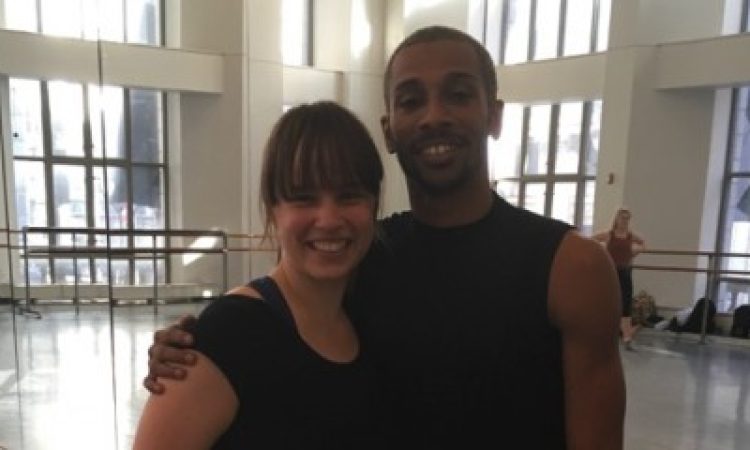
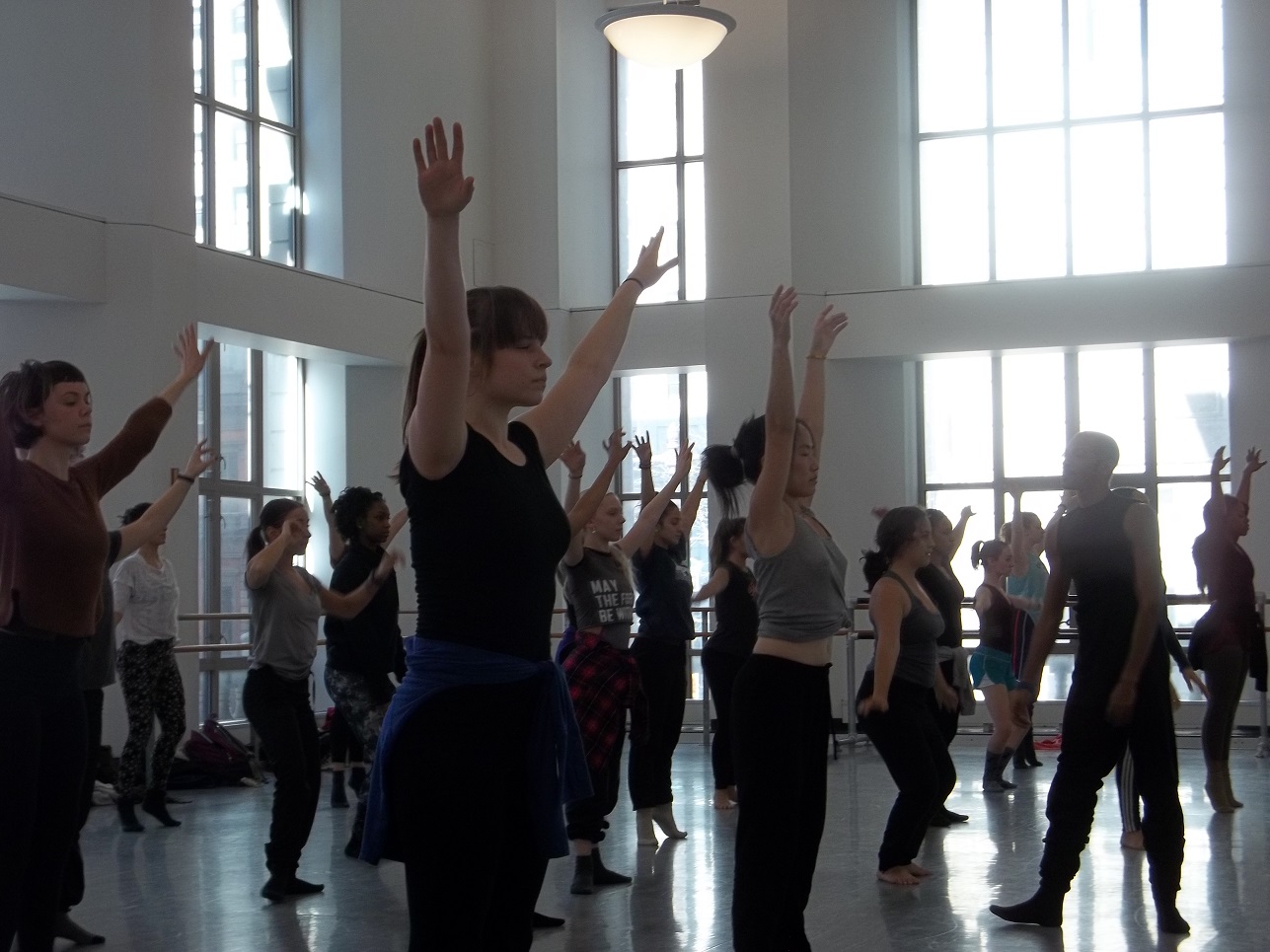
Continuing my quest to experience the technical styles of the companies brought to Philadelphia by NextMove Dance *, I attended Malpaso Dance Company’s master class prior to attending their performance. Taught by Osnel Delgado, co-founder and artistic director of Malpaso, this class is described as Cuban modern dance technique, “a fusion of North American Modern Dance (including Sokolow, Graham, Limón, and Cunningham), European Ballet, and traditional Afro-Cuban dances and rhythms.”
I was trained in dance lineages connected to Graham and Limón, and so I recognized certain movement patterns within the class combinations. When Delgado asked us to contract our torsos, he emphasized shoulders-over-hips alignment and the C-curve contraction that I associate with Graham, though the Cunningham upper-back curve made a few appearances. Relying mostly on visual cues to teach the combinations, Delgado’s main instructions to the group were to enhance the movement with more breath and to drop the weight into a swinging momentum, directives that feel particular to Humphrey/Limón techniques. He spoke to us in English with a relaxed and unintimidating energy, though if we missed a musical accent, he asked for repetition. As he demonstrated these movements, his own body was long, sinewy, and rhythmically precise.
However, viewing this class, one might not have recognized these influences. The exercises often asked students to undulate their spines sequentially through contraction and release, a movement pattern with variations in several dance forms derived from African lineages. The exercises also emphasized side-isolations of the pelvis, shifting the hipbone to one side as the torso reached diagonally to the other. A live drummer accompanied the class, leading the students with Afro-Cuban rhythms.
Midway through the class, what felt initially like a modern dance class suddenly shifted gears into West African dance techniques, emphasizing rhythmic complexity and grounded weight. Perhaps this is what a Cuban modern dance technique class typically looks like—one half euro-centric one half afro-centric—but I was curious about this sharp shift in influence. Is this what “fusion” looks like? Was the class structured in this way in order to give students a taste of Malpaso’s production at the Prince Theater? Does claiming a lineage of both American modern dance and African dance make a company more “marketable” in the American dance tour circuit?
Recently, I have been questioning nationalism’s role in art making, touring, diplomacy, and cultural exportation.** I’m curious about the history and development of Cuban modern dance—how it was claimed as a national product and identified as something “uniquely Cuban.” According to the post-show talk back with Malpaso co-founder Fernando Sáez, Ramiro Guerra, the “Grandfather” of Cuban modern dance, studied in the US with mid-century modern choreographers such as Graham and Limón and brought their techniques back to Cuba when he formed the National School of Modern Dance in 1959. Soon after, Guerra began studying and including West African dance influences in the technique that was soon claimed as uniquely Cuban. What does it mean for a Cuban nationalistic form to have been influenced by Graham, whose choreography has been exported as uniquely American? And what does it mean for Graham to be claimed as uniquely American when her own beginnings at Denishawn trained her in “Oriental” techniques, which unapologetically borrowed from Asian cultures?
Malpaso’s program featured full works by both Delgado and Ronald K. Brown. The latter was the audience’s clear favorite and was given a whooping standing ovation. Primed by my experience in Delgado’s class, I was eager to identify how the lineages prominent in his class manifested in his choreography. I recognized similar alignments and “modern” approaches to gravity, but I also saw divergences in Delgado’s work. It was gestural and humorous at times. Delgado seemed more concerned with how the dancers were relating to each other as they wove through intricate partnerships than he did with replicating the technical themes he taught in class. This could be contrasted with Graham, whose technical exercises were identifiably derived from her choreography and vice versa. Delgado’s intention for 24 Hours and a Dog was, quite literally, to portray a day in the life of a dancer, so—if anything—his choreography was a straightforward narrative.
As a dancer-audience member, I recognized some of the nuanced divergences from the Cuban modern dance technique that Delgado was likely exploring in his work. Perhaps these divergences make him postmodern/contemporary Cuban? What would those labels mean outside of their American concert dance contexts? I may have to go to Cuba to find out!
_____
*Prior class/performance explorations from the NextMove Studio: RUBBERBANDance Group and Doug Varone and Dancers
**Some recent articles on thINKingDANCE have also called these themes into question, namely Lynn Matluck Brooks on Dance and the Cold War and Carolyn Merritt on Balé Folclórico de Bahia.
_____
Malpaso Cuban modern dance master class, Friday February 17, free class to Philadelphia dance professionals and UArts students offered through NextMove Dance. Malpaso Dance Company, Prince Theater, February 15-19, 2017.