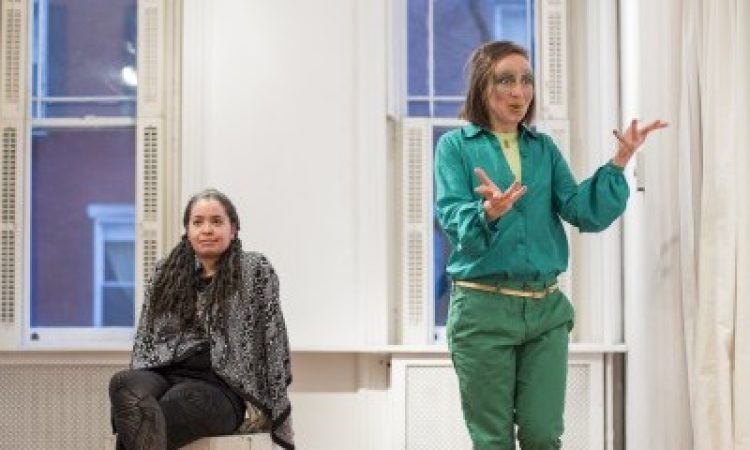
Humans are driven by repetition, satisfied by routine, fulfilled by the completion of our perceived self and societal expectations. Or are we? Do we ever truly feel a sense of achievement? How gratified are we after buying necessities? I wonder how much of what we do is driven and determined by the constant input of the external environment. Parrot Talk philosophized about these questions as Orlando, the feverishly ill heroine, embarked on a mission for groceries. As the saying goes, life is a journey. Orlando’s journey broke away from your usual Acme run.
After the show, audience members gathered with a few writers from thINKingDANCE for their own journeys through writing and discussion. We went in circles, veering on detours that returned us to the same place with new perspectives. Below are some Parrot Talk moments that stood out to Write Back Atcha participants.
The overall quality of the speaking of words in a certain character and the mesmerizing quality resulting. The entire play was like a massage of sounds and rhythms. Being kneaded with sensations. – Rhonda Moore
Evil wheel of the grocery cart, something that turns, is always spinning. It’s meant to complete a whole object, and its absence or dysfunction is highly inconvenient. Words are inconvenient, language is. But it’s a necessary crutch for expression. In order to move life forward, you need wheels. The evil wheel encapsulates the fallibility of words to get us where we need to go. It gets us stuck in a cycle where we can’t say what we want. “Um, um, umm.” That’s the evil wheel. – Vanessa Ogbuehi
The stillness of the tree as a visual aesthetic stuck out to me – particularly given the juxtaposition of the mind snake’s perpetual movement afterwards. It seemed to mark the conclusion of a thought. The expressiveness of the actor directly contradicted the object classification we oft associate with tree-ness. As existing in and of the authority of itself — outside its imposed relationship to the thought-words we are conditioned to prescribe. The inclusion of an object-subject that is inherently devoid of human noise, as we traditionally ascribe it to be, was very … thoughtful. – Jonathan K.
I am drawn to the line, “The things we do to pass the time,” and the way the players pass the time. Orlando passes it trying to explain her surroundings and philosophy, the parrot spends it attempting to understand her cage, and the scientist tries to elucidate the past and his vision of reality. The mind snake tries to find a common thread in the winds around it. – Seraphina Ferraro
Solo performance by Orlando in the supermarket seemed to sum up and encapsulate the essence of the idea of the illusory nature of our perceptions and the fluidity of language as we continually strive to harness the “reality” of our experiences. It also seemed to bring to light the ongoing attempts we all make to bring clarity and context to our experiences, our efforts to wade through our philosophical concepts. – Chris Ferraro
Orlando delivered word associations similarly to the verbal mannerisms of the parrot. Quick. Related yet unconnected. Nonsensically relevant, rotating. Repetitive. Contextual. Orlando was the parrot. Is the parrot. A concoction of passing time and meaningless meaning. Significant nothings fill her mind, space, lifestyle, being. From afar — in a parrot cage, as a bird perched above, with a feverish mind — she questions, observes, questions, wanders, wonders, sits. – Whitney Weinstein
The succinct parrot gestures beckoned the audience into a feeling of an immobilized, captured expanse of questioning. What? Why? Where? – Emma Dill
When philosophical conversations surface, questions tend to emerge — as answers, as explorations, as response. Write Back Atcha participants were asked to write inquiries directed towards Julius Ferraro*, Parrot Talk’s playwright, and came up with a long list, including the following:
1. Should we shut everything out?
2. Should we open our hearts to the scientist?
3. How do you get through the day?
4. Why should we care whether or not the cup exists?
5. What meaning do you pull from your own work when you see it performed?
6. What illusions do you still hold onto for the world?
7. Do you think illusions keep us sane, or do you think illusions keep us safe?
8. How far is the grocery store?
9. Do the questions answer questions until we come full circle?
10. Will you tell me another parrot joke?
*Julius Ferraro is currently thINKingDANCE’s Editor-in-Chief.
Parrot Talk, Da Vinci Art Alliance, March 31-April 2, April 28-30, http://www.davinciartalliance.org/parrot-talk/