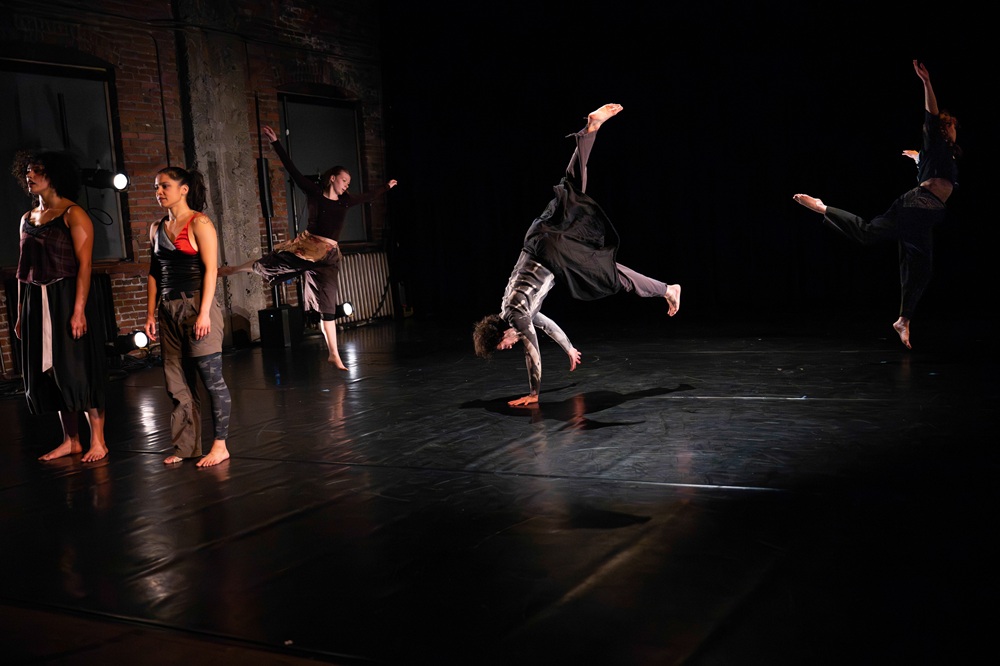
When I show up at CHI Movement Arts Center for the dance show Mujeres, a multiracial, multigenerational cast of performers bustle around the marley. Stretching, meeting and talking—they create a relaxed, communal space. Community and inclusivity have deep roots as feminist ideals, creating supportive groups that enable women to pursue their ambitions. Mujeres (“women” in Spanish) is about the uniquely female stories of childbirth, childrearing, and attendant issues, told by a powerful and experienced cast of dancers.
The first piece, MILK, choreographed by Evalina “Wally” Carbonell, rebels against traditional presentations of femininity while also celebrating the physical connection that exists between baby and mother. A small group of dynamic women move with sharp efficiency, all of the energy coming straight out from their spines, with powerful abdominal control holding rigid torsos razor-straight. They mime a baby cradled in their arms, swinging this imaginary child sharply but elastically, using the last swing to actually spin their bodies 45 degrees. Gentleness and grace are excised from normally sensual contact.
HERstory, choreographed by Annielille “Ani” Gavino, has a cast twice the size of MILK’s, and a scope which ranges from myth to the colloquial present. Gavino gives center stage at times to video by Jasmine Lynea, poetry by Lenora Elaine, and song lyrics by the astounding performer Maya Simone. Though the work begins with the story of the collapse of her native Philippine matriarchal culture, she brings in black perspectives and other contemporary female stories.
A woman pulls herself on stage in a partial blackout. She carries a wooden crate over her head. As she slowly moves through the dark space, holding her arm in front of her, with large, wild hair hovering above her head—we never fully see her face. “I will try to keep my hair in check,” she recites. “I will try to be pretty for a black girl. I will try to give everyone love but myself, to keep my body on display.”
Gavino performs a duet with the only male performer. This begins with seduction, him towering over her, but evolves into a story of growth and familiarity. They struggle through Gavino’s fear and rebellion, eventually moving into surprisingly funny sexual encounters. Standing face to face, Gavino hops up onto her partner’s shoulders, legs around his face, eyes wide and hands over mouth. Eventually, they embody shared strength, as they walk, arm-in-arm.
The beginning of the performance featured Gavino in regal garb, performing dances from her native Philippines, the site of a now-vanished matriarchal culture. It ends with a six-year-old girl center stage, watching the dances of the older women and absorbing the community she inherits.
Mujeres, Gavino + Carbonell, September 22-24, http://fringearts.com/event/mujeres/