Had you told me when I moved to Philadelphia in 2005 that the city would develop an appetite for Rosas, I doubt that I would have believed you. Yet here we are, awaiting a sold-out run to the music of John Coltrane—a collaboration, born in that very year, of Anne Terese De Keersmaeker and Salva Sanchis (once her student) now newly revised.
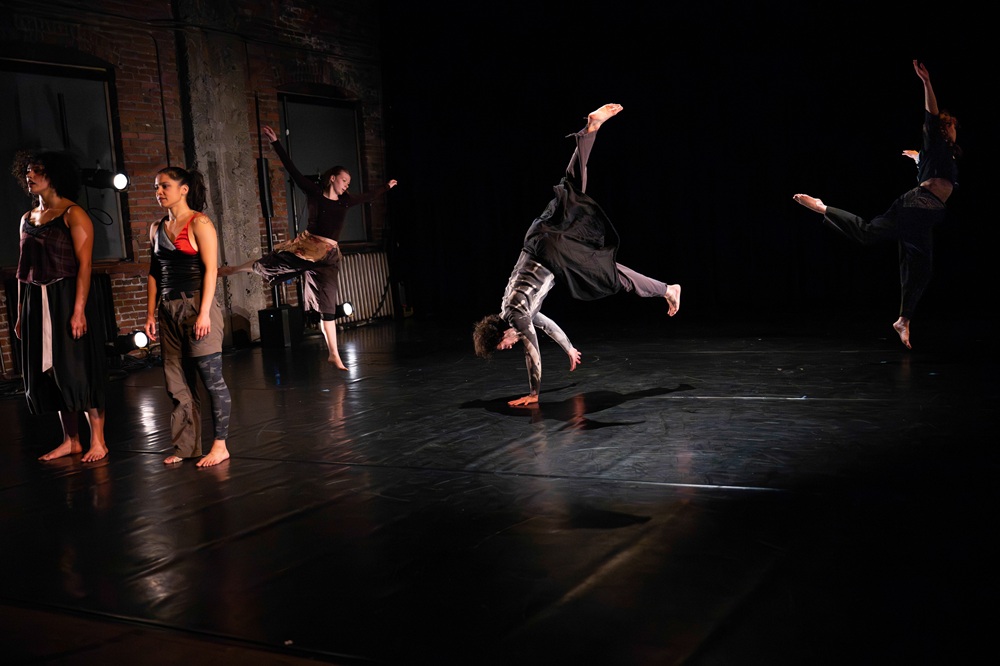
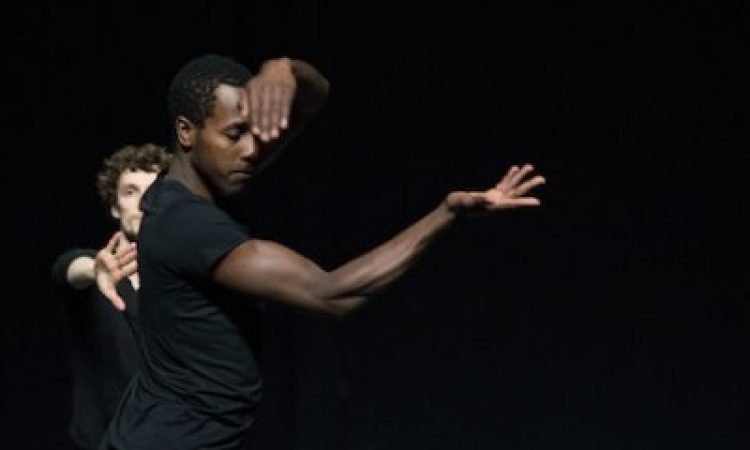
Four men jog through their backspace in silence, suspending and unfolding among themselves as a sundial of extended limbs and lifts. On this third occasion of the company at FringeArts, a silent solo full of softness and rebound settles to a close and the score comes crashing in. Exercises in formality gone, counterpulse leads as the dancers reclaim the stage. Carving the space with fingertips and wrists, they play the bass notes abstractly in the air. The invisible substance becomes thick with gesture.
Bits of unison movement catch my eye amidst the ever-going independent notations assigned each body. But these men are each distinct, their training and personal histories evidenced by the angle of an elbow or index finger, the articulation of the spine. More ballet here … a little more shoulder there.… A wry smile escapes and I’ve found the dancer that my eye will follow for the evening. The notes are the same each night, recorded but very much alive since their 1965 release; the dancers are careening between choreography and improvisation. There is no “slow,” even with space to see the movement.
I find satisfaction in moments of symmetry that punctuate the asynchrony. Each body has been assigned a musical instrument as a structural element. Ever comforting, though, is the fleeting unison. It comes together as orbits align, only to get wilder with so many notes to play. The movement rides alongside, on top, and between the notes, eliding any Mickey-Mousing. These aren’t “steps to counts”—nothing that simple.
I see a thread linking two decades of De Keersmaeker’s work at play. Elements that have graced this very stage—performance quartets, geometric patterns inscribed on the floor, an initial period of movement in silence that re-emerges at the end, with accompaniment. Structure. Enormous European stagelights. Flat-blade-hands transformed into closed fists have come back across the ocean too. I wish that my knowledge of Sanchis and Coltrane were equally deep; I’m still missing something. I feel the tension between choreography and improvisation and sense that same investigation aurally as well as visually.
An hour slips by, and the silent lifts return, counterweight and contact now lit cinematically with shadow and sound. The underscore makes the action of touching yet more tactile. The performers slip off stage, leaving us a few bars of illuminated music, which have the rightful last word.
A Love Supreme, FringeArts. September 22-24 2017, http://fringearts.com/event/a-love-supreme/
Further Reading at the FringeBlog .