Andrea Miller, artistic director of Gallim Dance, is the first ever Artist-in-Residence in dance at the Metropolitan Museum of Art in New York City. Upon learning this, I was intrigued both to see what this already well-known choreographer would create during her time in residence, and also to see how this residency program would continue to integrate new dance into the Met’s variety of vast spaces.*
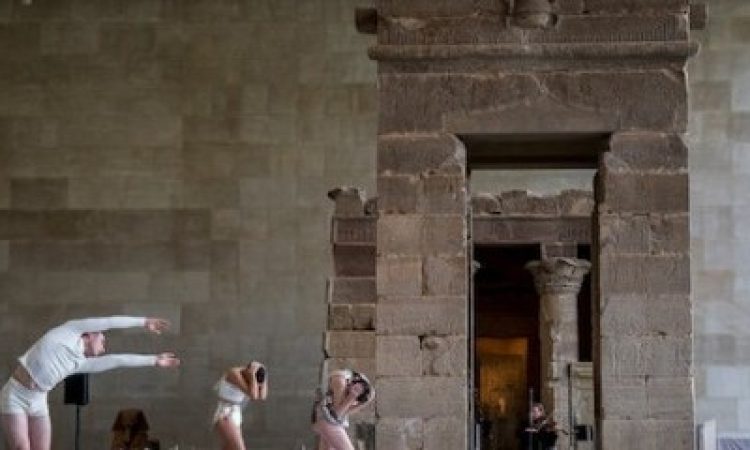
Stone Skipping, a site-specific work for the Temple of Dendur in The Sackler Wing, is the first performance presented in conjunction with the residency. The crowd seemed more museum-goers and old-school patrons of the arts than members of the dance community. The attending patrons were formal, seated as I arrived, and ready to take in the dance. The Temple of Dendur itself comprises a huge rectangular arch and a partial enclosure with a column, both of heavy sandstone, atop an enormous platform with a small pool of water extending across the front edge. At times, the dancers were reflected by the pool, but otherwise the water was left un-rippled, no literal stones skipping across. A live band, Firewood, was set up behind the arch, all four playing violas, which they looped electronically. From my seat, I could barely see just one musician, her viola poised, keeping her eyes on the dancers throughout the piece’s unfolding, unfurling, flailing, pushing, and pulling.
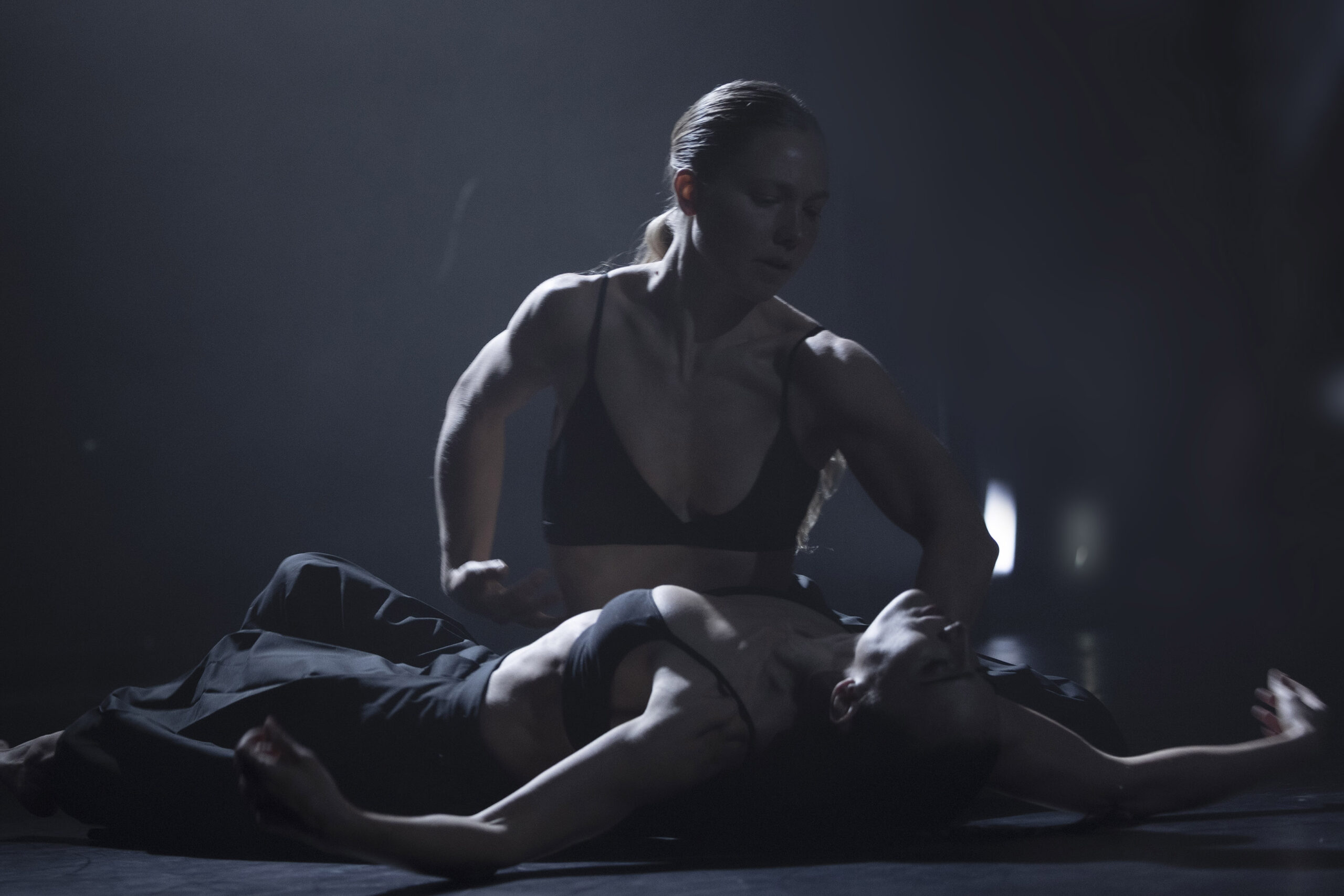
The piece began with a soloist rising slowly up from under the arch. Low musical drones began as the dancer balanced, her initially shaky standing leg strengthening as she gained confidence throughout her tensely wringing solo, gradually gaining the surety to carry these moments alone. By the time other dancers came into view from well behind the temple, slowly moving in a procession one by one, then in twos and threes, she displayed with strength what have become some of Miller’s signature movements: an enormous fourth position melting into the floor, a low backbend with the head reaching far behind the body, and a wide open focus that suggests that the body is somehow being danced. This initial procession of dancers during the opening solo was one of the strongest sections of the piece, giving a sense of the grandeur of the space—dancers taking one slow step, then a few quick steps with hands lifted in slowly-changing gestures. But as the dancers entered, I questioned the costumes—leotards with draping shiny shorts and sequins. Why dress this way in a temple?
Though it was billed as site-specific, much of the rest of the piece could have taken place on any proscenium stage. Perhaps Miller intends to tour the piece to other spaces, which would make sense, given her business savvy. Because of the proscenium feel, I wished for stage-lighting at times, so that the large space and multiple groupings of dancers could become more focused for my viewing. Or, alternately, I would have liked to move more freely, as audiences often do during museum or gallery shows, to see the groupings from different angles.
Moments stood out, for different reasons, from the sometimes chaotic forming and unforming: one soloist, a young man who moved in clear lines, throwing his limbs as he leapt with extreme grace; a duet in which a nimble female dancer scaled her partner’s body again and again to perch on shoulders and neck. Two large pieces of plastic came out about halfway through and felt distracting and overused, an unnecessary addition while much of the actual space was left unexplored. Though not always connected to the site, the tactile, contortive, and effortful movement was enough—was a struggle, was plenty to take in—and though there were a couple of false endings, the actual ending of heavy skipping through the space (a motif that had appeared at another point in the piece) was strong. The dancers skipped in an enormous circle in front of the Temple, until they formed a standing line across the space, buzzing from their efforts, as lithe young soloist skipped on and on around them.
*The Met also presented Eiko’s A Body in Places this past November at three of its locations—The Met Cloisters, The Met Breuer, and The Met Fifth Avenue.
Stone Skipping, Gallim Dance, Metropolitan Museum of Art, the Temple of Dendur in The Sackler Wing, October 28-29